

AI in e-commerce: use cases, benefits and adoption
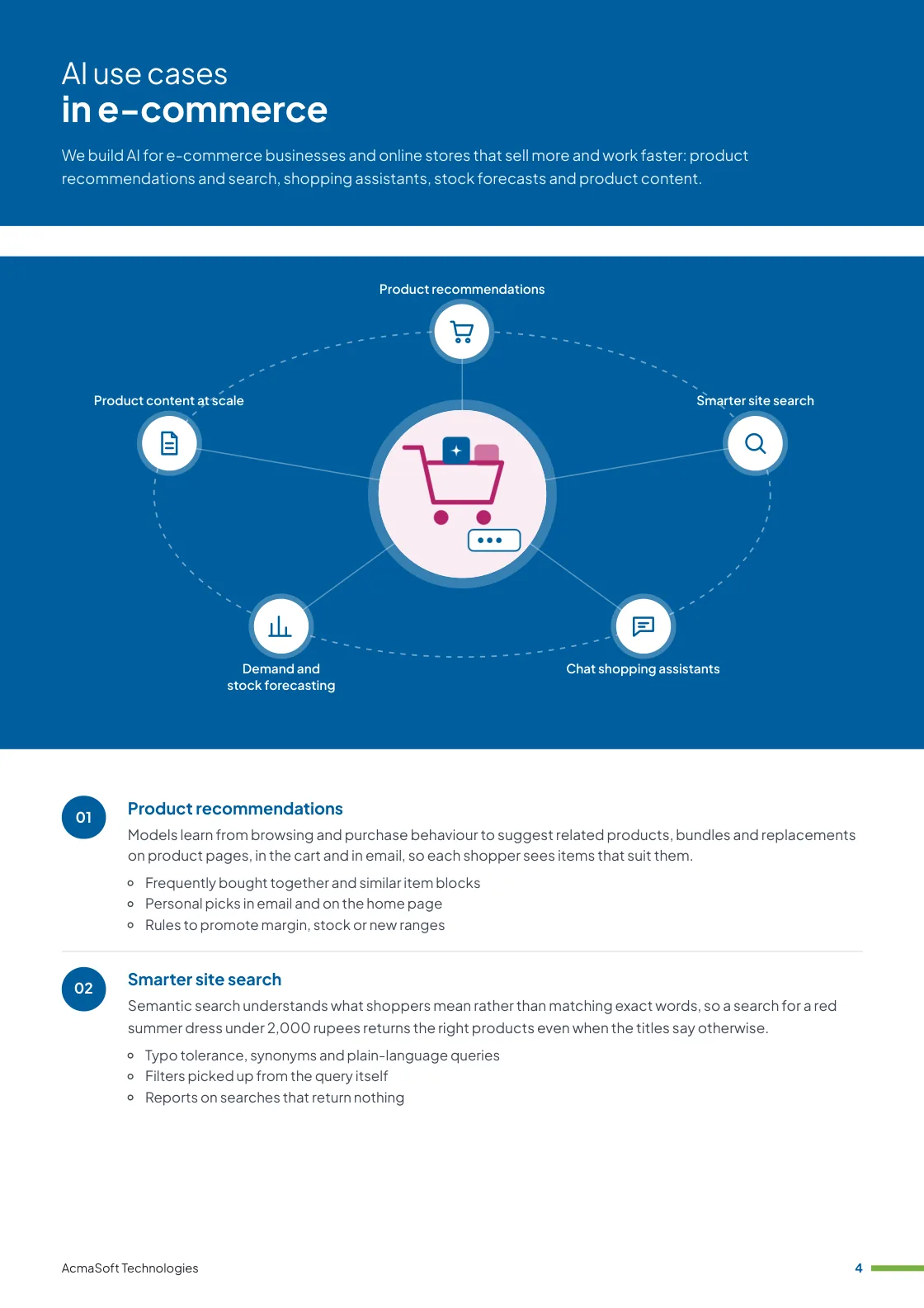
AcmaSoft builds AI for e-commerce businesses and online stores: product recommendations and search, shopping assistants, stock forecasts and product content.

AI use cases in e-commerce
Five places AI is proving useful in e-commerce today, what each one needs from your data and where people stay in charge.
-
Product recommendations
Models learn from browsing and purchase behaviour to suggest related products, bundles and replacements on product pages, in the cart and in email, so each shopper sees items that suit them.
- Frequently bought together and similar item blocks
- Personal picks in email and on the home page
- Rules to promote margin, stock or new ranges
-
Smarter site search
Semantic search understands what shoppers mean rather than matching exact words, so a search for a red summer dress under 2,000 rupees returns the right products even when the titles say otherwise.
- Typo tolerance, synonyms and plain-language queries
- Filters picked up from the query itself
- Reports on searches that return nothing
-
Chat shopping assistants
An assistant on your store or WhatsApp answers product questions, compares items, checks order status and hands complex or unhappy customers to your support team.
- Answers drawn only from your catalogue and policies
- Order tracking, returns and size guidance
- Hand-off to an agent with the full conversation
-
Demand and stock forecasting
Forecasts by product and location help you reorder at the right time, plan for sales events and avoid both stockouts and slow stock tying up cash.
- Item-level forecasts that account for seasonality and promotions
- Reorder suggestions by warehouse
- Early warnings for slow-moving stock
-
Product content at scale
Generative AI drafts product titles, descriptions, attributes and translations from supplier data and images, in your brand voice and with the keywords your shoppers use.
- Descriptions and bullet points from supplier sheets
- Missing attributes filled in from images and text
- Translations for each store language
Shopper data and consent
Recommendations and personalization use behavioural data, which privacy laws such as GDPR and India's DPDP Act regulate. We build on consented data, respect opt-outs and keep generated content subject to the same rules on product claims as anything your team writes.
Benefits of AI in e-commerce
-
Higher order values
Relevant suggestions and bundles help shoppers find what they would otherwise miss.
-
More searches that end in a sale
Shoppers find products in fewer tries, and you see what they could not find.
-
Support that scales with traffic
Routine questions are answered instantly, so your team handles the cases that need judgement.
-
Leaner stock
Better forecasts free cash from slow stock and reduce lost sales from stockouts.
Not sure your data is ready for AI? Start with a short readiness check.
Take the AI readiness assessmentAI adoption challenges in e-commerce and how we address them
Most AI projects that stall do so for the same few reasons. These are the ones we plan for from the first review.
Messy product data
Recommendations and search are only as good as the catalogue behind them.
- Attribute clean-up and enrichment before modelling
- Consistent categories and variant structure
- Automatic checks on new products
Too little history
New or small stores may not have enough orders to train on.
- Content-based models that work from product attributes
- Simple rules first, models as data grows
- Clear thresholds for when a model is worth it
Wrong or invented answers
An assistant that makes up a policy or a spec damages trust.
- Answers grounded only in your own content
- Refusal when the answer is not in the data
- Review of transcripts during the pilot
Platform limits
Shopify, Magento and WooCommerce each limit what can be changed.
- Integration through each platform's APIs and apps
- Fast responses so pages stay quick
- A fallback when the AI service is slow
AI technologies behind these use cases
The building blocks we combine for each use case, and the service that delivers them.
-
Recommendation systems
Collaborative and content-based models that rank products for each shopper and page.
AI recommendation engine development -
Semantic search
Vector search over your catalogue that matches meaning as well as keywords.
Generative AI and LLM integration -
Conversational AI
Shopping and support assistants grounded in your catalogue and order data.
AI chatbots and assistants -
Forecasting models
Time-series models for demand by product, location and season.
Machine learning development
Working with international clients
Our team delivers remotely, so the questions that matter are when we can talk and how the work is run. Here are our office hours beside yours.
Our office hours Monday to Saturday, 9:30 am to 6:30 pm India time (IST)
Evening hours for North American clients, by arrangement: Monday to Friday, 6:30 pm to 9:30 pm India time
| Your region | Our hours in your time | Shared working hours |
|---|---|---|
| UKLondon | 4 am to 1 pm | 9 am to 1 pm |
| Central EuropeParis, Berlin | 5 am to 2 pm | 9 am to 2 pm |
| US EastNew York, Toronto | 11 pm to 8 am (next day) Evening hours to 11 am | 9 am to 11 am In our evening hours, by arrangement |
| US WestLos Angeles, Vancouver | 8 pm to 5 am (next day) Evening hours to 8 am | No overlap Early calls 7 am to 8 am, by arrangement |
| GulfDubai, Abu Dhabi | 8 am to 5 pm | 9 am to 5 pm |
| Singapore | 12 noon to 9 pm | 12 noon to 6 pm |
| Australia EastSydney, Melbourne | 3 pm to 12 midnight | 3 pm to 6 pm |
Our day ends before yours starts, so updates are waiting each morning and we agree call times with you.
Times follow daylight saving where your region uses it, against a working day of 9 am to 6 pm. Messages sent outside our hours are picked up when the team is back.
-
Remote delivery
Discovery, design, development and testing run remotely, with one named lead, a demo of working features at the end of each sprint and a staging site you can try.
-
How we stay in touch
Email, video calls and chat such as Slack, Microsoft Teams or WhatsApp, with the hours of overlap and meeting times agreed in the communication plan at the start.
-
Contracts and invoices
Proposals, contracts and invoices are in English and priced in US dollars, or in your own currency on request. A non-disclosure agreement can be signed before you share any details.
-
Privacy laws we design for
We design forms, consent and data handling with the law of your market in mind: GDPR and UK GDPR, CCPA and CPRA, PIPEDA, the UAE PDPL, the Australian Privacy Act, Singapore's PDPA and India's DPDP Act.
How we implement AI in e-commerce
Five stages, each ending in something you can review before you commit to the next.
-
Use case and data review
We agree which task or decision AI should support, look at the data you hold and set the measure of success before any build starts.
You get A scoped use case and a go or no-go decision
-
Prototype on your data
A small working model or assistant is tested on real samples of your data and compared with the way the task is done today.
You get Measured results you can judge
-
Pilot with people in the loop
A small team uses it on live work while every output is reviewed, so errors and gaps surface before wider use.
You get An error log and user feedback
-
Integration and launch
We connect it to your systems with access control, logging and a manual fallback, then roll it out in stages.
You get A production system your team can run
-
Monitoring and improvement
Accuracy, cost and usage are tracked after launch, and models are retrained or adjusted as your data changes.
You get Monthly reports and a change plan
What our clients say
More client reviews-
AcmaSoft delivered software solutions that streamlined our operations. Their attention to detail and commitment to quality set them apart.
Michael L Berlin -
Kudos to AcmaSoft for their innovative approach to software development. Their solutions are cutting-edge, providing a significant competitive advantage.
Aisha R Dubai
Questions about AI in e-commerce
Have a question we have not covered? An AI consultant will answer it directly.
Ask an AI consultantDoes AI work for a small online store?
Some use cases do from day one, such as product content drafts and a support assistant grounded in your policies. Recommendations and forecasting need order history, so smaller stores often start with rules and add models as data grows.
Can you add AI to our Shopify, Magento or WooCommerce store?
Yes. We integrate through each platform's APIs, apps and extensions, so the store keeps working as it does today and the AI features sit alongside it.
Will AI-written product descriptions hurt our SEO?
Search engines judge content on quality and usefulness rather than how it was written. Drafts are based on real product data, edited by your team and kept unique per product, which is what matters for ranking.
How do you stop a shopping assistant giving wrong answers?
It answers only from your catalogue, policies and order data, says when it does not know and hands the customer to your team. We review conversations during the pilot and tighten its instructions before launch.
AI in e-commerce brochure
We build AI for e-commerce businesses and online stores that sell more and work faster: product recommendations and search, shopping assistants, stock forecasts and product content.
Inside this brochure
- AI use cases in e-commerce
- What each use case needs
- Benefits of AI in e-commerce
- AI adoption challenges in e-commerce and how we address them
- 3.3 MB
- 12 pages
- AI and automation
You have downloaded from us before, so this one needs no form.
Get the brochure
Tell us who you are and the download starts straight away. We remember you on this device for 90 days, so you only fill this in once.
Your download has started.
If it does not start, download the brochure here. The links work for 15 minutes.
- Your reference
- Brochure
What you can do next
- Read it and share itShare the brochure with your team before you get in touch. It is free to read and share.
- Get a quote when you are readySix short questions on our request a quote page, and a reply within one business day.
Plan your first AI project in e-commerce
Describe the task or decision you want AI to help with. An AI consultant will reply with questions about your data and a suggested first step.
- Emailsales@acmasoft.com
- Call+1 (707) 706 4092
- Prefer a call?
Thank you, your message is on its way.
It has reached our sales team, together with the page you sent it from.
- Your reference
- Budget
While we prepare your reply, here is the AI in e-commerce brochure.
Download the brochure, AI in e-commerce brochure, PDF, 3.3 MBWhat happens next
- A specialist gets in touchWithin one business day, by email or phone, with any questions about what you need.
- We talk it throughA short call about your goals, users, timeline and budget. We can sign an NDA first.
- You get a proposalScope, team, timeline and cost, with the engagement model that fits the work.