

API development and system integration services
At AcmaSoft, we design and build REST and GraphQL APIs, connect your software to payment, shipping, messaging and business systems, and set up the middleware, webhooks, documentation and versioning that keep integrations dependable as they change.
Download the API development and system integration brochure
- Years of experience
- 17+
- Clients served
- 650+
- Projects delivered
- 2,000+
- Products shipped
- 300+
Why integrations fail, and how to build ones that last
Most software now depends on other software: a payment gateway, a courier, an SMS or WhatsApp provider, an accounting package, a partner’s system. Each connection is a point where data can be lost, duplicated or delayed, often without anyone noticing until a customer complains.
Reliable integration comes down to unglamorous details: a clear contract for each API, credentials that are easy to rotate, retries that do not create duplicate orders, logs that show what was sent and received, and a way to change an API without breaking the apps that use it.
This service is for connections engineered in code. When the job is moving data between cloud apps that already have ready-made connectors, workflow automation is usually quicker. For systems with no API at all, robotic process automation can bridge the gap.
What you get with API development and system integration
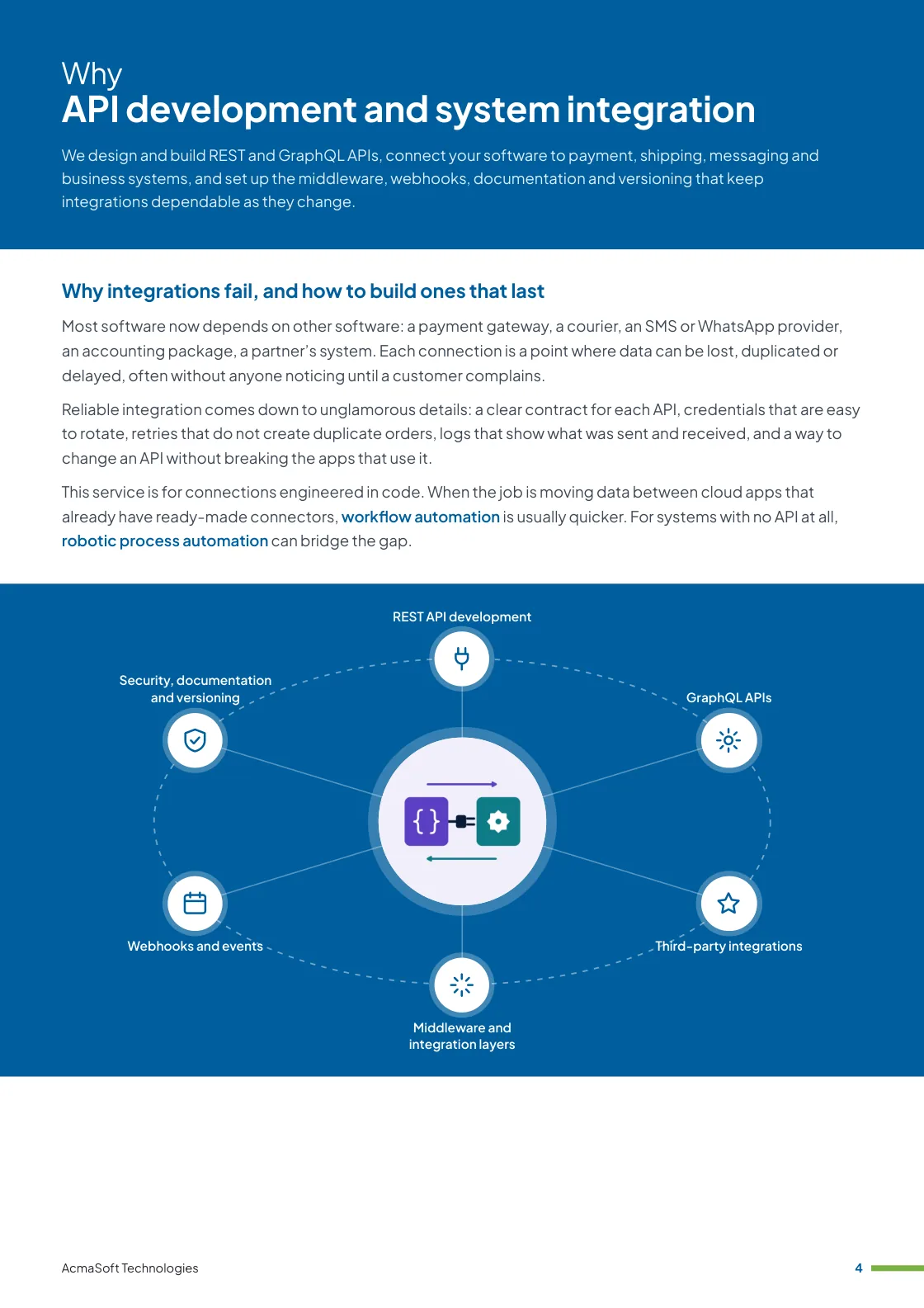
- REST API development
- GraphQL APIs
- Third-party integrations
- Middleware and integration layers
- Webhooks and events
- One named lead from first call to launch
- Support and improvements after launch
More in Software and app development
Our API development and integration services
Six kinds of work, from a single payment integration to the API your partners build on.
-
REST API development
Clear, predictable endpoints
APIs designed contract first with OpenAPI, with consistent naming, pagination, filtering and error formats, built in frameworks such as Laravel, Node.js, Django or ASP.NET Core.
We agree the contract with the teams that will use the API before the code is written.
-
GraphQL APIs
One query for what a screen needs
GraphQL schemas for apps that combine data from many sources, with limits on query depth and cost, batching to avoid repeated database calls and caching where responses allow.
We recommend GraphQL only where its flexibility helps; many APIs are simpler and easier to cache as REST.
-
Third-party integrations
Payments, logistics, messaging and more
Integrations with payment gateways such as Stripe, PayPal, Adyen or Razorpay, shipping and courier APIs, SMS and the WhatsApp Business Platform, maps, accounting software and marketplaces.
We handle sandbox testing, credentials, callbacks and each provider’s rate limits and error codes.
-
Middleware and integration layers
Connecting systems that do not fit
A service between your systems that maps data formats, queues messages, applies business rules and keeps each system unaware of the others’ quirks.
When one side is down, messages wait in a queue and are delivered once it returns, instead of being lost.
-
Webhooks and events
Reacting as things happen
Incoming webhooks verified by signature and processed idempotently, so a provider sending the same event twice does not record two payments, and outgoing webhooks with retries and delivery logs for your own customers.
For internal events we use queues or message brokers such as RabbitMQ or Kafka where the volume justifies them.
-
Security, documentation and versioning
APIs others can trust
Authentication with OAuth 2.0 or scoped API keys, rate limiting, input validation and checks against the OWASP API Security Top 10, plus reference documentation, examples and a sandbox for developers.
Versioning and deprecation notices let you change an API without breaking the apps that depend on it.
What to look for in an API development company
An integration that works in a demo can still fail on the first busy day. Ask a potential partner about:
-
Failure handling
How they deal with timeouts, duplicate events, partial failures and a provider that changes its responses without notice.
-
Contracts and documentation
Whether they agree API contracts before coding and leave behind documentation another developer can follow.
-
Monitoring after launch
Logs, alerts and dashboards that show failed calls and stuck messages, and a named person responsible for acting on them.
Ways to work with us
Choose the model that fits your scope and budget for API development and system integration. Many clients start with one and move to another as the work grows.
-
Fixed price
A defined scope delivered for an agreed price and timeline, in milestones you approve.
- Best for
- Clear requirements, a fixed budget and a firm deadline.
- How it is priced
- One agreed price, paid in instalments tied to milestones.
-
Dedicated team
A team with a project lead that works only on your product, on the priorities you set.
- Best for
- Long-term products and roadmaps that change often.
- How it is priced
- A monthly fee per team member, based on role and seniority.
-
Time and material
You pay for the hours worked and can change the scope as you learn, in short iterations.
- Best for
- Requirements that are hard to fix up front, and ongoing improvements.
- How it is priced
- Hourly or daily rates by role, invoiced monthly against logged time.
Need Node.js developers to join your own team instead?
Hire Node.js developersWhat our clients say
More client reviews-
The adaptive nature of AcmaSoft's agile development is commendable. Changes are seamlessly incorporated, ensuring our project stays on track and meets our evolving needs.
Mei Ling Singapore -
Collaborating with AcmaSoft using agile methods has been a pleasure. Their team's adaptability and communication ensure a smooth development journey.
Rahul S Bangalore
Industries our software and app development team works in
Our software and app development team builds for businesses in these industries, and we adapt API development and system integration to each one's rules, systems and customers.



Technologies we use
We choose the stack for your budget, goals and current systems. Each link explains how we work with that technology or product.
Not sure which technology fits your project? Ask one of our architects.
Talk to an architectWorking with international clients
Our team delivers remotely, so the questions that matter are when we can talk and how the work is run. Here are our office hours beside yours.
Our office hours Monday to Saturday, 9:30 am to 6:30 pm India time (IST)
Evening hours for North American clients, by arrangement: Monday to Friday, 6:30 pm to 9:30 pm India time
| Your region | Our hours in your time | Shared working hours |
|---|---|---|
| UKLondon | 4 am to 1 pm | 9 am to 1 pm |
| Central EuropeParis, Berlin | 5 am to 2 pm | 9 am to 2 pm |
| US EastNew York, Toronto | 11 pm to 8 am (next day) Evening hours to 11 am | 9 am to 11 am In our evening hours, by arrangement |
| US WestLos Angeles, Vancouver | 8 pm to 5 am (next day) Evening hours to 8 am | No overlap Early calls 7 am to 8 am, by arrangement |
| GulfDubai, Abu Dhabi | 8 am to 5 pm | 9 am to 5 pm |
| Singapore | 12 noon to 9 pm | 12 noon to 6 pm |
| Australia EastSydney, Melbourne | 3 pm to 12 midnight | 3 pm to 6 pm |
Our day ends before yours starts, so updates are waiting each morning and we agree call times with you.
Times follow daylight saving where your region uses it, against a working day of 9 am to 6 pm. Messages sent outside our hours are picked up when the team is back.
-
Remote delivery
Discovery, design, development and testing run remotely, with one named lead, a demo of working features at the end of each sprint and a staging site you can try.
-
How we stay in touch
Email, video calls and chat such as Slack, Microsoft Teams or WhatsApp, with the hours of overlap and meeting times agreed in the communication plan at the start.
-
Contracts and invoices
Proposals, contracts and invoices are in English and priced in US dollars, or in your own currency on request. A non-disclosure agreement can be signed before you share any details.
-
Privacy laws we design for
We design forms, consent and data handling with the law of your market in mind: GDPR and UK GDPR, CCPA and CPRA, PIPEDA, the UAE PDPL, the Australian Privacy Act, Singapore's PDPA and India's DPDP Act.
Questions about API development and system integration
Something else on your mind? Ask us directly and a specialist will reply.
Ask a questionShould our API use REST or GraphQL?
REST suits most public and partner APIs: it is widely understood, easy to cache and simple to document. GraphQL helps when apps combine data from many sources and different screens need different fields. Some products use REST for partners and GraphQL for their own front end.
Can you integrate with a system that has poor documentation or no API?
Often, yes. We test the API in a sandbox, inspect real responses and contact the provider's support where needed. If a system has no API at all, the options include database views, scheduled file exchange or, as a last resort, robotic process automation.
How do you prevent duplicate orders or payments when a call is retried?
We use idempotency keys and unique references, so a request or webhook received twice is recognised and processed only once, and we reconcile records against the provider's reports.
How do you secure an API?
With HTTPS throughout, OAuth 2.0 or scoped API keys, permission checks on every request, input validation, rate limits and logging, tested against common risks in the OWASP API Security Top 10. Secrets live in a vault or server configuration, never in the code.
Will you document the API for our partners?
Yes. We publish an OpenAPI description or GraphQL schema with reference documentation, example requests, error codes and a changelog, and can set up a sandbox where partners test without touching live data.
Related insights
All insights-
 16 Nov 2026
How to hire dedicated developers: models, vetting, contracts and costs
A buyer guide to hiring dedicated developers: choosing the engagement model, where to find developers, vetting and a scorecard, contract…
-
 16 Nov 2026
Custom software development: process, team, costs and contracts
How a custom software project should run, from discovery to support: the team at each phase, what drives the cost,…
-
 13 Nov 2026
Outsourcing vs in-house software development: how to decide
Compare in-house and outsourced software development on control, cost, skills and risk, with a decision flow, a three-year cost structure…
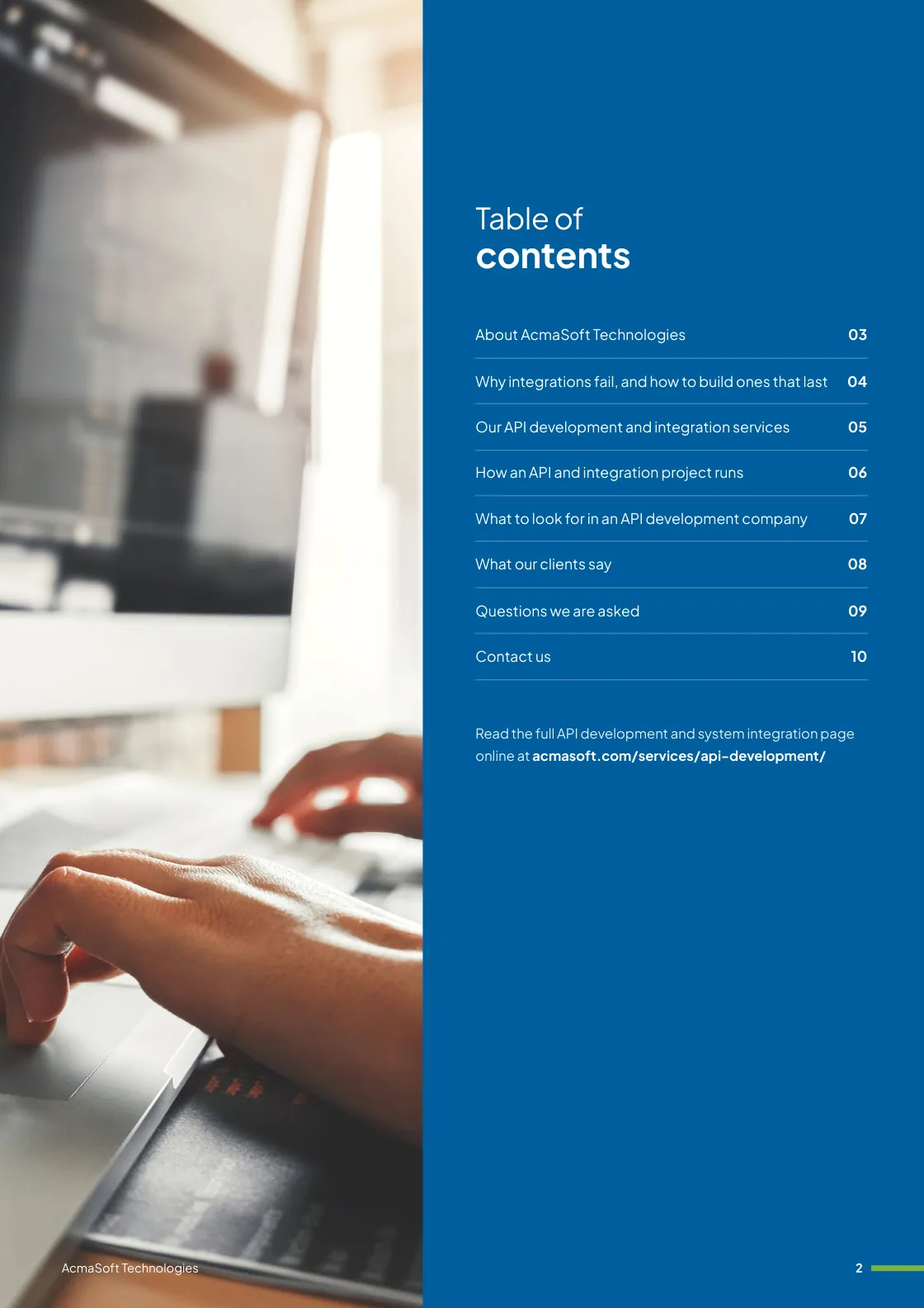
API development and system integration brochure
We design and build REST and GraphQL APIs, connect your software to payment, shipping, messaging and business systems, and set up the middleware, webhooks, documentation and versioning that keep integrations dependable as they change.
Inside this brochure
- Why integrations fail, and how to build ones that last
- Our API development and integration services
- How an API and integration project runs
- Technologies and solutions
- 2.7 MB
- 10 pages
- Services
You have downloaded from us before, so this one needs no form.
Get the brochure
Tell us who you are and the download starts straight away. We remember you on this device for 90 days, so you only fill this in once.
Your download has started.
If it does not start, download the brochure here. The links work for 15 minutes.
- Your reference
- Brochure
What you can do next
- Read it and share itShare the brochure with your team before you get in touch. It is free to read and share.
- Get a quote when you are readySix short questions on our request a quote page, and a reply within one business day.
Start your API development and system integration project
Tell us what you are planning and a specialist will reply with next steps, a rough timeline and the questions we need answered.
- Emailsales@acmasoft.com
- Call+1 (707) 706 4092
- Prefer a call?
Thank you, your message is on its way.
It has reached our sales team, together with the page you sent it from.
- Your reference
- Budget
While we prepare your reply, here is the API development and system integration brochure.
Download the brochure, API development and system integration brochure, PDF, 2.7 MBWhat happens next
- A specialist gets in touchWithin one business day, by email or phone, with any questions about what you need.
- We talk it throughA short call about your goals, users, timeline and budget. We can sign an NDA first.
- You get a proposalScope, team, timeline and cost, with the engagement model that fits the work.