

AI in finance: use cases, benefits and adoption
AcmaSoft builds AI for banks, lenders, insurers and fintechs that spots risk sooner and processes work faster, from fraud detection and documents to customer assistants and credit decisions.

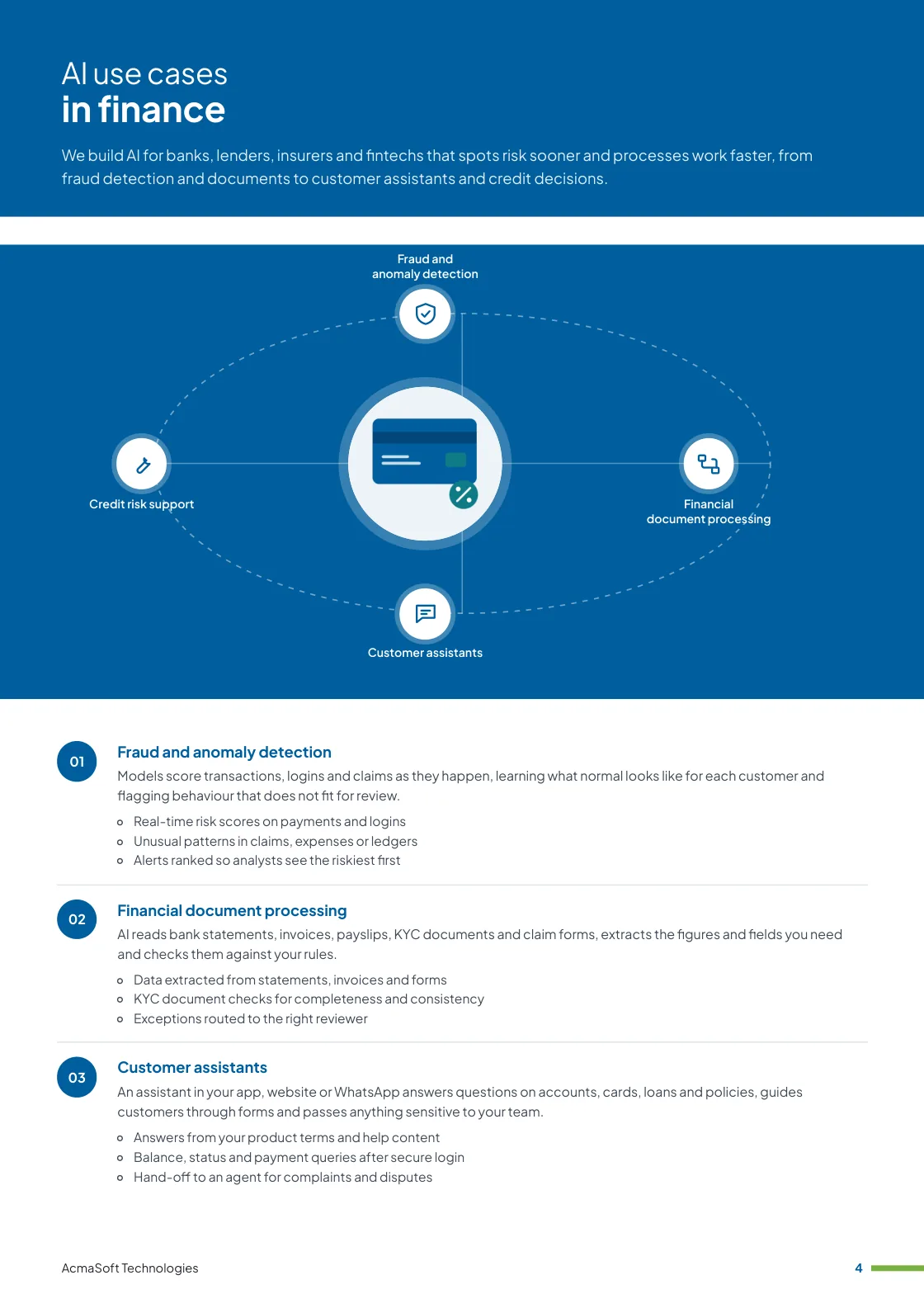
AI use cases in finance
Four places AI is proving useful in finance today, what each one needs from your data and where people stay in charge.
-
Fraud and anomaly detection
Models score transactions, logins and claims as they happen, learning what normal looks like for each customer and flagging behaviour that does not fit for review.
- Real-time risk scores on payments and logins
- Unusual patterns in claims, expenses or ledgers
- Alerts ranked so analysts see the riskiest first
-
Financial document processing
AI reads bank statements, invoices, payslips, KYC documents and claim forms, extracts the figures and fields you need and checks them against your rules.
- Data extracted from statements, invoices and forms
- KYC document checks for completeness and consistency
- Exceptions routed to the right reviewer
-
Customer assistants
An assistant in your app, website or WhatsApp answers questions on accounts, cards, loans and policies, guides customers through forms and passes anything sensitive to your team.
- Answers from your product terms and help content
- Balance, status and payment queries after secure login
- Hand-off to an agent for complaints and disputes
-
Credit risk support
Models combine application, bureau and transaction data to estimate default risk and explain the main factors, helping underwriters decide faster and more consistently.
- Risk estimates with the factors that drove them
- Cash-flow analysis from bank statement data
- Portfolio monitoring for early signs of stress
Regulation and explainability
Financial services are closely regulated, and the rules differ by country and licence. The EU AI Act treats AI for creditworthiness assessment as high-risk, and many regulators expect lenders to explain a declined application. We build explainable models and audit trails, and your compliance team signs off each use case.
Benefits of AI in finance
-
Fraud caught earlier
Real-time scoring flags suspicious activity before money leaves the account.
-
Faster onboarding and claims
Document checks that took hours take minutes, with people handling the exceptions.
-
Consistent credit decisions
Every application is assessed against the same factors, with the reasons recorded.
-
Lower service costs
Routine questions are answered instantly, at any hour.
Not sure your data is ready for AI? Start with a short readiness check.
Take the AI readiness assessmentAI adoption challenges in finance and how we address them
Most AI projects that stall do so for the same few reasons. These are the ones we plan for from the first review.
Explaining decisions
Customers and regulators expect clear reasons for an outcome.
- Interpretable models or explanation methods such as SHAP
- Reason codes stored with every score
- Model documentation your auditors can read
Data security
Financial data is a prime target for attackers.
- Encryption in transit and at rest
- Data kept in the region your regulator requires
- Least-privilege access and full audit logs
Bias in credit models
Historical data can carry unfair patterns into decisions.
- Protected characteristics and close proxies removed
- Outcome testing across customer groups
- Regular fairness reviews after launch
Models that drift
Fraud patterns and economic conditions change quickly.
- Performance monitored against fresh outcomes
- Retraining on a set schedule or trigger
- Champion and challenger testing before any switch
AI technologies behind these use cases
The building blocks we combine for each use case, and the service that delivers them.
-
Anomaly detection and classification
Gradient-boosted and unsupervised models for fraud and risk scoring.
Machine learning development -
Document AI
OCR and language models for statements, invoices, KYC and claims.
Document and invoice automation -
Conversational AI
Secure assistants for account, card, loan and policy questions.
AI chatbots and assistants -
Analytics and reporting
Risk dashboards, portfolio monitoring and model performance reports.
Data Analytics and BI
Working with international clients
Our team delivers remotely, so the questions that matter are when we can talk and how the work is run. Here are our office hours beside yours.
Our office hours Monday to Saturday, 9:30 am to 6:30 pm India time (IST)
Evening hours for North American clients, by arrangement: Monday to Friday, 6:30 pm to 9:30 pm India time
| Your region | Our hours in your time | Shared working hours |
|---|---|---|
| UKLondon | 4 am to 1 pm | 9 am to 1 pm |
| Central EuropeParis, Berlin | 5 am to 2 pm | 9 am to 2 pm |
| US EastNew York, Toronto | 11 pm to 8 am (next day) Evening hours to 11 am | 9 am to 11 am In our evening hours, by arrangement |
| US WestLos Angeles, Vancouver | 8 pm to 5 am (next day) Evening hours to 8 am | No overlap Early calls 7 am to 8 am, by arrangement |
| GulfDubai, Abu Dhabi | 8 am to 5 pm | 9 am to 5 pm |
| Singapore | 12 noon to 9 pm | 12 noon to 6 pm |
| Australia EastSydney, Melbourne | 3 pm to 12 midnight | 3 pm to 6 pm |
Our day ends before yours starts, so updates are waiting each morning and we agree call times with you.
Times follow daylight saving where your region uses it, against a working day of 9 am to 6 pm. Messages sent outside our hours are picked up when the team is back.
-
Remote delivery
Discovery, design, development and testing run remotely, with one named lead, a demo of working features at the end of each sprint and a staging site you can try.
-
How we stay in touch
Email, video calls and chat such as Slack, Microsoft Teams or WhatsApp, with the hours of overlap and meeting times agreed in the communication plan at the start.
-
Contracts and invoices
Proposals, contracts and invoices are in English and priced in US dollars, or in your own currency on request. A non-disclosure agreement can be signed before you share any details.
-
Privacy laws we design for
We design forms, consent and data handling with the law of your market in mind: GDPR and UK GDPR, CCPA and CPRA, PIPEDA, the UAE PDPL, the Australian Privacy Act, Singapore's PDPA and India's DPDP Act.
How we implement AI in finance
Five stages, each ending in something you can review before you commit to the next.
-
Use case and data review
We agree which task or decision AI should support, look at the data you hold and set the measure of success before any build starts.
You get A scoped use case and a go or no-go decision
-
Prototype on your data
A small working model or assistant is tested on real samples of your data and compared with the way the task is done today.
You get Measured results you can judge
-
Pilot with people in the loop
A small team uses it on live work while every output is reviewed, so errors and gaps surface before wider use.
You get An error log and user feedback
-
Integration and launch
We connect it to your systems with access control, logging and a manual fallback, then roll it out in stages.
You get A production system your team can run
-
Monitoring and improvement
Accuracy, cost and usage are tracked after launch, and models are retrained or adjusted as your data changes.
You get Monthly reports and a change plan
What our clients say
More client reviews-
Collaborating with AcmaSoft using agile methods has been a pleasure. Their team's adaptability and communication ensure a smooth development journey.
Rahul S Bangalore -
AcmaSoft delivered software solutions that streamlined our operations. Their attention to detail and commitment to quality set them apart.
Michael L Berlin
Questions about AI in finance
Have a question we have not covered? An AI consultant will answer it directly.
Ask an AI consultantCan AI make lending decisions on its own?
We build credit models to support underwriters, not replace them. The model gives a risk estimate with its reasons, and a person makes and owns the decision, which is also what many regulators expect.
How do you make AI decisions explainable?
We prefer models that can be interpreted directly, use explanation methods such as SHAP where needed, store reason codes with every score and document how each model was built and tested.
Is our financial data safe with AI providers?
We use providers and settings that do not train on your data, encrypt data in transit and at rest, and can deploy models in your own cloud or region where your regulator requires it.
Do you guarantee regulatory compliance?
No supplier can guarantee that for you. We build in the controls regulators usually look for, such as audit trails, explanations and access logs, and work with your compliance team to sign off each use case.
AI in finance brochure
We build AI for banks, lenders, insurers and fintechs that spots risk sooner and processes work faster, from fraud detection and documents to customer assistants and credit decisions.
Inside this brochure
- AI use cases in finance
- What each use case needs
- Benefits of AI in finance
- AI adoption challenges in finance and how we address them
- 3.2 MB
- 12 pages
- AI and automation
You have downloaded from us before, so this one needs no form.
Get the brochure
Tell us who you are and the download starts straight away. We remember you on this device for 90 days, so you only fill this in once.
Your download has started.
If it does not start, download the brochure here. The links work for 15 minutes.
- Your reference
- Brochure
What you can do next
- Read it and share itShare the brochure with your team before you get in touch. It is free to read and share.
- Get a quote when you are readySix short questions on our request a quote page, and a reply within one business day.
Plan your first AI project in finance
Describe the task or decision you want AI to help with. An AI consultant will reply with questions about your data and a suggested first step.
- Emailsales@acmasoft.com
- Call+1 (707) 706 4092
- Prefer a call?
Thank you, your message is on its way.
It has reached our sales team, together with the page you sent it from.
- Your reference
- Budget
While we prepare your reply, here is the AI in finance brochure.
Download the brochure, AI in finance brochure, PDF, 3.2 MBWhat happens next
- A specialist gets in touchWithin one business day, by email or phone, with any questions about what you need.
- We talk it throughA short call about your goals, users, timeline and budget. We can sign an NDA first.
- You get a proposalScope, team, timeline and cost, with the engagement model that fits the work.