

AI voice assistant development for inbound and outbound phone calls
At AcmaSoft, we build AI voice agents that answer your phone line, understand callers speaking naturally, book appointments, route calls to the right person and save a transcript and summary of every call.
- Years of experience
- 17+
- Clients served
- 650+
- Projects delivered
- 2,000+
- Products shipped
- 300+
What changes when AI answers the phone
Phone calls still carry many of the conversations that matter most: urgent problems, bookings, payment questions and customers who simply prefer to talk. Traditional IVR menus make callers press numbers and repeat themselves, and calls missed after hours often become lost business.
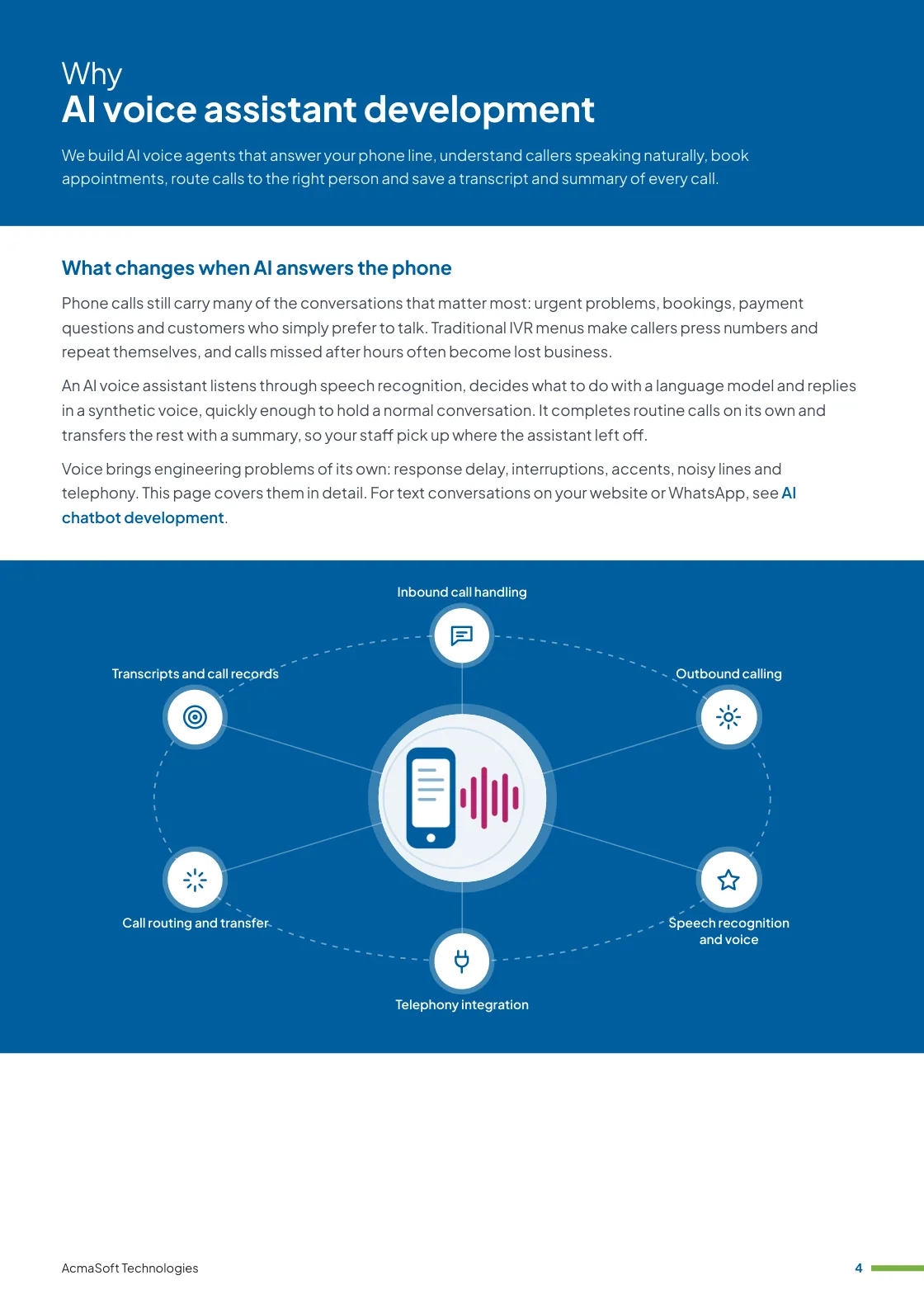
An AI voice assistant listens through speech recognition, decides what to do with a language model and replies in a synthetic voice, quickly enough to hold a normal conversation. It completes routine calls on its own and transfers the rest with a summary, so your staff pick up where the assistant left off.
Voice brings engineering problems of its own: response delay, interruptions, accents, noisy lines and telephony. This page covers them in detail. For text conversations on your website or WhatsApp, see AI chatbot development.
What you get with AI voice assistant development
- Inbound call handling
- Outbound calling
- Speech recognition and voice
- Telephony integration
- Call routing and transfer
- One named lead from first call to launch
- Support and improvements after launch
More in AI and automation
What we build for AI phone agents
Six components that decide whether a voice assistant sounds natural and does useful work.
-
Inbound call handling
Answering every call
The assistant greets callers, works out why they are calling and handles routine requests such as opening hours, appointment booking, order status or rescheduling.
It can answer around the clock, or only when your team is busy or closed.
-
Outbound calling
Calls you need to make
Reminder calls, appointment confirmations, payment follow-ups and feedback surveys, placed from your call list at the times you allow.
We build in consent checks, do-not-call lists and a clear statement that the caller is speaking with an AI assistant.
-
Speech recognition and voice
Hearing and speaking clearly
We select speech-to-text and text-to-speech services, or a real-time speech model, for your languages and accents, and tune the pronunciation of product and place names.
Callers can interrupt mid-sentence, and the assistant stops and listens as a person would.
-
Telephony integration
Your numbers and phone system
The assistant connects to your numbers through a provider such as Twilio, Plivo or Exotel, or through a SIP trunk to your current phone system.
Callers keep dialling the numbers they already know.
-
Call routing and transfer
The right person, with context
When a caller needs a person, the assistant transfers the call to the right team by topic, language or account, and passes on a short summary.
If nobody is free, it takes a message or books a callback instead.
-
Transcripts and call records
Every call written down
Each call can be recorded with notice to the caller, transcribed, summarised and logged to your CRM or helpdesk with its outcome.
You can search calls, review the assistant’s answers and see which requests still need a person.
What to look for in a voice AI developer
A voice agent that works in a quiet demo can still struggle on a real phone line. Look for a team with:
-
Real-time engineering skills
Experience keeping delay low across speech recognition, the model and speech synthesis, because long pauses make callers hang up.
-
Testing in real call conditions
A test plan that covers accents, mixed languages, weak mobile signal, background noise and callers who interrupt.
-
Respect for calling rules
Knowledge of consent, recording notices and calling-hour rules in the countries you call, and a design that tells callers they are speaking with AI.
Ways to work with us
Choose the model that fits your scope and budget for AI voice assistant development. Many clients start with one and move to another as the work grows.
-
Fixed price
A defined scope delivered for an agreed price and timeline, in milestones you approve.
- Best for
- Clear requirements, a fixed budget and a firm deadline.
- How it is priced
- One agreed price, paid in instalments tied to milestones.
-
Dedicated team
A team with a project lead that works only on your product, on the priorities you set.
- Best for
- Long-term products and roadmaps that change often.
- How it is priced
- A monthly fee per team member, based on role and seniority.
-
Time and material
You pay for the hours worked and can change the scope as you learn, in short iterations.
- Best for
- Requirements that are hard to fix up front, and ongoing improvements.
- How it is priced
- Hourly or daily rates by role, invoiced monthly against logged time.
Need AI and LLM developers to join your own team instead?
Hire AI and LLM developersWhat our clients say
More client reviews-
Collaborating with AcmaSoft using agile methods has been a pleasure. Their team's adaptability and communication ensure a smooth development journey.
Rahul S Bangalore -
AcmaSoft delivered software solutions that streamlined our operations. Their attention to detail and commitment to quality set them apart.
Michael L Berlin
Related work
See all our work-
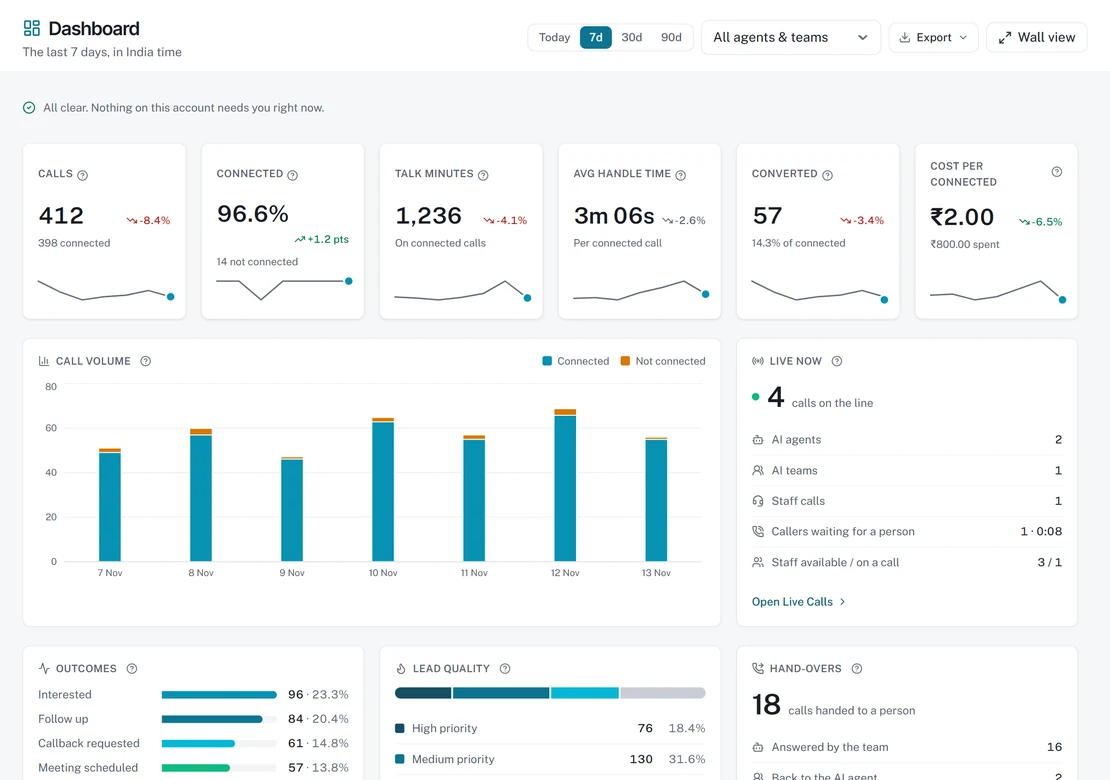 AI Call Studio: the AI voice agent platform
Web application for AI voice agents that make and answer calls for Indian calling teams, with campaigns, call logs, quality checks and analytics
Our own product
-
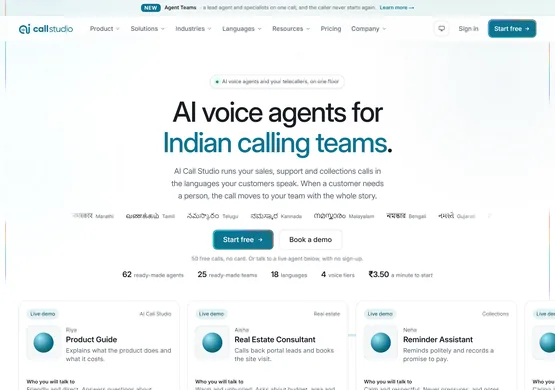 AI Call Studio website
AI voice agents for sales, support and collections calls in Indian languages
Our own product
Industries our AI and automation team works in
Our AI and automation team builds for businesses in these industries, and we adapt AI voice assistant development to each one's rules, systems and customers.



Working with international clients
Our team delivers remotely, so the questions that matter are when we can talk and how the work is run. Here are our office hours beside yours.
Our office hours Monday to Saturday, 9:30 am to 6:30 pm India time (IST)
Evening hours for North American clients, by arrangement: Monday to Friday, 6:30 pm to 9:30 pm India time
| Your region | Our hours in your time | Shared working hours |
|---|---|---|
| UKLondon | 4 am to 1 pm | 9 am to 1 pm |
| Central EuropeParis, Berlin | 5 am to 2 pm | 9 am to 2 pm |
| US EastNew York, Toronto | 11 pm to 8 am (next day) Evening hours to 11 am | 9 am to 11 am In our evening hours, by arrangement |
| US WestLos Angeles, Vancouver | 8 pm to 5 am (next day) Evening hours to 8 am | No overlap Early calls 7 am to 8 am, by arrangement |
| GulfDubai, Abu Dhabi | 8 am to 5 pm | 9 am to 5 pm |
| Singapore | 12 noon to 9 pm | 12 noon to 6 pm |
| Australia EastSydney, Melbourne | 3 pm to 12 midnight | 3 pm to 6 pm |
Our day ends before yours starts, so updates are waiting each morning and we agree call times with you.
Times follow daylight saving where your region uses it, against a working day of 9 am to 6 pm. Messages sent outside our hours are picked up when the team is back.
-
Remote delivery
Discovery, design, development and testing run remotely, with one named lead, a demo of working features at the end of each sprint and a staging site you can try.
-
How we stay in touch
Email, video calls and chat such as Slack, Microsoft Teams or WhatsApp, with the hours of overlap and meeting times agreed in the communication plan at the start.
-
Contracts and invoices
Proposals, contracts and invoices are in English and priced in US dollars, or in your own currency on request. A non-disclosure agreement can be signed before you share any details.
-
Privacy laws we design for
We design forms, consent and data handling with the law of your market in mind: GDPR and UK GDPR, CCPA and CPRA, PIPEDA, the UAE PDPL, the Australian Privacy Act, Singapore's PDPA and India's DPDP Act.
Questions about AI voice assistant development
Something else on your mind? Ask us directly and a specialist will reply.
Ask a questionCan an AI voice assistant understand Indian accents and Hindi?
Current speech models handle Indian English and Hindi reasonably well, while support for other Indian languages is improving but uneven. We test with recordings that match your callers before choosing a speech service, and route calls to people wherever recognition is not reliable enough.
Will callers know they are talking to AI?
They should, and we design for it. The assistant introduces itself as an AI assistant at the start of each call and offers a person whenever the caller asks. In some places this disclosure is also a legal requirement.
Can the assistant make outbound calls?
Yes, for calls customers expect, such as reminders, confirmations and follow-ups. Outbound calling has to follow consent and calling-hour rules, for example TRAI's commercial communication regulations in India and the TCPA in the United States, so we review these with you before any calls start.
Does it work with our existing phone numbers and system?
In most cases. We connect through a telephony provider or a SIP trunk to your current phone system, and calls the assistant cannot handle are transferred to your existing extensions or queues.
How quickly does the assistant respond during a call?
Response delay depends on the speech services, the model and the network, so we measure it during testing and tune each part. The aim is a pause short enough for the conversation to feel natural, and you see the measured figures before launch.
Related insights
All insights-
 16 Nov 2026
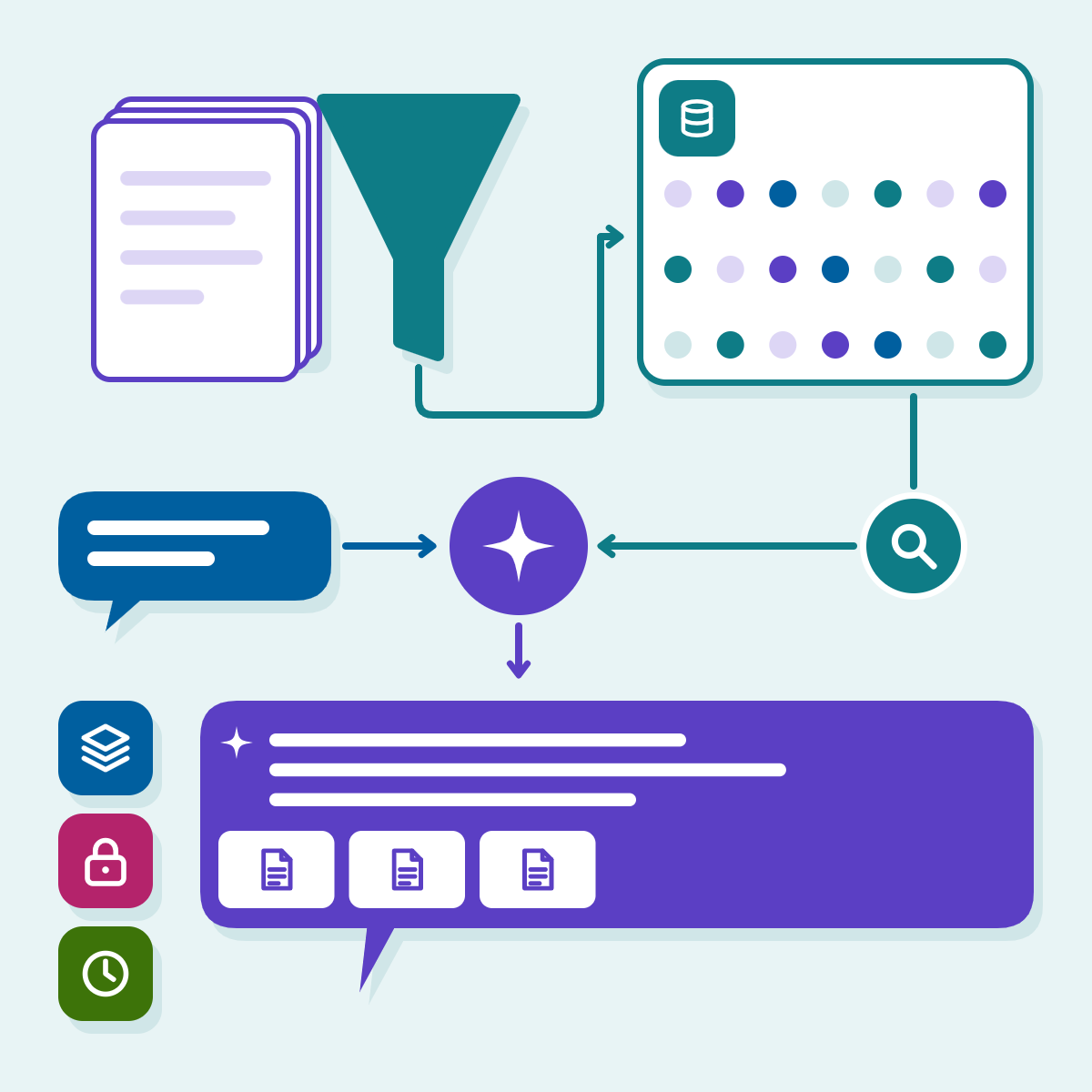
RAG explained: how retrieval-augmented generation works and when a business needs it
A plain walk-through of retrieval-augmented generation, a minimal pgvector query, the decisions that decide quality (chunking, permissions, freshness, evaluation) and…
-
 16 Nov 2026
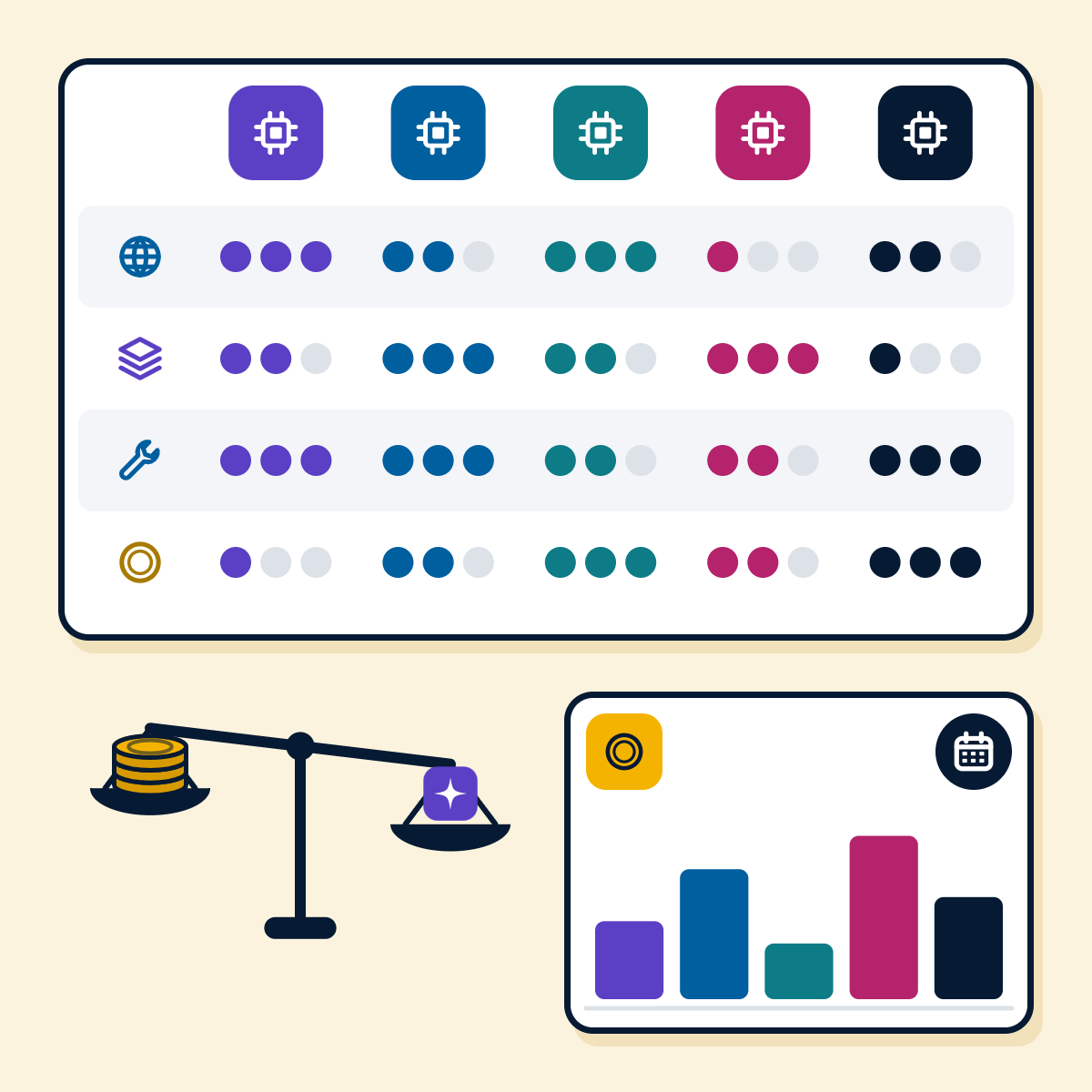
Choosing an LLM in 2026: GPT, Claude, Gemini, Llama and Mistral compared for business use
GPT, Claude, Gemini, Llama and Mistral compared on what decides a business project: price per million tokens, context, tool use,…
-
 16 Nov 2026
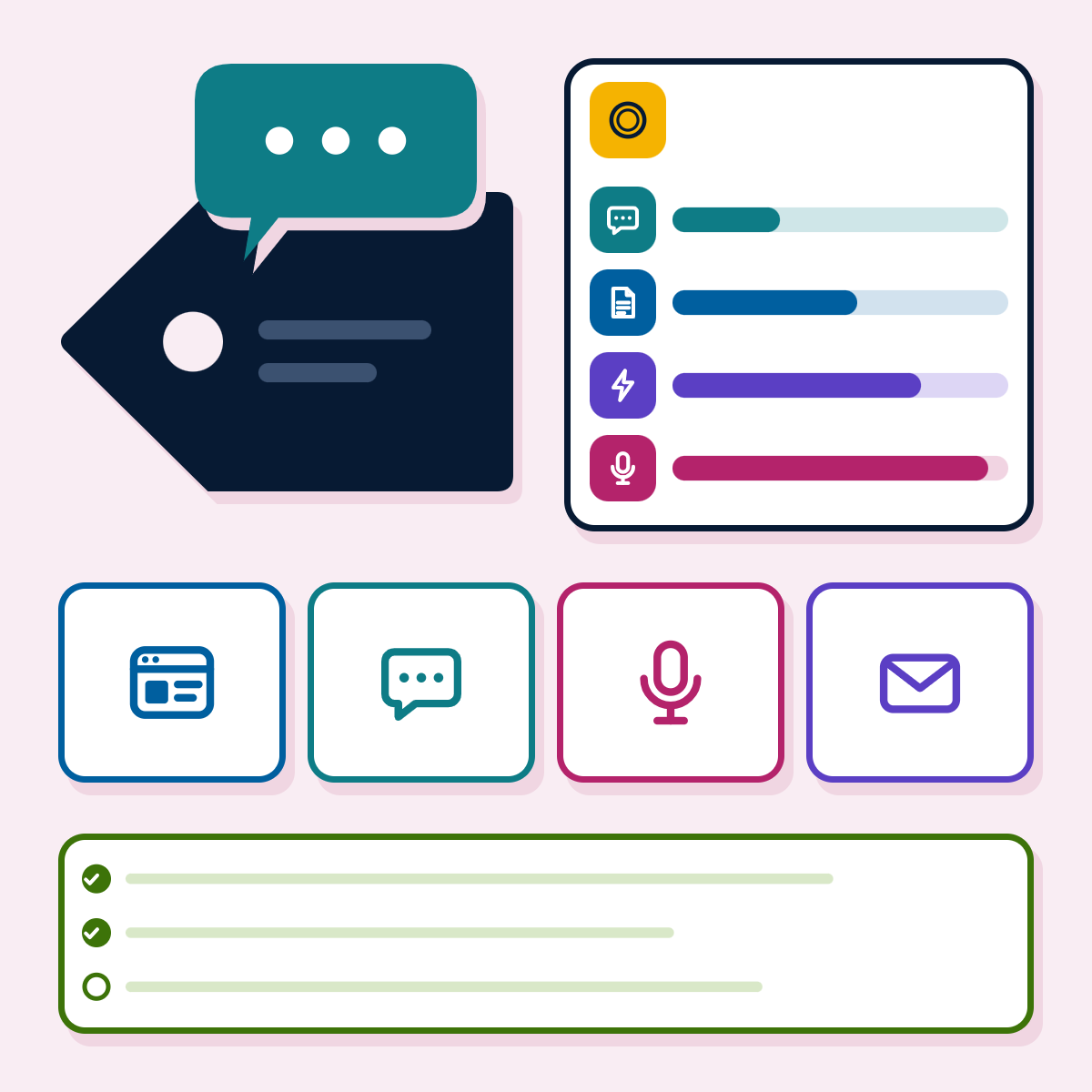
Chatbot development cost in 2026: a breakdown by type and channel
What drives the build and run cost of a chatbot by type and channel, with model prices and WhatsApp pricing…
AI voice assistant development brochure
We build AI voice agents that answer your phone line, understand callers speaking naturally, book appointments, route calls to the right person and save a transcript and summary of every call.
Inside this brochure
- What changes when AI answers the phone
- What we build for AI phone agents
- How an AI voice assistant project runs
- What to look for in a voice AI developer
- 2.6 MB
- 10 pages
- AI and automation
You have downloaded from us before, so this one needs no form.
Get the brochure
Tell us who you are and the download starts straight away. We remember you on this device for 90 days, so you only fill this in once.
Your download has started.
If it does not start, download the brochure here. The links work for 15 minutes.
- Your reference
- Brochure
What you can do next
- Read it and share itShare the brochure with your team before you get in touch. It is free to read and share.
- Get a quote when you are readySix short questions on our request a quote page, and a reply within one business day.
Start your AI voice assistant development project
Tell us what you are planning and a specialist will reply with next steps, a rough timeline and the questions we need answered.
- Emailsales@acmasoft.com
- Call+1 (707) 706 4092
- Prefer a call?
Thank you, your message is on its way.
It has reached our sales team, together with the page you sent it from.
- Your reference
- Budget
While we prepare your reply, here is the AI voice assistant development brochure.
Download the brochure, AI voice assistant development brochure, PDF, 2.6 MBWhat happens next
- A specialist gets in touchWithin one business day, by email or phone, with any questions about what you need.
- We talk it throughA short call about your goals, users, timeline and budget. We can sign an NDA first.
- You get a proposalScope, team, timeline and cost, with the engagement model that fits the work.