

AI in transport and logistics: use cases, benefits and adoption
AcmaSoft builds AI for fleets, logistics firms and transport operators, from route planning and vehicle maintenance to demand forecasts and the sensors behind autonomous vehicles.
AI use cases in transport
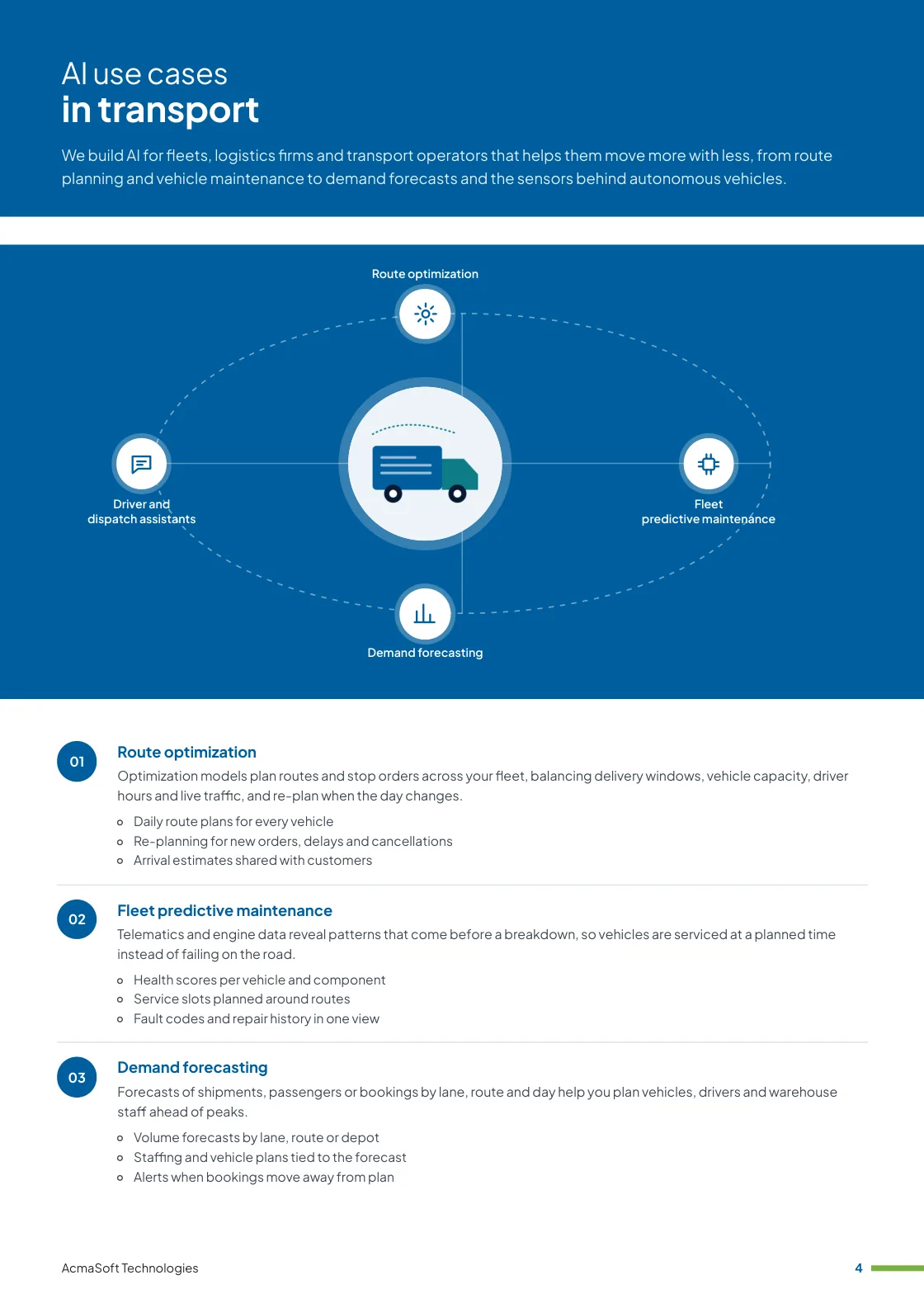
Four places AI is proving useful in transport today, what each one needs from your data and where people stay in charge.
-
Route optimization
Optimization models plan routes and stop orders across your fleet, balancing delivery windows, vehicle capacity, driver hours and live traffic, and re-plan when the day changes.
- Daily route plans for every vehicle
- Re-planning for new orders, delays and cancellations
- Arrival estimates shared with customers
-
Fleet predictive maintenance
Telematics and engine data reveal patterns that come before a breakdown, so vehicles are serviced at a planned time instead of failing on the road.
- Health scores per vehicle and component
- Service slots planned around routes
- Fault codes and repair history in one view
-
Demand forecasting
Forecasts of shipments, passengers or bookings by lane, route and day help you plan vehicles, drivers and warehouse staff ahead of peaks.
- Volume forecasts by lane, route or depot
- Staffing and vehicle plans tied to the forecast
- Alerts when bookings move away from plan
-
Driver and dispatch assistants
Assistants answer driver and customer questions on delivery status, documents and procedures, and draft incident and delivery reports from photos and notes.
- Delivery status answers for customers
- Proof-of-delivery and damage photos sorted and checked
- Procedures and documents searchable by drivers
Safety and driver data
Vehicle safety and driver monitoring are regulated, and tracking data is personal data under laws such as GDPR and the DPDP Act. Our tools support dispatchers and workshops rather than control vehicles, and we agree with you how driver data is used and who can see it.
How autonomous vehicles sense the road
Self-driving and driver-assistance systems combine several sensors because each one sees the world differently and each has weak spots.
-
Cameras
See colour, texture, lane markings, signs and traffic lights, and give the richest picture for recognizing objects. They struggle in glare, darkness and heavy rain.
-
Radar
Sends radio waves to measure the distance and speed of objects. It works in rain, fog and darkness, but gives a coarse picture of shape.
-
Lidar
Pulses laser light to build a precise 3D point map of the surroundings, measuring shape and distance accurately. Heavy rain, fog and snow reduce its range.
-
Sensor fusion
Software combines camera, radar and lidar data, often with GPS and motion sensors, into one model of the scene, so a weakness in one sensor is covered by another.
We do not build self-driving systems. We build software that works with the data vehicles already produce, such as camera footage, telematics and driver-assistance events, for fleet safety reviews, maintenance and analytics.
Benefits of AI in transport
-
Fewer kilometres per delivery
Better routes cut fuel, driving time and missed delivery windows.
-
Fewer roadside breakdowns
Planned servicing keeps vehicles on the road and deliveries on time.
-
Capacity ready for peaks
Forecasts give time to arrange vehicles and staff before demand arrives.
-
Customers kept informed
Accurate arrival times and instant status answers reduce calls to your team.
Not sure your data is ready for AI? Start with a short readiness check.
Take the AI readiness assessmentAI adoption challenges in transport and how we address them
Most AI projects that stall do so for the same few reasons. These are the ones we plan for from the first review.
Data from mixed fleets
Different vehicles and telematics providers report data differently.
- Telematics feeds brought into one format
- Gaps and faulty readings detected and handled
- Start with the vehicle types that matter most
Plans that ignore real roads
Routes that look good on a map can fail at the kerb.
- Driver feedback built into the planning rules
- Actual stop times learned from GPS history
- Easy manual changes for dispatchers
Driver privacy and trust
Tracking can feel like surveillance to drivers.
- Clear rules on what data is used and why
- Access limited by role
- Drivers shown the benefits, such as fairer routes
Legacy dispatch systems
Older TMS and dispatch tools are hard to connect.
- Integration through APIs or file exchange
- Plans pushed back into the tools staff use
- A pilot on one depot first
AI technologies behind these use cases
The building blocks we combine for each use case, and the service that delivers them.
-
Optimization and forecasting models
Route solvers and time-series models for routes, volumes and capacity.
Machine learning development -
Computer vision
Dashcam and proof-of-delivery image analysis for safety reviews and claims.
Computer vision development -
Telematics analytics
Dashboards for fleet health, fuel, utilization and on-time performance.
Data Analytics and BI -
AI agents
Assistants that answer status questions and update dispatch and CRM systems.
AI agents and agentic automation
Working with international clients
Our team delivers remotely, so the questions that matter are when we can talk and how the work is run. Here are our office hours beside yours.
Our office hours Monday to Saturday, 9:30 am to 6:30 pm India time (IST)
Evening hours for North American clients, by arrangement: Monday to Friday, 6:30 pm to 9:30 pm India time
| Your region | Our hours in your time | Shared working hours |
|---|---|---|
| UKLondon | 4 am to 1 pm | 9 am to 1 pm |
| Central EuropeParis, Berlin | 5 am to 2 pm | 9 am to 2 pm |
| US EastNew York, Toronto | 11 pm to 8 am (next day) Evening hours to 11 am | 9 am to 11 am In our evening hours, by arrangement |
| US WestLos Angeles, Vancouver | 8 pm to 5 am (next day) Evening hours to 8 am | No overlap Early calls 7 am to 8 am, by arrangement |
| GulfDubai, Abu Dhabi | 8 am to 5 pm | 9 am to 5 pm |
| Singapore | 12 noon to 9 pm | 12 noon to 6 pm |
| Australia EastSydney, Melbourne | 3 pm to 12 midnight | 3 pm to 6 pm |
Our day ends before yours starts, so updates are waiting each morning and we agree call times with you.
Times follow daylight saving where your region uses it, against a working day of 9 am to 6 pm. Messages sent outside our hours are picked up when the team is back.
-
Remote delivery
Discovery, design, development and testing run remotely, with one named lead, a demo of working features at the end of each sprint and a staging site you can try.
-
How we stay in touch
Email, video calls and chat such as Slack, Microsoft Teams or WhatsApp, with the hours of overlap and meeting times agreed in the communication plan at the start.
-
Contracts and invoices
Proposals, contracts and invoices are in English and priced in US dollars, or in your own currency on request. A non-disclosure agreement can be signed before you share any details.
-
Privacy laws we design for
We design forms, consent and data handling with the law of your market in mind: GDPR and UK GDPR, CCPA and CPRA, PIPEDA, the UAE PDPL, the Australian Privacy Act, Singapore's PDPA and India's DPDP Act.
How we implement AI in transport
Five stages, each ending in something you can review before you commit to the next.
-
Use case and data review
We agree which task or decision AI should support, look at the data you hold and set the measure of success before any build starts.
You get A scoped use case and a go or no-go decision
-
Prototype on your data
A small working model or assistant is tested on real samples of your data and compared with the way the task is done today.
You get Measured results you can judge
-
Pilot with people in the loop
A small team uses it on live work while every output is reviewed, so errors and gaps surface before wider use.
You get An error log and user feedback
-
Integration and launch
We connect it to your systems with access control, logging and a manual fallback, then roll it out in stages.
You get A production system your team can run
-
Monitoring and improvement
Accuracy, cost and usage are tracked after launch, and models are retrained or adjusted as your data changes.
You get Monthly reports and a change plan
What our clients say
More client reviews-
AcmaSoft's agile development methods are a game-changer. The iterative approach allowed us to witness progress at every stage, ensuring our project's success.
Daniel K Chicago -
The adaptive nature of AcmaSoft's agile development is commendable. Changes are seamlessly incorporated, ensuring our project stays on track and meets our evolving needs.
Mei Ling Singapore
Questions about AI in transport
Have a question we have not covered? An AI consultant will answer it directly.
Ask an AI consultantDo you build autonomous driving software?
No. We build AI for fleet and logistics operations, such as routing, maintenance, forecasting and analysis of the camera and telematics data your vehicles already produce.
Can route optimization work with our existing dispatch system?
Usually, yes. We read orders and vehicles from your TMS or dispatch tool through its API or file exports and send the planned routes back into it.
Which telematics providers can you work with?
Any provider that offers an API or data export. Most commercial telematics platforms do, and we combine feeds when a fleet uses more than one.
How much data is needed for predictive maintenance?
You need sensor or fault-code history plus records of past repairs and breakdowns. We check what you have in the first review and tell you if more history is needed before a model is worth building.
AI in transport brochure
We build AI for fleets, logistics firms and transport operators that helps them move more with less, from route planning and vehicle maintenance to demand forecasts and the sensors behind autonomous vehicles.
Inside this brochure
- AI use cases in transport
- What each use case needs
- Benefits of AI in transport
- AI adoption challenges in transport and how we address them
- 3.3 MB
- 12 pages
- AI and automation
You have downloaded from us before, so this one needs no form.
Get the brochure
Tell us who you are and the download starts straight away. We remember you on this device for 90 days, so you only fill this in once.
Your download has started.
If it does not start, download the brochure here. The links work for 15 minutes.
- Your reference
- Brochure
What you can do next
- Read it and share itShare the brochure with your team before you get in touch. It is free to read and share.
- Get a quote when you are readySix short questions on our request a quote page, and a reply within one business day.
Plan your first AI project in transport
Describe the task or decision you want AI to help with. An AI consultant will reply with questions about your data and a suggested first step.
- Emailsales@acmasoft.com
- Call+1 (707) 706 4092
- Prefer a call?
Thank you, your message is on its way.
It has reached our sales team, together with the page you sent it from.
- Your reference
- Budget
While we prepare your reply, here is the AI in transport brochure.
Download the brochure, AI in transport brochure, PDF, 3.3 MBWhat happens next
- A specialist gets in touchWithin one business day, by email or phone, with any questions about what you need.
- We talk it throughA short call about your goals, users, timeline and budget. We can sign an NDA first.
- You get a proposalScope, team, timeline and cost, with the engagement model that fits the work.