

AI in travel and hospitality: use cases, benefits and adoption
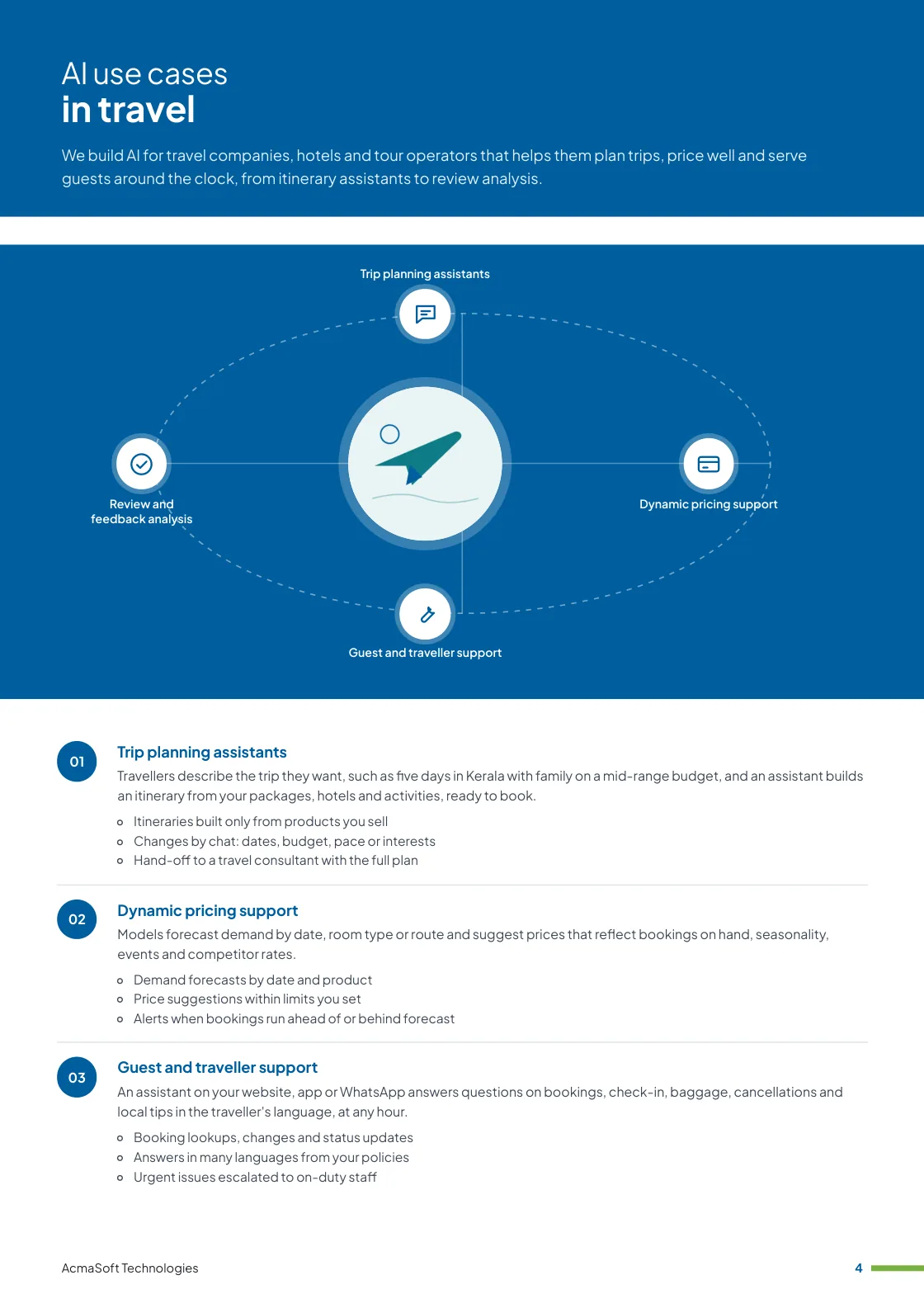
AcmaSoft builds AI for travel companies, hotels and tour operators that helps them plan trips, price well and serve guests around the clock, from itinerary assistants to review analysis.

AI use cases in travel
Four places AI is proving useful in travel today, what each one needs from your data and where people stay in charge.
-
Trip planning assistants
Travellers describe the trip they want, such as five days in Kerala with family on a mid-range budget, and an assistant builds an itinerary from your packages, hotels and activities, ready to book.
- Itineraries built only from products you sell
- Changes by chat: dates, budget, pace or interests
- Hand-off to a travel consultant with the full plan
-
Dynamic pricing support
Models forecast demand by date, room type or route and suggest prices that reflect bookings on hand, seasonality, events and competitor rates.
- Demand forecasts by date and product
- Price suggestions within limits you set
- Alerts when bookings run ahead of or behind forecast
-
Guest and traveller support
An assistant on your website, app or WhatsApp answers questions on bookings, check-in, baggage, cancellations and local tips in the traveller's language, at any hour.
- Booking lookups, changes and status updates
- Answers in many languages from your policies
- Urgent issues escalated to on-duty staff
-
Review and feedback analysis
AI reads reviews and survey comments across platforms, groups them by topic and sentiment, and shows each property or product team what guests praise and what needs fixing.
- Topics such as cleanliness, staff, food and value tracked over time
- Comparisons across properties or tours
- Draft replies to reviews for staff to edit
Fair pricing and traveller data
Pricing in travel is covered by consumer protection rules in many markets, including rules on showing the full price upfront. Passport and booking details are personal data under laws such as GDPR and the DPDP Act. We keep pricing within limits you set and use traveller data only for the purpose it was collected.
Benefits of AI in travel
-
More enquiries turned into bookings
Instant, tailored itineraries keep travellers engaged while they are ready to book.
-
Prices that follow demand
Forecast-led suggestions help fill quiet dates and earn more on busy ones.
-
Service across time zones
Travellers get answers at any hour and in their own language.
-
A clear view of guest feedback
Thousands of comments turn into a short list of fixes for each property.
Not sure your data is ready for AI? Start with a short readiness check.
Take the AI readiness assessmentAI adoption challenges in travel and how we address them
Most AI projects that stall do so for the same few reasons. These are the ones we plan for from the first review.
Live inventory and prices
An assistant that quotes stale prices or sold-out rooms frustrates travellers.
- Real-time connection to your booking engine or GDS
- Availability checked before any quote
- Clear messages when a price may change
Seasonal and disrupted demand
Events, weather and crises break historical patterns.
- Models that include events and booking pace
- Manual overrides for unusual periods
- Forecast accuracy reviewed every season
Traveller trust
Prices that feel unfair or assistants that dodge questions damage loyalty.
- Price limits and rules set by your team
- Easy hand-off to a person
- Plain explanations of fees and policies
Many systems to connect
PMS, channel managers, booking engines and CRMs all hold part of the picture.
- Integration through each system's API
- One customer and booking record
- Staged roll-out by property or channel
AI technologies behind these use cases
The building blocks we combine for each use case, and the service that delivers them.
-
Conversational AI
Planning and support assistants connected to your booking systems.
AI chatbots and assistants -
Language models with retrieval
Itineraries, destination content and review summaries from your own data.
Generative AI and LLM integration -
Demand forecasting models
Time-series and pricing models for rooms, seats and packages.
Machine learning development -
Analytics and sentiment
Dashboards for bookings, pricing and guest feedback by topic.
Data Analytics and BI
Working with international clients
Our team delivers remotely, so the questions that matter are when we can talk and how the work is run. Here are our office hours beside yours.
Our office hours Monday to Saturday, 9:30 am to 6:30 pm India time (IST)
Evening hours for North American clients, by arrangement: Monday to Friday, 6:30 pm to 9:30 pm India time
| Your region | Our hours in your time | Shared working hours |
|---|---|---|
| UKLondon | 4 am to 1 pm | 9 am to 1 pm |
| Central EuropeParis, Berlin | 5 am to 2 pm | 9 am to 2 pm |
| US EastNew York, Toronto | 11 pm to 8 am (next day) Evening hours to 11 am | 9 am to 11 am In our evening hours, by arrangement |
| US WestLos Angeles, Vancouver | 8 pm to 5 am (next day) Evening hours to 8 am | No overlap Early calls 7 am to 8 am, by arrangement |
| GulfDubai, Abu Dhabi | 8 am to 5 pm | 9 am to 5 pm |
| Singapore | 12 noon to 9 pm | 12 noon to 6 pm |
| Australia EastSydney, Melbourne | 3 pm to 12 midnight | 3 pm to 6 pm |
Our day ends before yours starts, so updates are waiting each morning and we agree call times with you.
Times follow daylight saving where your region uses it, against a working day of 9 am to 6 pm. Messages sent outside our hours are picked up when the team is back.
-
Remote delivery
Discovery, design, development and testing run remotely, with one named lead, a demo of working features at the end of each sprint and a staging site you can try.
-
How we stay in touch
Email, video calls and chat such as Slack, Microsoft Teams or WhatsApp, with the hours of overlap and meeting times agreed in the communication plan at the start.
-
Contracts and invoices
Proposals, contracts and invoices are in English and priced in US dollars, or in your own currency on request. A non-disclosure agreement can be signed before you share any details.
-
Privacy laws we design for
We design forms, consent and data handling with the law of your market in mind: GDPR and UK GDPR, CCPA and CPRA, PIPEDA, the UAE PDPL, the Australian Privacy Act, Singapore's PDPA and India's DPDP Act.
How we implement AI in travel
Five stages, each ending in something you can review before you commit to the next.
-
Use case and data review
We agree which task or decision AI should support, look at the data you hold and set the measure of success before any build starts.
You get A scoped use case and a go or no-go decision
-
Prototype on your data
A small working model or assistant is tested on real samples of your data and compared with the way the task is done today.
You get Measured results you can judge
-
Pilot with people in the loop
A small team uses it on live work while every output is reviewed, so errors and gaps surface before wider use.
You get An error log and user feedback
-
Integration and launch
We connect it to your systems with access control, logging and a manual fallback, then roll it out in stages.
You get A production system your team can run
-
Monitoring and improvement
Accuracy, cost and usage are tracked after launch, and models are retrained or adjusted as your data changes.
You get Monthly reports and a change plan
What our clients say
More client reviews-
AcmaSoft delivered software solutions that streamlined our operations. Their attention to detail and commitment to quality set them apart.
Michael L Berlin -
Kudos to AcmaSoft for their innovative approach to software development. Their solutions are cutting-edge, providing a significant competitive advantage.
Aisha R Dubai
Questions about AI in travel
Have a question we have not covered? An AI consultant will answer it directly.
Ask an AI consultantCan an AI assistant book trips directly?
Yes, when it is connected to your booking engine. It can hold or book products you sell, and you decide which bookings it completes on its own and which go to a consultant.
Will dynamic pricing change our prices without approval?
Only if you allow it. Most clients start with suggestions their revenue team approves, within floors and ceilings they set, and allow automatic changes later for selected products.
Can it work with our PMS or channel manager?
Usually, yes. We integrate through the APIs your property management system, channel manager or booking engine provides.
Which languages can a travel assistant handle?
Current language models handle most major languages well. We test the languages your travellers use most and check that policy answers stay accurate in each one.
AI in travel brochure
We build AI for travel companies, hotels and tour operators that helps them plan trips, price well and serve guests around the clock, from itinerary assistants to review analysis.
Inside this brochure
- AI use cases in travel
- What each use case needs
- Benefits of AI in travel
- AI adoption challenges in travel and how we address them
- 3.3 MB
- 12 pages
- AI and automation
You have downloaded from us before, so this one needs no form.
Get the brochure
Tell us who you are and the download starts straight away. We remember you on this device for 90 days, so you only fill this in once.
Your download has started.
If it does not start, download the brochure here. The links work for 15 minutes.
- Your reference
- Brochure
What you can do next
- Read it and share itShare the brochure with your team before you get in touch. It is free to read and share.
- Get a quote when you are readySix short questions on our request a quote page, and a reply within one business day.
Plan your first AI project in travel
Describe the task or decision you want AI to help with. An AI consultant will reply with questions about your data and a suggested first step.
- Emailsales@acmasoft.com
- Call+1 (707) 706 4092
- Prefer a call?
Thank you, your message is on its way.
It has reached our sales team, together with the page you sent it from.
- Your reference
- Budget
While we prepare your reply, here is the AI in travel brochure.
Download the brochure, AI in travel brochure, PDF, 3.3 MBWhat happens next
- A specialist gets in touchWithin one business day, by email or phone, with any questions about what you need.
- We talk it throughA short call about your goals, users, timeline and budget. We can sign an NDA first.
- You get a proposalScope, team, timeline and cost, with the engagement model that fits the work.