

AI in healthcare: use cases, benefits and adoption
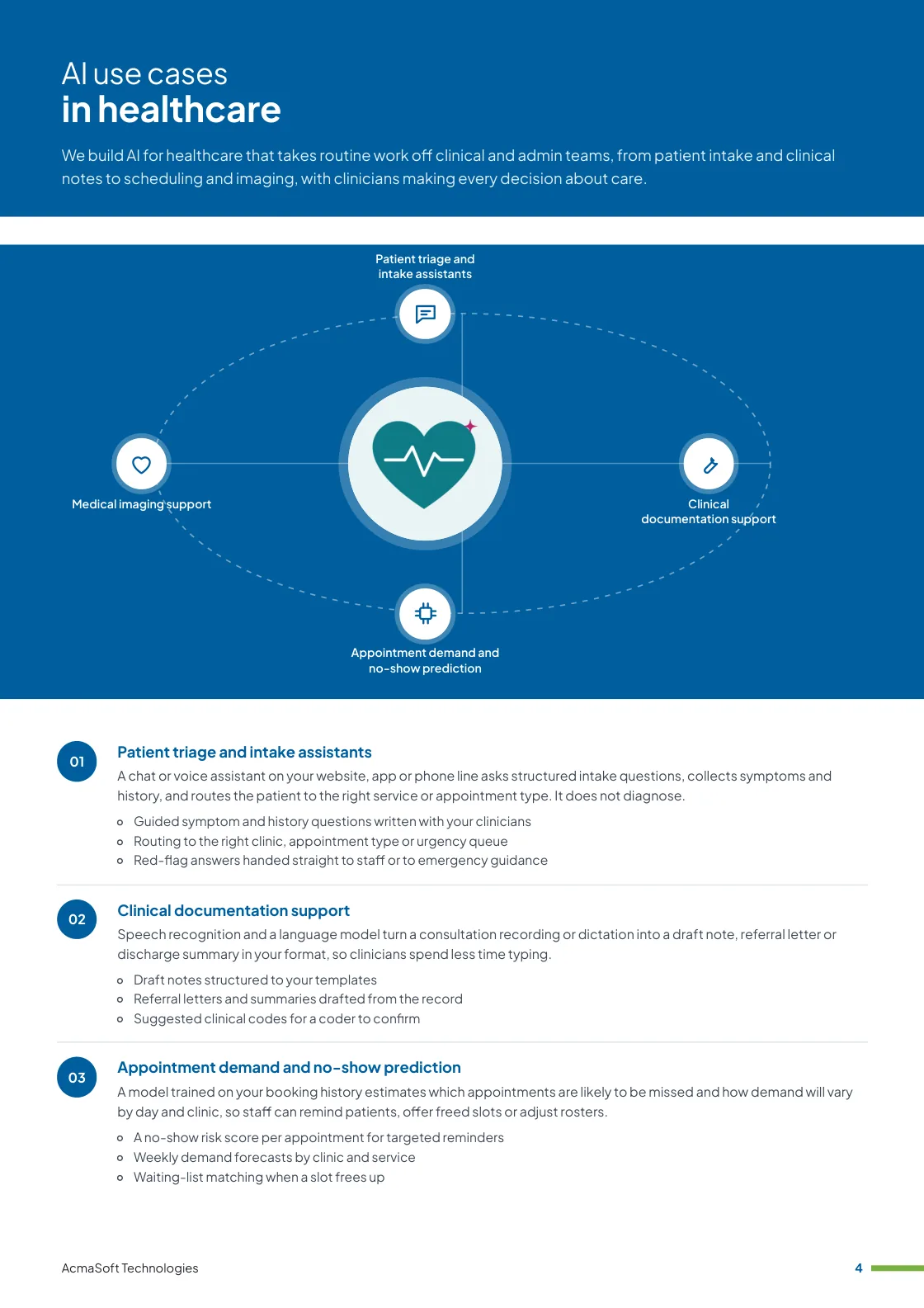
AcmaSoft builds AI for healthcare that takes routine work off clinical and admin teams, from patient intake and clinical notes to scheduling and imaging, with clinicians making every decision about care.
AI use cases in healthcare
Four places AI is proving useful in healthcare today, what each one needs from your data and where people stay in charge.
-
Patient triage and intake assistants
A chat or voice assistant on your website, app or phone line asks structured intake questions, collects symptoms and history, and routes the patient to the right service or appointment type. It does not diagnose.
- Guided symptom and history questions written with your clinicians
- Routing to the right clinic, appointment type or urgency queue
- Red-flag answers handed straight to staff or to emergency guidance
-
Clinical documentation support
Speech recognition and a language model turn a consultation recording or dictation into a draft note, referral letter or discharge summary in your format, so clinicians spend less time typing.
- Draft notes structured to your templates
- Referral letters and summaries drafted from the record
- Suggested clinical codes for a coder to confirm
-
Appointment demand and no-show prediction
A model trained on your booking history estimates which appointments are likely to be missed and how demand will vary by day and clinic, so staff can remind patients, offer freed slots or adjust rosters.
- A no-show risk score per appointment for targeted reminders
- Weekly demand forecasts by clinic and service
- Waiting-list matching when a slot frees up
-
Medical imaging support
Computer vision models can sort imaging worklists, flag studies that may need earlier review and take routine measurements. The radiology section below explains where these tools fit.
- Worklist prioritization for reading teams
- Automatic measurements and comparison with prior studies
- Image quality checks at acquisition
Patient privacy
Patient data is handled under the privacy law that applies to you, such as HIPAA in the United States, GDPR in Europe or the DPDP Act in India. We develop and test on de-identified data wherever possible, keep data in the region you choose and agree data processing terms with your compliance team before any patient data is shared.
AI in medical imaging and radiology
Radiology is where clinical AI is most established and also most regulated. These are the places it fits in a reading workflow, and where it stops.
-
Worklist triage
Models flag studies with a possible urgent finding, such as a suspected bleed on a head CT, so they are read sooner. Every study is still read.
-
Detection support
The software marks regions for the radiologist to look at, for example possible nodules on a chest CT. A mark is a prompt to review, not a finding.
-
Measurement and follow-up
Automatic measurements and side-by-side views of prior studies speed up routine follow-up reports.
-
Reporting help
Structured templates and a draft impression built from the radiologist's own dictation, edited before sign-off.
Software that supports diagnosis is regulated as a medical device in many markets, for example by the FDA in the United States and under the MDR in the European Union. A tool needs that clearance before clinical use, so we plan imaging projects around it from the first review.
Benefits of AI in healthcare
-
Less time on paperwork
Draft notes and letters cut typing, while clinicians keep the final word on every document.
-
Faster answers for patients
Intake assistants respond and route enquiries at any hour, including evenings and weekends.
-
Fuller clinic lists
Targeted reminders and quick rebooking of freed slots reduce wasted appointments.
-
Urgent cases seen sooner
Prioritized worklists help studies with possible urgent findings reach a reader earlier.
Not sure your data is ready for AI? Start with a short readiness check.
Take the AI readiness assessmentAI adoption challenges in healthcare and how we address them
Most AI projects that stall do so for the same few reasons. These are the ones we plan for from the first review.
Sensitive patient data
Health records are among the most sensitive data any organization holds.
- De-identified data for development and testing
- Data kept in the region and cloud you choose
- Role-based access and audit logs on every AI feature
Clinical safety
An unnoticed AI error can harm a patient.
- Clinicians define the scope and approve outputs
- Testing on your own patient population before go-live
- Clear escalation when the model is unsure
Medical device rules
Tools that support diagnosis can count as regulated medical devices.
- Regulatory status mapped for each use case at the start
- Decision-support tools kept to their intended use
- Intended use, data and test results documented
Busy clinical workflows
Tools that add clicks or another screen are quickly ignored.
- Integration with your EHR, PACS or booking system
- A pilot with one clinical team first
- Success measured in time saved as well as accuracy
AI technologies behind these use cases
The building blocks we combine for each use case, and the service that delivers them.
-
Conversational AI
Intake and booking assistants on your website, app or WhatsApp that follow your clinical rules.
AI chatbots and assistants -
Speech recognition and language models
Dictation and consultation audio turned into structured draft notes and letters.
Generative AI and LLM integration -
Predictive models
No-show risk and demand forecasts trained on your booking history.
Machine learning development -
Computer vision
Image analysis for worklist sorting, measurement and quality checks.
Computer vision development
Working with international clients
Our team delivers remotely, so the questions that matter are when we can talk and how the work is run. Here are our office hours beside yours.
Our office hours Monday to Saturday, 9:30 am to 6:30 pm India time (IST)
Evening hours for North American clients, by arrangement: Monday to Friday, 6:30 pm to 9:30 pm India time
| Your region | Our hours in your time | Shared working hours |
|---|---|---|
| UKLondon | 4 am to 1 pm | 9 am to 1 pm |
| Central EuropeParis, Berlin | 5 am to 2 pm | 9 am to 2 pm |
| US EastNew York, Toronto | 11 pm to 8 am (next day) Evening hours to 11 am | 9 am to 11 am In our evening hours, by arrangement |
| US WestLos Angeles, Vancouver | 8 pm to 5 am (next day) Evening hours to 8 am | No overlap Early calls 7 am to 8 am, by arrangement |
| GulfDubai, Abu Dhabi | 8 am to 5 pm | 9 am to 5 pm |
| Singapore | 12 noon to 9 pm | 12 noon to 6 pm |
| Australia EastSydney, Melbourne | 3 pm to 12 midnight | 3 pm to 6 pm |
Our day ends before yours starts, so updates are waiting each morning and we agree call times with you.
Times follow daylight saving where your region uses it, against a working day of 9 am to 6 pm. Messages sent outside our hours are picked up when the team is back.
-
Remote delivery
Discovery, design, development and testing run remotely, with one named lead, a demo of working features at the end of each sprint and a staging site you can try.
-
How we stay in touch
Email, video calls and chat such as Slack, Microsoft Teams or WhatsApp, with the hours of overlap and meeting times agreed in the communication plan at the start.
-
Contracts and invoices
Proposals, contracts and invoices are in English and priced in US dollars, or in your own currency on request. A non-disclosure agreement can be signed before you share any details.
-
Privacy laws we design for
We design forms, consent and data handling with the law of your market in mind: GDPR and UK GDPR, CCPA and CPRA, PIPEDA, the UAE PDPL, the Australian Privacy Act, Singapore's PDPA and India's DPDP Act.
How we implement AI in healthcare
Five stages, each ending in something you can review before you commit to the next.
-
Use case and data review
We agree which task or decision AI should support, look at the data you hold and set the measure of success before any build starts.
You get A scoped use case and a go or no-go decision
-
Prototype on your data
A small working model or assistant is tested on real samples of your data and compared with the way the task is done today.
You get Measured results you can judge
-
Pilot with people in the loop
A small team uses it on live work while every output is reviewed, so errors and gaps surface before wider use.
You get An error log and user feedback
-
Integration and launch
We connect it to your systems with access control, logging and a manual fallback, then roll it out in stages.
You get A production system your team can run
-
Monitoring and improvement
Accuracy, cost and usage are tracked after launch, and models are retrained or adjusted as your data changes.
You get Monthly reports and a change plan
What our clients say
More client reviews-
Kudos to AcmaSoft for their innovative approach to software development. Their solutions are cutting-edge, providing a significant competitive advantage.
Aisha R Dubai -
AcmaSoft's agile development methods are a game-changer. The iterative approach allowed us to witness progress at every stage, ensuring our project's success.
Daniel K Chicago
Questions about AI in healthcare
Have a question we have not covered? An AI consultant will answer it directly.
Ask an AI consultantCan AI diagnose patients?
No tool we build makes a diagnosis. Our assistants collect information, route patients and draft documents, and imaging tools highlight studies or regions for review. A qualified clinician makes every clinical decision.
How is patient data protected?
We use de-identified data for development wherever we can, keep data in the region you choose, restrict access by role and log every use. Data processing terms are agreed with your compliance team before any patient data is shared.
Does healthcare AI need regulatory approval?
It depends on what the tool does. Admin tools such as booking assistants usually do not, while software that supports diagnosis is often regulated as a medical device. We map the status of each use case at the start and plan the work around it.
Can it work with our EHR or booking system?
Usually, yes. We connect through the system's API or through HL7 and FHIR interfaces where your system offers them, so staff work in the screens they already use.
Where should a clinic start with AI?
Admin work is the safest start: intake, reminders and documentation drafts. They save time quickly, carry lower clinical risk and build the data and trust needed for later clinical use cases.
AI in healthcare brochure
We build AI for healthcare that takes routine work off clinical and admin teams, from patient intake and clinical notes to scheduling and imaging, with clinicians making every decision about care.
Inside this brochure
- AI use cases in healthcare
- What each use case needs
- Benefits of AI in healthcare
- AI adoption challenges in healthcare and how we address them
- 2.9 MB
- 12 pages
- AI and automation
You have downloaded from us before, so this one needs no form.
Get the brochure
Tell us who you are and the download starts straight away. We remember you on this device for 90 days, so you only fill this in once.
Your download has started.
If it does not start, download the brochure here. The links work for 15 minutes.
- Your reference
- Brochure
What you can do next
- Read it and share itShare the brochure with your team before you get in touch. It is free to read and share.
- Get a quote when you are readySix short questions on our request a quote page, and a reply within one business day.
Plan your first AI project in healthcare
Describe the task or decision you want AI to help with. An AI consultant will reply with questions about your data and a suggested first step.
- Emailsales@acmasoft.com
- Call+1 (707) 706 4092
- Prefer a call?
Thank you, your message is on its way.
It has reached our sales team, together with the page you sent it from.
- Your reference
- Budget
While we prepare your reply, here is the AI in healthcare brochure.
Download the brochure, AI in healthcare brochure, PDF, 2.9 MBWhat happens next
- A specialist gets in touchWithin one business day, by email or phone, with any questions about what you need.
- We talk it throughA short call about your goals, users, timeline and budget. We can sign an NDA first.
- You get a proposalScope, team, timeline and cost, with the engagement model that fits the work.