

Generative AI development and LLM integration for your products and data
At AcmaSoft, we add large language models from OpenAI, Anthropic and others to your software, connect them to your documents with retrieval-augmented generation, and test quality, cost and response time before anything reaches users.
- Years of experience
- 17+
- Clients served
- 650+
- Projects delivered
- 2,000+
- Products shipped
- 300+
Turning language models into working features
Calling a language model API takes minutes. Building a feature people can rely on takes more: the right model for the task, the right context from your data, checks on what comes back and control over cost and speed.
We integrate models such as OpenAI GPT and Anthropic Claude into web apps, mobile apps and internal tools for search, summaries, drafting, classification and question answering over company knowledge.
Each feature is measured against test cases from your own data, and we are plain about the limits: models can be wrong, so outputs that matter are checked by people or by rules.
What you get with generative AI and LLM integration
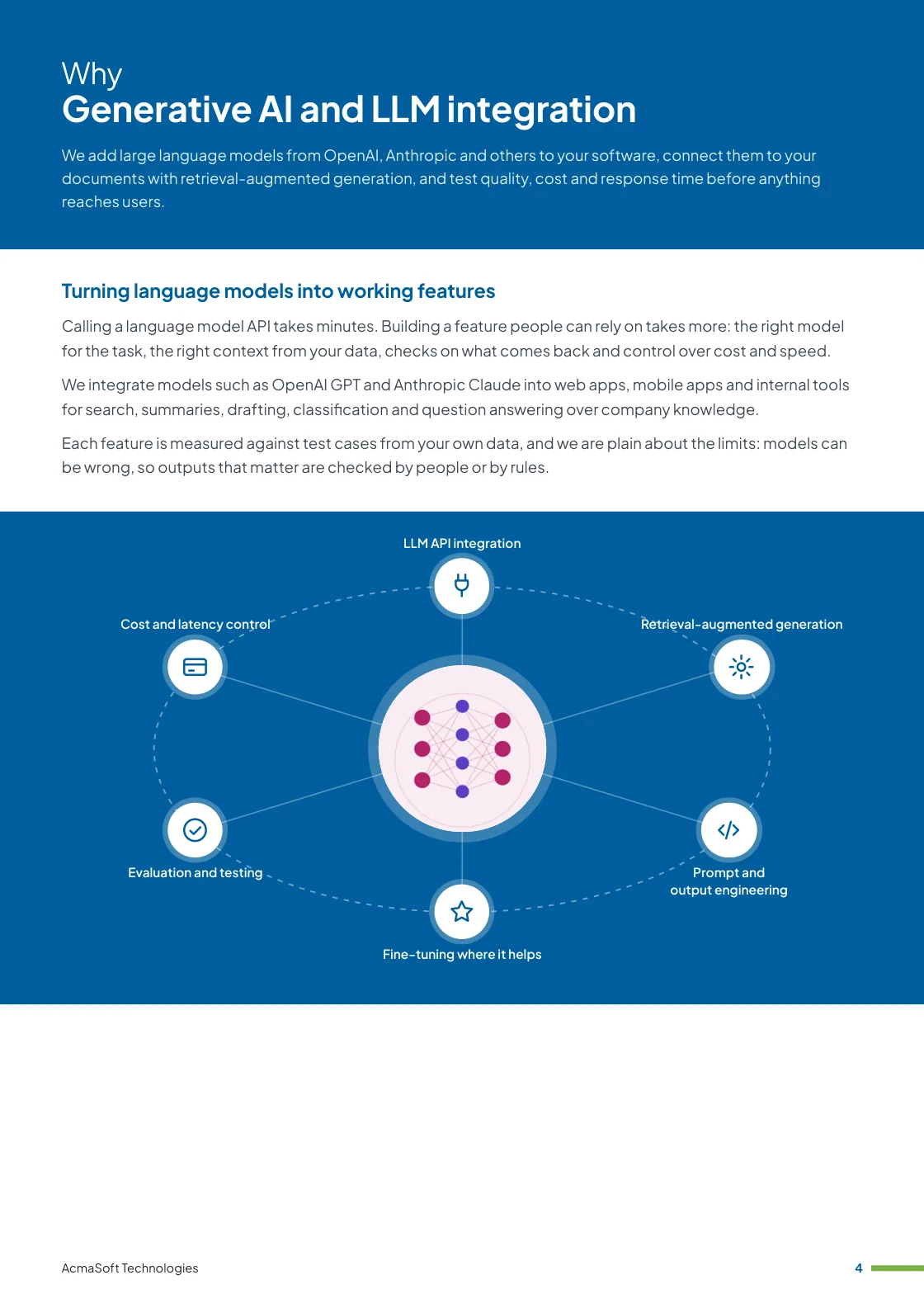
- LLM API integration
- Retrieval-augmented generation
- Prompt and output engineering
- Fine-tuning where it helps
- Evaluation and testing
- One named lead from first call to launch
- Support and improvements after launch
More in AI and automation
Our generative AI development services
Six areas of work, from choosing a model to running it in production.
-
LLM API integration
OpenAI, Claude and more
We connect your application to OpenAI, Anthropic Claude, Google Gemini or open models, with streaming responses, structured outputs and function calling where needed.
The model layer stays replaceable, so you can switch providers as prices and capabilities change.
-
Retrieval-augmented generation
Answers from your documents
We index your documents, wikis, tickets and databases so the model answers from your own content and cites its sources.
Access rules carry over, so people only get answers from documents they are allowed to see.
-
Prompt and output engineering
Consistent results
We write and version the prompts, define structured output formats and add validation, so responses fit your application and your house style.
Guardrails catch off-topic requests, prompt injection attempts and answers that fail checks.
-
Fine-tuning where it helps
Specialised models
When prompts and retrieval are not enough, for example to enforce a format or run a smaller, cheaper model on a narrow task, we prepare training data and fine-tune.
We recommend it only when tests show a clear gain over the simpler approach.
-
Evaluation and testing
Measuring quality
We build test sets from your real cases and score outputs for accuracy, relevance and format, with automated checks and human review.
Every change to a prompt, model or data source is tested before release.
-
Cost and latency control
Fast and affordable
We track tokens, cost and response time per feature, route simple requests to smaller models, cache repeated work and trim the context sent to the model.
Usage limits and alerts prevent unexpected bills.
What to look for in a generative AI development partner
Many teams can build an impressive demo. For a feature that runs every day, look for:
-
Software engineering depth
The model is one part of the system. Authentication, data pipelines, error handling and monitoring matter as much as the prompt.
-
Evidence over impressions
Decisions about models, prompts and fine-tuning backed by test results on your data, not by a few good-looking examples.
-
Care with your data
Clear answers about where data goes, how long providers keep it, whether it is used for training and how access is controlled.
Ways to work with us
Choose the model that fits your scope and budget for generative AI and LLM integration. Many clients start with one and move to another as the work grows.
-
Fixed price
A defined scope delivered for an agreed price and timeline, in milestones you approve.
- Best for
- Clear requirements, a fixed budget and a firm deadline.
- How it is priced
- One agreed price, paid in instalments tied to milestones.
-
Dedicated team
A team with a project lead that works only on your product, on the priorities you set.
- Best for
- Long-term products and roadmaps that change often.
- How it is priced
- A monthly fee per team member, based on role and seniority.
-
Time and material
You pay for the hours worked and can change the scope as you learn, in short iterations.
- Best for
- Requirements that are hard to fix up front, and ongoing improvements.
- How it is priced
- Hourly or daily rates by role, invoiced monthly against logged time.
Need AI and LLM developers to join your own team instead?
Hire AI and LLM developersWhat our clients say
More client reviews-
The adaptive nature of AcmaSoft's agile development is commendable. Changes are seamlessly incorporated, ensuring our project stays on track and meets our evolving needs.
Mei Ling Singapore -
Collaborating with AcmaSoft using agile methods has been a pleasure. Their team's adaptability and communication ensure a smooth development journey.
Rahul S Bangalore
Industries our AI and automation team works in
Our AI and automation team builds for businesses in these industries, and we adapt generative AI and LLM integration to each one's rules, systems and customers.


Technology we use
We choose the stack for your budget, goals and current systems. Each link explains how we work with that technology or product.
Back end
Not sure which technology fits your project? Ask one of our architects.
Talk to an architectWorking with international clients
Our team delivers remotely, so the questions that matter are when we can talk and how the work is run. Here are our office hours beside yours.
Our office hours Monday to Saturday, 9:30 am to 6:30 pm India time (IST)
Evening hours for North American clients, by arrangement: Monday to Friday, 6:30 pm to 9:30 pm India time
| Your region | Our hours in your time | Shared working hours |
|---|---|---|
| UKLondon | 4 am to 1 pm | 9 am to 1 pm |
| Central EuropeParis, Berlin | 5 am to 2 pm | 9 am to 2 pm |
| US EastNew York, Toronto | 11 pm to 8 am (next day) Evening hours to 11 am | 9 am to 11 am In our evening hours, by arrangement |
| US WestLos Angeles, Vancouver | 8 pm to 5 am (next day) Evening hours to 8 am | No overlap Early calls 7 am to 8 am, by arrangement |
| GulfDubai, Abu Dhabi | 8 am to 5 pm | 9 am to 5 pm |
| Singapore | 12 noon to 9 pm | 12 noon to 6 pm |
| Australia EastSydney, Melbourne | 3 pm to 12 midnight | 3 pm to 6 pm |
Our day ends before yours starts, so updates are waiting each morning and we agree call times with you.
Times follow daylight saving where your region uses it, against a working day of 9 am to 6 pm. Messages sent outside our hours are picked up when the team is back.
-
Remote delivery
Discovery, design, development and testing run remotely, with one named lead, a demo of working features at the end of each sprint and a staging site you can try.
-
How we stay in touch
Email, video calls and chat such as Slack, Microsoft Teams or WhatsApp, with the hours of overlap and meeting times agreed in the communication plan at the start.
-
Contracts and invoices
Proposals, contracts and invoices are in English and priced in US dollars, or in your own currency on request. A non-disclosure agreement can be signed before you share any details.
-
Privacy laws we design for
We design forms, consent and data handling with the law of your market in mind: GDPR and UK GDPR, CCPA and CPRA, PIPEDA, the UAE PDPL, the Australian Privacy Act, Singapore's PDPA and India's DPDP Act.
Questions about generative AI and LLM integration
Something else on your mind? Ask us directly and a specialist will reply.
Ask a questionWhich large language models do you work with?
Mainly OpenAI GPT models and Anthropic Claude through their APIs, and open models when you need to host the model yourself. We choose per task after testing quality, speed and cost on your own examples.
What is retrieval-augmented generation (RAG)?
A method where the system first searches your documents for the passages relevant to a question, then asks the model to answer using those passages and cite them. Answers stay current and grounded in your content without retraining the model.
Do we need to fine-tune a model?
Usually not. Good prompts and retrieval meet most needs. Fine-tuning helps when you need a consistent format or style across many outputs, or a smaller, cheaper model for a narrow task, and we recommend it only when tests show a clear gain.
Is our data used to train the provider's models?
The major providers state that data sent through their business APIs is not used for training by default. We confirm the current terms and data retention settings for your account and can keep sensitive data out of requests altogether.
How do you control cost and response time?
We measure tokens and latency for every request, use the smallest model that meets the quality bar, cache repeated work, trim the context sent to the model and set usage limits and alerts.
Related insights
All insights-
 16 Nov 2026
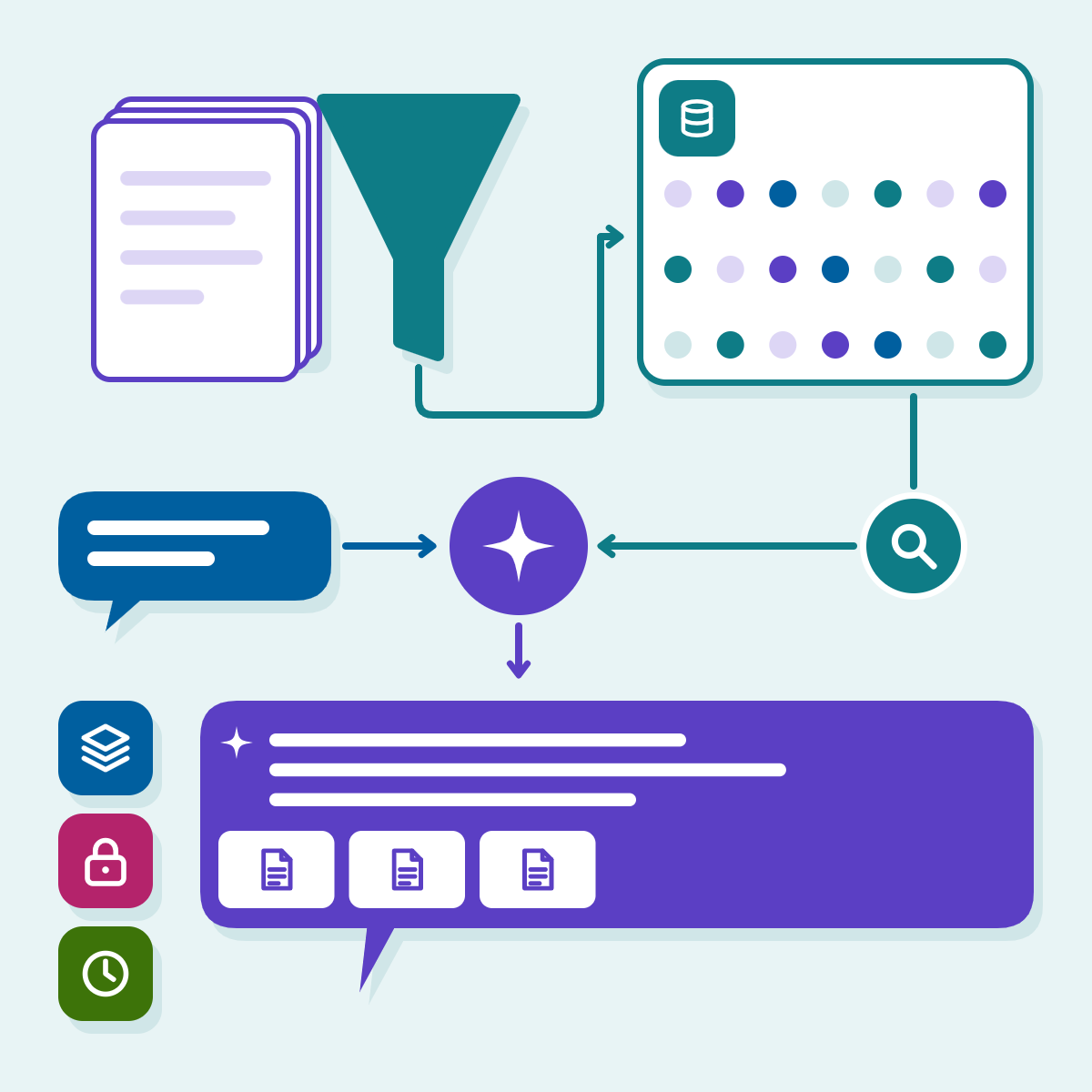
RAG explained: how retrieval-augmented generation works and when a business needs it
A plain walk-through of retrieval-augmented generation, a minimal pgvector query, the decisions that decide quality (chunking, permissions, freshness, evaluation) and…
-
 16 Nov 2026
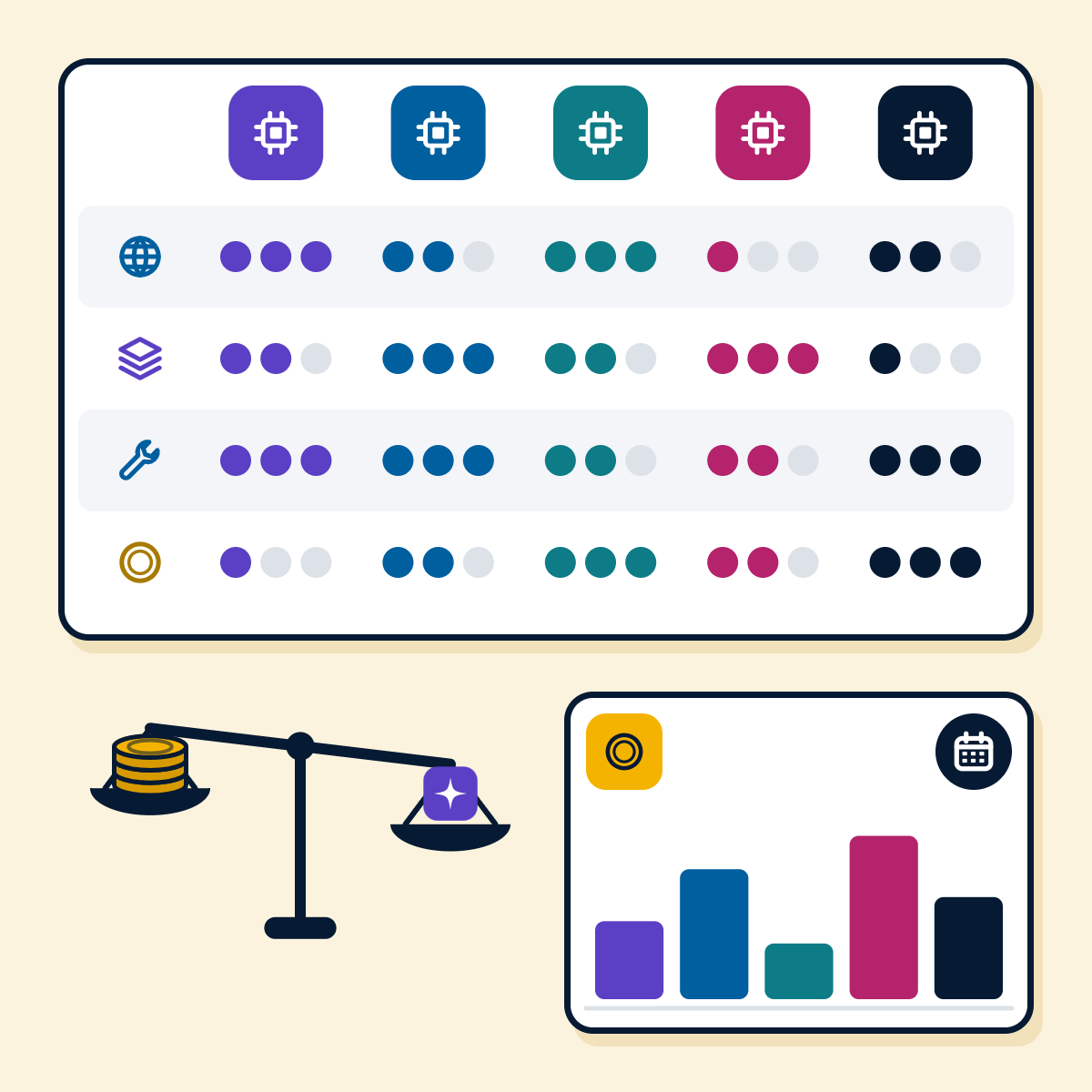
Choosing an LLM in 2026: GPT, Claude, Gemini, Llama and Mistral compared for business use
GPT, Claude, Gemini, Llama and Mistral compared on what decides a business project: price per million tokens, context, tool use,…
-
 16 Nov 2026
Chatbot development cost in 2026: a breakdown by type and channel
What drives the build and run cost of a chatbot by type and channel, with model prices and WhatsApp pricing…
Generative AI and LLM integration brochure
We add large language models from OpenAI, Anthropic and others to your software, connect them to your documents with retrieval-augmented generation, and test quality, cost and response time before anything reaches users.
Inside this brochure
- Turning language models into working features
- Our generative AI development services
- How a generative AI project runs
- Technologies and solutions
- 2.5 MB
- 10 pages
- AI and automation
You have downloaded from us before, so this one needs no form.
Get the brochure
Tell us who you are and the download starts straight away. We remember you on this device for 90 days, so you only fill this in once.
Your download has started.
If it does not start, download the brochure here. The links work for 15 minutes.
- Your reference
- Brochure
What you can do next
- Read it and share itShare the brochure with your team before you get in touch. It is free to read and share.
- Get a quote when you are readySix short questions on our request a quote page, and a reply within one business day.
Start your Generative AI and LLM integration project
Tell us what you are planning and a specialist will reply with next steps, a rough timeline and the questions we need answered.
- Emailsales@acmasoft.com
- Call+1 (707) 706 4092
- Prefer a call?
Thank you, your message is on its way.
It has reached our sales team, together with the page you sent it from.
- Your reference
- Budget
While we prepare your reply, here is the Generative AI and LLM integration brochure.
Download the brochure, Generative AI and LLM integration brochure, PDF, 2.5 MBWhat happens next
- A specialist gets in touchWithin one business day, by email or phone, with any questions about what you need.
- We talk it throughA short call about your goals, users, timeline and budget. We can sign an NDA first.
- You get a proposalScope, team, timeline and cost, with the engagement model that fits the work.