

AI SaaS development services for building and running AI software products
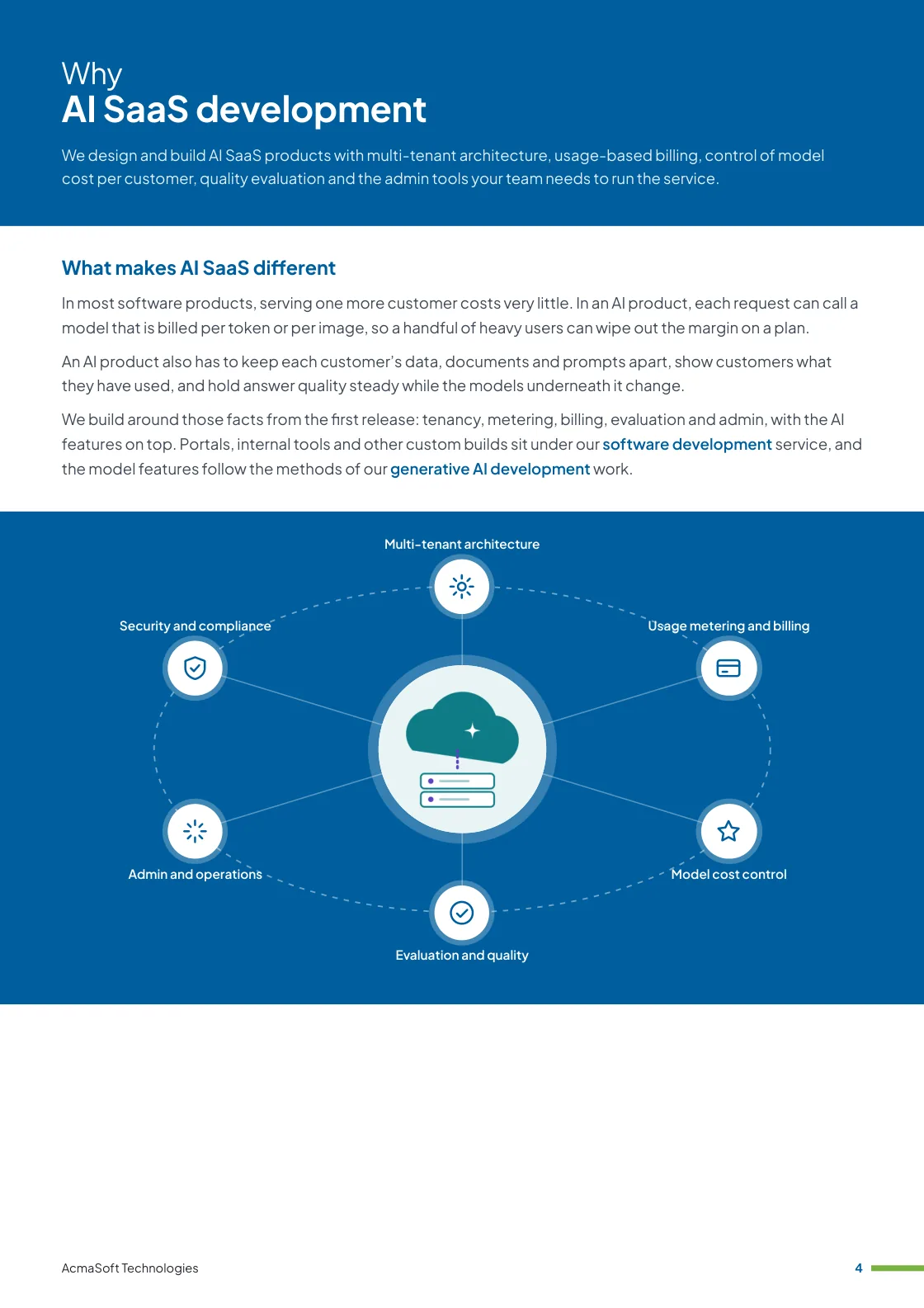
At AcmaSoft, we design and build AI SaaS products with multi-tenant architecture, usage-based billing, control of model cost per customer, quality evaluation and the admin tools your team needs to run the service.
- Years of experience
- 17+
- Clients served
- 650+
- Projects delivered
- 2,000+
- Products shipped
- 300+
What makes AI SaaS different
In most software products, serving one more customer costs very little. In an AI product, each request can call a model that is billed per token or per image, so a handful of heavy users can wipe out the margin on a plan.
An AI product also has to keep each customer’s data, documents and prompts apart, show customers what they have used, and hold answer quality steady while the models underneath it change.
We build around those facts from the first release: tenancy, metering, billing, evaluation and admin, with the AI features on top. Portals, internal tools and other custom builds sit under our software development service, and the model features follow the methods of our generative AI development work.
What you get with AI SaaS development
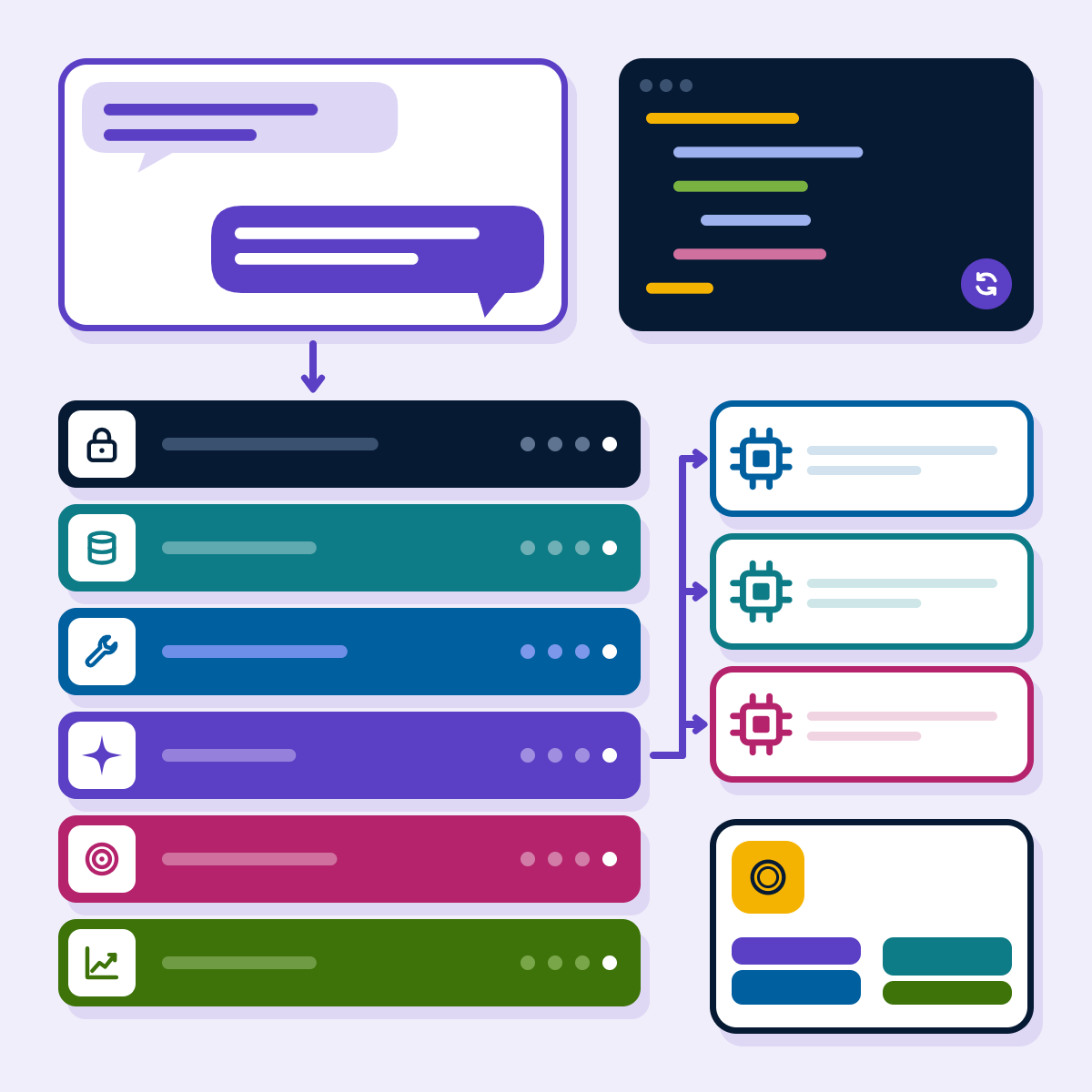
- Multi-tenant architecture
- Usage metering and billing
- Model cost control
- Evaluation and quality
- Admin and operations
- One named lead from first call to launch
- Support and improvements after launch
More in AI and automation
What we build for AI SaaS products
Six parts of an AI product that decide whether it can grow without losing money or trust.
-
Multi-tenant architecture
Each customer kept apart
We design how tenants are separated in the database, file storage, vector indexes and caches, so one customer’s data cannot appear in another customer’s answers.
Shared or dedicated resources can be set per plan, so enterprise customers can have their own environment when they need it.
-
Usage metering and billing
Charging for what is used
We meter usage per tenant and per user, in units your customers understand such as documents, credits or requests, and connect it to Stripe, Razorpay or Chargebee for plans, overages and invoices.
Customers see their usage and limits inside the product before the invoice arrives.
-
Model cost control
Protecting the margin
We track the cost of every request by tenant and feature, route simple tasks to smaller models, cache repeated work and enforce limits by plan.
A margin dashboard shows which customers and features cost more to serve than they bring in.
-
Evaluation and quality
Knowing the product still works
We build test sets for each AI feature and score results automatically on every release and every model change, with human review for cases rules cannot judge.
When a provider updates a model, you see the effect on quality before your customers do.
-
Admin and operations
Running the service
Internal admin screens for tenants, plans, feature flags, usage, support access and audit logs, plus customer settings for teams, roles and single sign-on.
Support staff can investigate a customer’s issue without reading data they should not see.
-
Security and compliance
Ready for business buyers
Encryption, role-based access, audit trails, data retention controls and data processing terms with every model provider you use.
We prepare the documentation business customers ask for and help you get ready for audits such as SOC 2 or ISO 27001, which independent auditors carry out.
What to look for in an AI SaaS development partner
An AI product is a business as well as software. A partner worth hiring brings:
-
Product and SaaS experience
Familiarity with subscriptions, trials, onboarding, tenancy and the unglamorous parts that keep a service running.
-
Attention to unit economics
A habit of estimating the cost of serving each customer before features are built, not after the first large bill.
-
A plan for model change
An architecture that lets you switch or upgrade models without rewriting the product, backed by tests that show what changed.
Ways to work with us
Choose the model that fits your scope and budget for AI SaaS development. Many clients start with one and move to another as the work grows.
-
Fixed price
A defined scope delivered for an agreed price and timeline, in milestones you approve.
- Best for
- Clear requirements, a fixed budget and a firm deadline.
- How it is priced
- One agreed price, paid in instalments tied to milestones.
-
Dedicated team
A team with a project lead that works only on your product, on the priorities you set.
- Best for
- Long-term products and roadmaps that change often.
- How it is priced
- A monthly fee per team member, based on role and seniority.
-
Time and material
You pay for the hours worked and can change the scope as you learn, in short iterations.
- Best for
- Requirements that are hard to fix up front, and ongoing improvements.
- How it is priced
- Hourly or daily rates by role, invoiced monthly against logged time.
Need AI and LLM developers to join your own team instead?
Hire AI and LLM developersWhat our clients say
More client reviews-
AcmaSoft's agile development methods are a game-changer. The iterative approach allowed us to witness progress at every stage, ensuring our project's success.
Daniel K Chicago -
The adaptive nature of AcmaSoft's agile development is commendable. Changes are seamlessly incorporated, ensuring our project stays on track and meets our evolving needs.
Mei Ling Singapore
Industries our AI and automation team works in
Our AI and automation team builds for businesses in these industries, and we adapt AI SaaS development to each one's rules, systems and customers.

Working with international clients
Our team delivers remotely, so the questions that matter are when we can talk and how the work is run. Here are our office hours beside yours.
Our office hours Monday to Saturday, 9:30 am to 6:30 pm India time (IST)
Evening hours for North American clients, by arrangement: Monday to Friday, 6:30 pm to 9:30 pm India time
| Your region | Our hours in your time | Shared working hours |
|---|---|---|
| UKLondon | 4 am to 1 pm | 9 am to 1 pm |
| Central EuropeParis, Berlin | 5 am to 2 pm | 9 am to 2 pm |
| US EastNew York, Toronto | 11 pm to 8 am (next day) Evening hours to 11 am | 9 am to 11 am In our evening hours, by arrangement |
| US WestLos Angeles, Vancouver | 8 pm to 5 am (next day) Evening hours to 8 am | No overlap Early calls 7 am to 8 am, by arrangement |
| GulfDubai, Abu Dhabi | 8 am to 5 pm | 9 am to 5 pm |
| Singapore | 12 noon to 9 pm | 12 noon to 6 pm |
| Australia EastSydney, Melbourne | 3 pm to 12 midnight | 3 pm to 6 pm |
Our day ends before yours starts, so updates are waiting each morning and we agree call times with you.
Times follow daylight saving where your region uses it, against a working day of 9 am to 6 pm. Messages sent outside our hours are picked up when the team is back.
-
Remote delivery
Discovery, design, development and testing run remotely, with one named lead, a demo of working features at the end of each sprint and a staging site you can try.
-
How we stay in touch
Email, video calls and chat such as Slack, Microsoft Teams or WhatsApp, with the hours of overlap and meeting times agreed in the communication plan at the start.
-
Contracts and invoices
Proposals, contracts and invoices are in English and priced in US dollars, or in your own currency on request. A non-disclosure agreement can be signed before you share any details.
-
Privacy laws we design for
We design forms, consent and data handling with the law of your market in mind: GDPR and UK GDPR, CCPA and CPRA, PIPEDA, the UAE PDPL, the Australian Privacy Act, Singapore's PDPA and India's DPDP Act.
Questions about AI SaaS development
Something else on your mind? Ask us directly and a specialist will reply.
Ask a questionHow do you stop model costs from eating into our margin?
We measure the cost of every request by customer and feature, use the smallest model that meets the quality bar, cache repeated work, set limits per plan and price heavy usage as credits or overages. A margin report shows which customers or features need attention.
How is one customer's data kept separate from another's?
Every query, file, vector index and cache entry is tied to a tenant, and access checks run on the server for every request. We test isolation directly, including attempts to reach another tenant's data through prompts.
Can you build usage-based or credit pricing?
Yes. We meter the units you choose, such as requests, documents or minutes, show usage in the product and connect it to a billing platform such as Stripe, Razorpay or Chargebee for plans, top-ups and invoices.
What happens when a model provider changes or retires a model?
The model layer is separate from the rest of the product, so a model can be swapped through configuration. Before switching, we run the evaluation set on the new model and compare quality, speed and cost.
Can you take over an AI product that is already live?
Yes. We start by reviewing the code, infrastructure, running costs and output quality, fix the most serious risks first and then continue development under an agreed plan.
Related insights
All insights-
 16 Nov 2026
How to build an LLM application: architecture, stack and costs in 2026
A vendor-neutral reference architecture for LLM applications, the stack choices at each layer, a dated comparison of model providers and…
-
 16 Nov 2026
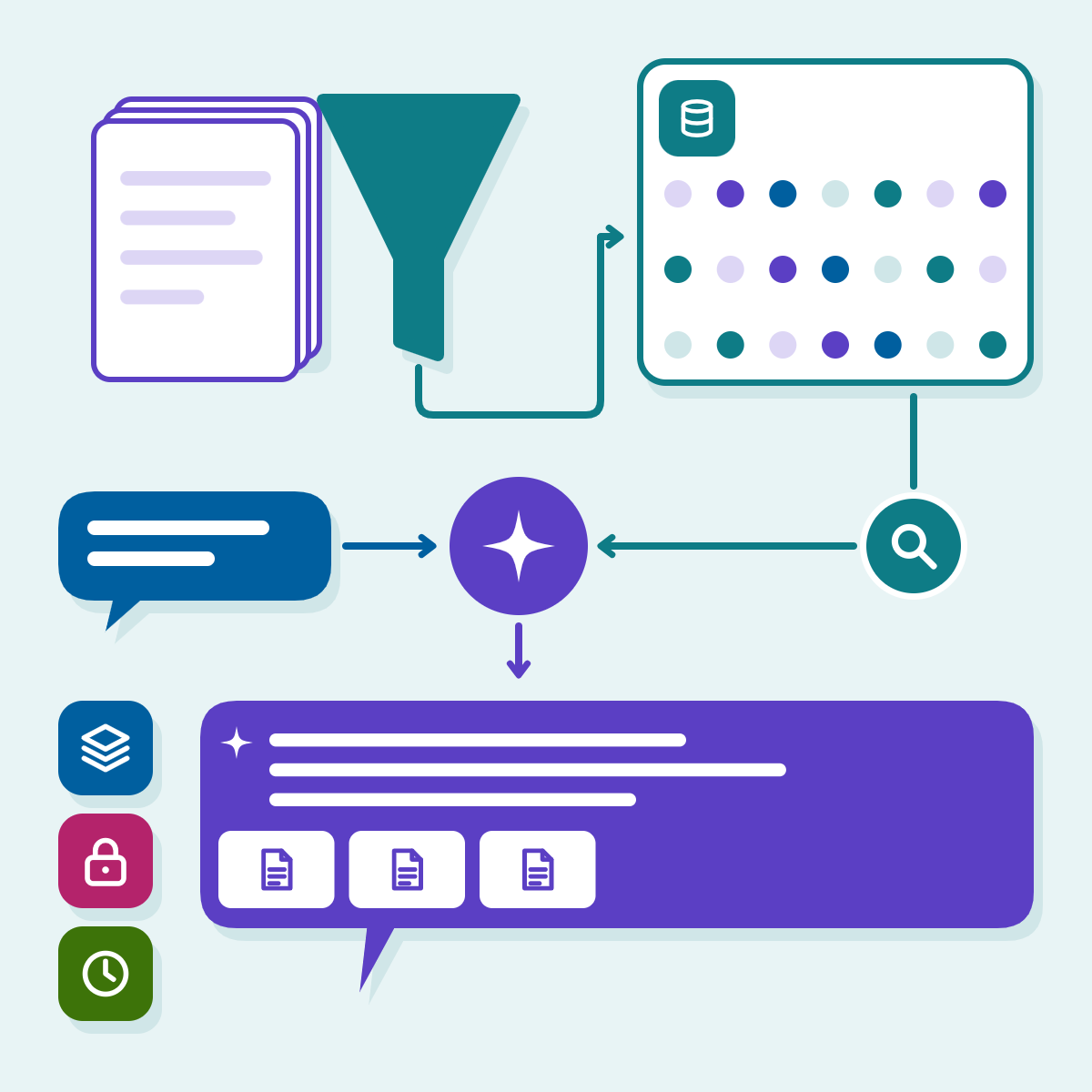
RAG explained: how retrieval-augmented generation works and when a business needs it
A plain walk-through of retrieval-augmented generation, a minimal pgvector query, the decisions that decide quality (chunking, permissions, freshness, evaluation) and…
-
 16 Nov 2026
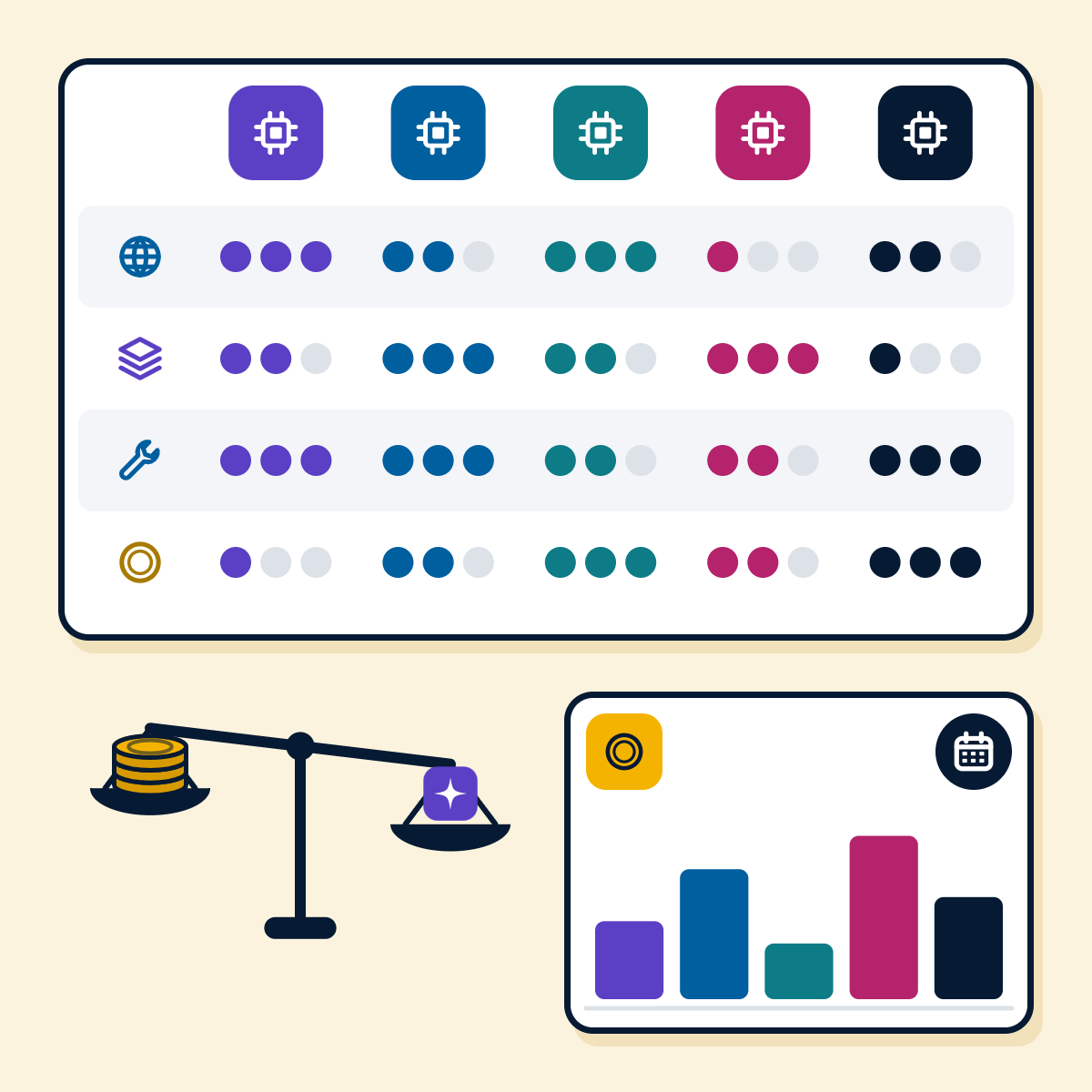
Choosing an LLM in 2026: GPT, Claude, Gemini, Llama and Mistral compared for business use
GPT, Claude, Gemini, Llama and Mistral compared on what decides a business project: price per million tokens, context, tool use,…
AI SaaS development brochure
We design and build AI SaaS products with multi-tenant architecture, usage-based billing, control of model cost per customer, quality evaluation and the admin tools your team needs to run the service.
Inside this brochure
- What makes AI SaaS different
- What we build for AI SaaS products
- How an AI SaaS project runs
- What to look for in an AI SaaS development partner
- 2.5 MB
- 10 pages
- AI and automation
You have downloaded from us before, so this one needs no form.
Get the brochure
Tell us who you are and the download starts straight away. We remember you on this device for 90 days, so you only fill this in once.
Your download has started.
If it does not start, download the brochure here. The links work for 15 minutes.
- Your reference
- Brochure
What you can do next
- Read it and share itShare the brochure with your team before you get in touch. It is free to read and share.
- Get a quote when you are readySix short questions on our request a quote page, and a reply within one business day.
Start your AI SaaS development project
Tell us what you are planning and a specialist will reply with next steps, a rough timeline and the questions we need answered.
- Emailsales@acmasoft.com
- Call+1 (707) 706 4092
- Prefer a call?
Thank you, your message is on its way.
It has reached our sales team, together with the page you sent it from.
- Your reference
- Budget
While we prepare your reply, here is the AI SaaS development brochure.
Download the brochure, AI SaaS development brochure, PDF, 2.5 MBWhat happens next
- A specialist gets in touchWithin one business day, by email or phone, with any questions about what you need.
- We talk it throughA short call about your goals, users, timeline and budget. We can sign an NDA first.
- You get a proposalScope, team, timeline and cost, with the engagement model that fits the work.