

DevOps and CI/CD services for faster, safer software releases
At AcmaSoft, we set up CI/CD pipelines, infrastructure as code, containers, monitoring and release automation, so your team can ship small changes often, spot problems early and roll back without drama.
- Years of experience
- 17+
- Clients served
- 650+
- Projects delivered
- 2,000+
- Products shipped
- 300+
Why releases get slow and risky
In many teams a release still means someone copying files to a server, running database changes by hand and hoping nothing was missed. Servers collect years of small tweaks that nobody wrote down, so building a new environment takes days and no two environments match.
DevOps practice replaces that with code and automation. Every change is built and tested the same way, infrastructure is described in files kept in version control, and monitoring reports a problem before your customers do. Releases become small and routine instead of large and tense.
This service is a project: we design and build the pipelines, infrastructure and monitoring, document them and hand them over, or keep running them under a support agreement. To add an engineer to your own team instead, see hire DevOps engineers. Moving workloads from your own servers to a cloud provider is covered by cloud migration services.
What you get with DevOps and CI/CD services
- CI/CD pipelines
- Infrastructure as code
- Containers and orchestration
- Monitoring and alerting
- Release automation
- One named lead from first call to launch
- Support and improvements after launch
More in Software and app development
Our DevOps and CI/CD services
Six areas we set up or improve, starting with whichever slows your team down most.
-
CI/CD pipelines
Every change built and tested
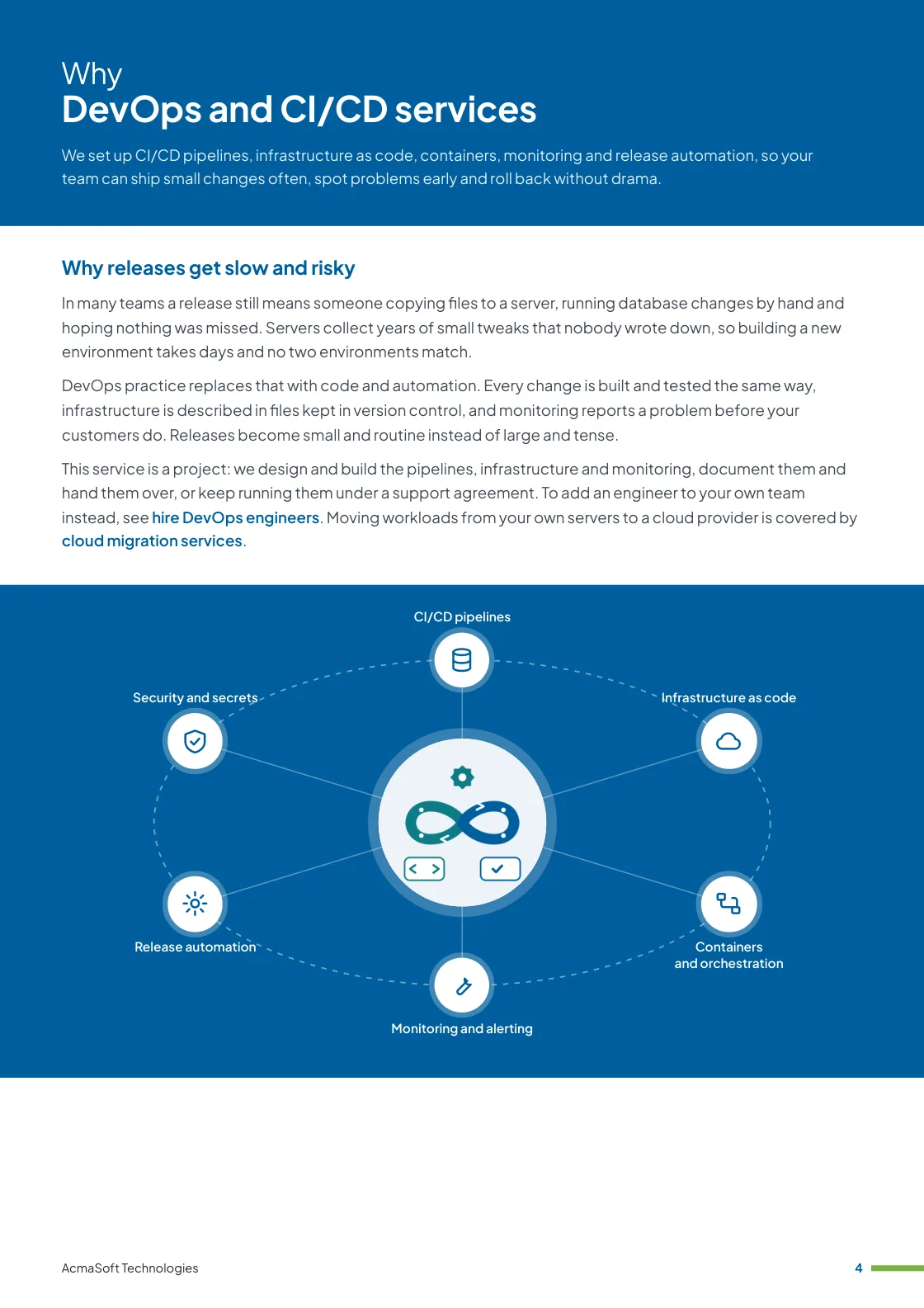
We build pipelines in tools such as GitHub Actions, GitLab CI, Bitbucket Pipelines or Jenkins that compile, test, scan and package each change, then deploy it to staging and, after approval, to production.
Failed tests stop a release before it reaches users, and every deployment can be traced to a commit and the person who approved it.
-
Infrastructure as code
Environments you can rebuild
Servers, networks, databases and permissions are defined in code with tools such as Terraform, OpenTofu or AWS CloudFormation, with Ansible for server configuration where it is still needed.
Infrastructure changes go through review like application code, and a staging or recovery environment is built from the same files as production.
-
Containers and orchestration
The same build everywhere
We package applications with Docker so they behave the same on a laptop, in testing and in production, and run them on managed services such as Amazon ECS, Google Cloud Run or Kubernetes when the workload justifies it.
For a handful of services Kubernetes is often more than you need, and we will say so.
-
Monitoring and alerting
Problems found before customers find them
Metrics, logs, uptime checks and error tracking with tools such as Prometheus and Grafana, your cloud provider’s own monitoring or Sentry, gathered in dashboards your team will actually open.
Alerts go to a named person only for problems that need action, and alerts nobody acts on are removed.
-
Release automation
Small, reversible releases
Database migrations, configuration and feature flags become part of the release, with blue-green or rolling deployments where your hosting supports them and a tested way to roll back.
Version tags and release notes come out of the pipeline rather than being written by hand afterwards.
-
Security and secrets
Safe defaults from the start
Passwords and keys move out of code into a secrets manager, pipelines scan dependencies and container images for known vulnerabilities, and access follows least privilege with an audit trail.
Backups run automatically and are restored on a schedule, because a backup nobody has tested is not a recovery plan.
What to look for in a DevOps services company
Tools are the easy part to buy. Before you choose a provider, check for:
-
Right-sized tooling
A setup that matches the size of your team and product, rather than the most complex stack on the market.
-
Documentation and handover
Runbooks, diagrams and training, so your own developers can run and change the pipelines without depending on the provider.
-
Attention to running cost
Awareness of what each environment, log store and build minute costs, with idle resources switched off.
Ways to work with us
Choose the model that fits your scope and budget for DevOps and CI/CD services. Many clients start with one and move to another as the work grows.
-
Fixed price
A defined scope delivered for an agreed price and timeline, in milestones you approve.
- Best for
- Clear requirements, a fixed budget and a firm deadline.
- How it is priced
- One agreed price, paid in instalments tied to milestones.
-
Dedicated team
A team with a project lead that works only on your product, on the priorities you set.
- Best for
- Long-term products and roadmaps that change often.
- How it is priced
- A monthly fee per team member, based on role and seniority.
-
Time and material
You pay for the hours worked and can change the scope as you learn, in short iterations.
- Best for
- Requirements that are hard to fix up front, and ongoing improvements.
- How it is priced
- Hourly or daily rates by role, invoiced monthly against logged time.
Need DevOps engineers to join your own team instead?
Hire DevOps engineersWhat our clients say
More client reviews-
Kudos to AcmaSoft's support team! Their responsiveness and expertise have been instrumental in resolving our queries promptly. Truly an excellent team.
James R Chicago -
The collaborative spirit within AcmaSoft's team is exceptional. Their collective expertise ensures that our hosting and support needs are consistently met with precision.
Isabella K Berlin
Industries our software and app development team works in
Our software and app development team builds for businesses in these industries, and we adapt DevOps and CI/CD services to each one's rules, systems and customers.


Technologies we use
We choose the stack for your budget, goals and current systems. Each link explains how we work with that technology or product.
Cloud and DevOps
Not sure which technology fits your project? Ask one of our architects.
Talk to an architectWorking with international clients
Our team delivers remotely, so the questions that matter are when we can talk and how the work is run. Here are our office hours beside yours.
Our office hours Monday to Saturday, 9:30 am to 6:30 pm India time (IST)
Evening hours for North American clients, by arrangement: Monday to Friday, 6:30 pm to 9:30 pm India time
| Your region | Our hours in your time | Shared working hours |
|---|---|---|
| UKLondon | 4 am to 1 pm | 9 am to 1 pm |
| Central EuropeParis, Berlin | 5 am to 2 pm | 9 am to 2 pm |
| US EastNew York, Toronto | 11 pm to 8 am (next day) Evening hours to 11 am | 9 am to 11 am In our evening hours, by arrangement |
| US WestLos Angeles, Vancouver | 8 pm to 5 am (next day) Evening hours to 8 am | No overlap Early calls 7 am to 8 am, by arrangement |
| GulfDubai, Abu Dhabi | 8 am to 5 pm | 9 am to 5 pm |
| Singapore | 12 noon to 9 pm | 12 noon to 6 pm |
| Australia EastSydney, Melbourne | 3 pm to 12 midnight | 3 pm to 6 pm |
Our day ends before yours starts, so updates are waiting each morning and we agree call times with you.
Times follow daylight saving where your region uses it, against a working day of 9 am to 6 pm. Messages sent outside our hours are picked up when the team is back.
-
Remote delivery
Discovery, design, development and testing run remotely, with one named lead, a demo of working features at the end of each sprint and a staging site you can try.
-
How we stay in touch
Email, video calls and chat such as Slack, Microsoft Teams or WhatsApp, with the hours of overlap and meeting times agreed in the communication plan at the start.
-
Contracts and invoices
Proposals, contracts and invoices are in English and priced in US dollars, or in your own currency on request. A non-disclosure agreement can be signed before you share any details.
-
Privacy laws we design for
We design forms, consent and data handling with the law of your market in mind: GDPR and UK GDPR, CCPA and CPRA, PIPEDA, the UAE PDPL, the Australian Privacy Act, Singapore's PDPA and India's DPDP Act.
Questions about DevOps and CI/CD services
Something else on your mind? Ask us directly and a specialist will reply.
Ask a questionHow do DevOps services differ from hiring a DevOps engineer?
DevOps services are a defined project, such as building your pipelines and monitoring, delivered with documentation and a handover. Hiring a DevOps engineer adds a person to your team who works under your direction on whatever comes up. The two can be combined.
Which CI/CD tools do you use?
Usually the one that sits next to your code, such as GitHub Actions, GitLab CI or Bitbucket Pipelines, or Jenkins and Azure DevOps where they are already in place. Changing tools is only worth it when the current one is holding you back.
Do we need Kubernetes?
Often not. A few services run well on a managed container service such as Google Cloud Run or Amazon ECS, or on virtual machines with good automation. Kubernetes earns its complexity when you run many services, need fine control over scaling or already have people who know it.
Can you work with our own servers rather than the cloud?
Yes. Pipelines, configuration management and monitoring work just as well on your own servers or with a hosting provider. Moving to a cloud platform is a separate decision, covered by our cloud migration service.
Will we depend on you to keep things running?
No. Everything is defined in code in your own repositories and accounts, with runbooks and diagrams. We train your developers to run releases, rollbacks and restores so they can carry on without us.
DevOps and CI/CD services brochure
We set up CI/CD pipelines, infrastructure as code, containers, monitoring and release automation, so your team can ship small changes often, spot problems early and roll back without drama.
Inside this brochure
- Why releases get slow and risky
- Our DevOps and CI/CD services
- How a DevOps project runs
- Technologies and solutions
- 2.8 MB
- 10 pages
- Services
You have downloaded from us before, so this one needs no form.
Get the brochure
Tell us who you are and the download starts straight away. We remember you on this device for 90 days, so you only fill this in once.
Your download has started.
If it does not start, download the brochure here. The links work for 15 minutes.
- Your reference
- Brochure
What you can do next
- Read it and share itShare the brochure with your team before you get in touch. It is free to read and share.
- Get a quote when you are readySix short questions on our request a quote page, and a reply within one business day.
Start your DevOps and CI/CD services project
Tell us what you are planning and a specialist will reply with next steps, a rough timeline and the questions we need answered.
- Emailsales@acmasoft.com
- Call+1 (707) 706 4092
- Prefer a call?
Thank you, your message is on its way.
It has reached our sales team, together with the page you sent it from.
- Your reference
- Budget
While we prepare your reply, here is the DevOps and CI/CD services brochure.
Download the brochure, DevOps and CI/CD services brochure, PDF, 2.8 MBWhat happens next
- A specialist gets in touchWithin one business day, by email or phone, with any questions about what you need.
- We talk it throughA short call about your goals, users, timeline and budget. We can sign an NDA first.
- You get a proposalScope, team, timeline and cost, with the engagement model that fits the work.