

QA and software testing services for web and mobile applications
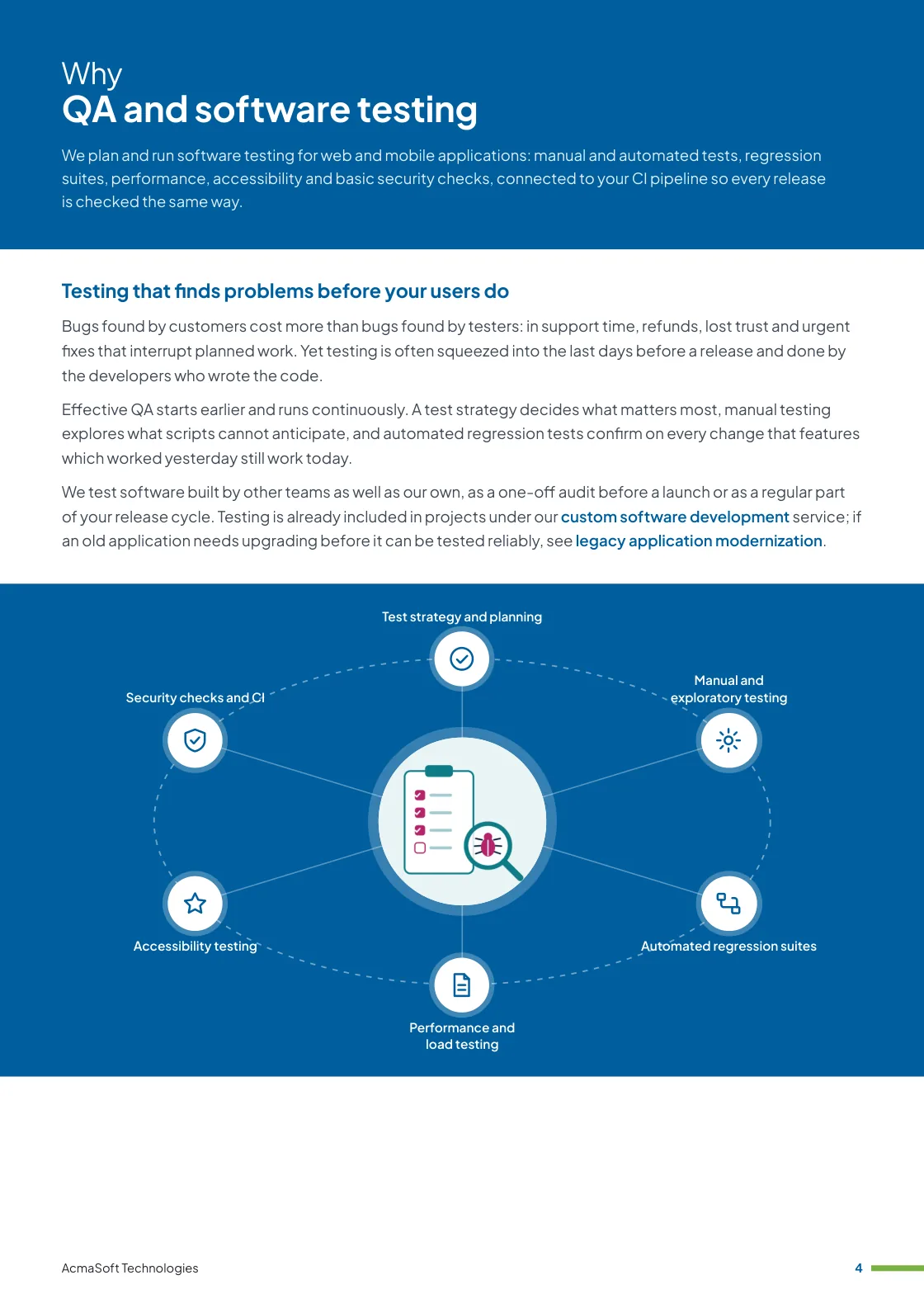
At AcmaSoft, we plan and run software testing for web and mobile applications: manual and automated tests, regression suites, performance, accessibility and basic security checks, connected to your CI pipeline so every release is checked the same way.
- Years of experience
- 17+
- Clients served
- 650+
- Projects delivered
- 2,000+
- Products shipped
- 300+
Testing that finds problems before your users do
Bugs found by customers cost more than bugs found by testers: in support time, refunds, lost trust and urgent fixes that interrupt planned work. Yet testing is often squeezed into the last days before a release and done by the developers who wrote the code.
Effective QA starts earlier and runs continuously. A test strategy decides what matters most, manual testing explores what scripts cannot anticipate, and automated regression tests confirm on every change that features which worked yesterday still work today.
We test software built by other teams as well as our own, as a one-off audit before a launch or as a regular part of your release cycle. Testing is already included in projects under our custom software development service; if an old application needs upgrading before it can be tested reliably, see legacy application modernization.
What you get with QA and software testing
- Test strategy and planning
- Manual and exploratory testing
- Automated regression suites
- Performance and load testing
- Accessibility testing
- One named lead from first call to launch
- Support and improvements after launch
More in Software and app development
Our QA and software testing services
Six kinds of testing, combined into a plan that fits your product and release pace.
-
Test strategy and planning
Deciding what to test and how
We identify the features and user journeys where a failure would cost most, choose the mix of manual and automated testing, and define test environments, data and exit criteria for each release.
The strategy is a short working document, not a binder nobody reads.
-
Manual and exploratory testing
A person trying to break it
Structured test cases for critical flows, plus exploratory sessions in which testers vary inputs, devices and the order of steps the way real users do.
Bugs are reported with steps to reproduce, screenshots or recordings, and the device and browser used.
-
Automated regression suites
Checking old features on every change
Browser tests with tools such as Playwright, Cypress or Selenium, mobile tests with Appium, and API tests that run in minutes instead of days of manual checking.
We automate stable, high-value flows first and keep the suite fast and free of flaky tests, which otherwise teach a team to ignore failures.
-
Performance and load testing
How it behaves under pressure
Load tests with tools such as k6 or JMeter that simulate expected and peak traffic, measure response times and show where the database, server or third-party calls slow down.
We also check page speed on mid-range phones and slower networks, which is how many users experience a site.
-
Accessibility testing
Usable by everyone
Automated checks with tools such as axe, followed by manual testing with the keyboard alone and with screen readers such as NVDA and VoiceOver, against WCAG 2.2 success criteria.
You get a list of issues by severity with the fix for each, and a retest once fixes are made.
-
Security checks and CI
Common flaws caught early
Checks for common weaknesses from the OWASP Top 10, dependency scanning and automated scans with tools such as OWASP ZAP, all running in your CI pipeline on GitHub Actions, GitLab CI or similar.
This catches common flaws early but does not replace a penetration test by a specialist firm, which we recommend for applications that handle payments or sensitive data.
What to look for in a software testing company
A report full of passed test cases says little on its own. A useful QA partner gives you:
-
Risk-based priorities
Effort focused on the journeys that earn money or carry risk, not spread evenly across every screen.
-
Clear, reproducible bug reports
Reports a developer can act on without a follow-up call, with severity levels agreed in advance.
-
Automation that lasts
Test code written and reviewed like product code, kept in your repository and maintainable by your own team.
Ways to work with us
Choose the model that fits your scope and budget for QA and software testing. Many clients start with one and move to another as the work grows.
-
Fixed price
A defined scope delivered for an agreed price and timeline, in milestones you approve.
- Best for
- Clear requirements, a fixed budget and a firm deadline.
- How it is priced
- One agreed price, paid in instalments tied to milestones.
-
Dedicated team
A team with a project lead that works only on your product, on the priorities you set.
- Best for
- Long-term products and roadmaps that change often.
- How it is priced
- A monthly fee per team member, based on role and seniority.
-
Time and material
You pay for the hours worked and can change the scope as you learn, in short iterations.
- Best for
- Requirements that are hard to fix up front, and ongoing improvements.
- How it is priced
- Hourly or daily rates by role, invoiced monthly against logged time.
Need developers, designers or marketers to join your own team instead?
See the roles you can hireWhat our clients say
More client reviews-
AcmaSoft's agile development methods are a game-changer. The iterative approach allowed us to witness progress at every stage, ensuring our project's success.
Daniel K Chicago -
The adaptive nature of AcmaSoft's agile development is commendable. Changes are seamlessly incorporated, ensuring our project stays on track and meets our evolving needs.
Mei Ling Singapore
Industries our software and app development team works in
Our software and app development team builds for businesses in these industries, and we adapt QA and software testing to each one's rules, systems and customers.


Working with international clients
Our team delivers remotely, so the questions that matter are when we can talk and how the work is run. Here are our office hours beside yours.
Our office hours Monday to Saturday, 9:30 am to 6:30 pm India time (IST)
Evening hours for North American clients, by arrangement: Monday to Friday, 6:30 pm to 9:30 pm India time
| Your region | Our hours in your time | Shared working hours |
|---|---|---|
| UKLondon | 4 am to 1 pm | 9 am to 1 pm |
| Central EuropeParis, Berlin | 5 am to 2 pm | 9 am to 2 pm |
| US EastNew York, Toronto | 11 pm to 8 am (next day) Evening hours to 11 am | 9 am to 11 am In our evening hours, by arrangement |
| US WestLos Angeles, Vancouver | 8 pm to 5 am (next day) Evening hours to 8 am | No overlap Early calls 7 am to 8 am, by arrangement |
| GulfDubai, Abu Dhabi | 8 am to 5 pm | 9 am to 5 pm |
| Singapore | 12 noon to 9 pm | 12 noon to 6 pm |
| Australia EastSydney, Melbourne | 3 pm to 12 midnight | 3 pm to 6 pm |
Our day ends before yours starts, so updates are waiting each morning and we agree call times with you.
Times follow daylight saving where your region uses it, against a working day of 9 am to 6 pm. Messages sent outside our hours are picked up when the team is back.
-
Remote delivery
Discovery, design, development and testing run remotely, with one named lead, a demo of working features at the end of each sprint and a staging site you can try.
-
How we stay in touch
Email, video calls and chat such as Slack, Microsoft Teams or WhatsApp, with the hours of overlap and meeting times agreed in the communication plan at the start.
-
Contracts and invoices
Proposals, contracts and invoices are in English and priced in US dollars, or in your own currency on request. A non-disclosure agreement can be signed before you share any details.
-
Privacy laws we design for
We design forms, consent and data handling with the law of your market in mind: GDPR and UK GDPR, CCPA and CPRA, PIPEDA, the UAE PDPL, the Australian Privacy Act, Singapore's PDPA and India's DPDP Act.
Questions about QA and software testing
Something else on your mind? Ask us directly and a specialist will reply.
Ask a questionShould we automate all of our tests?
No. Automation pays off for stable flows checked on every release, such as sign-in, checkout or key calculations. New features, visual layout and ease of use still benefit from a person testing them, so most products need both.
Can you test an application another company built?
Yes. We need a test environment, test accounts and whatever documentation exists. We start by exploring the application and agreeing priorities with you.
Which test automation tools do you use?
We choose per project, commonly Playwright or Cypress for web applications, Appium for mobile apps and code-based API tests, written in the same language as your product where that helps your developers maintain them.
Do you provide penetration testing?
We run basic security checks: reviews against the OWASP Top 10, dependency scans and automated scanning. A full penetration test should come from a specialist security firm, and we can work with the firm you choose and fix what it finds.
Do you test accessibility against WCAG?
Yes. We test against WCAG 2.2 level AA with automated tools and manual checks using the keyboard and screen readers, and report each issue with the success criterion it fails and how to fix it.

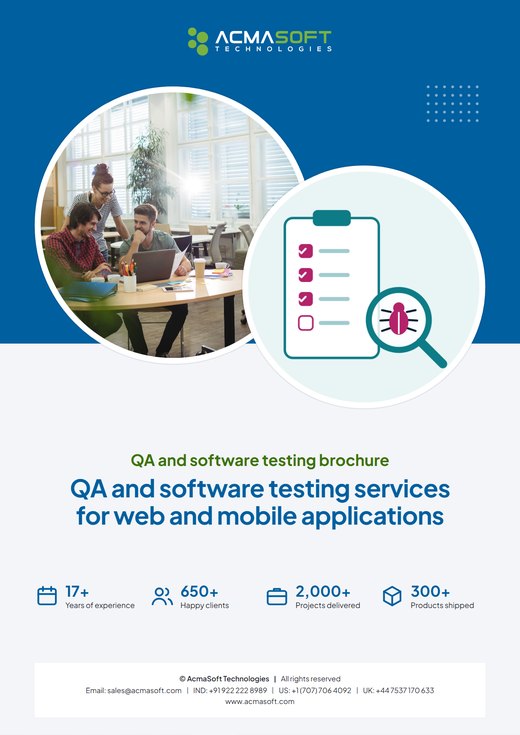
QA and software testing brochure
We plan and run software testing for web and mobile applications: manual and automated tests, regression suites, performance, accessibility and basic security checks, connected to your CI pipeline so every release is checked the same way.
Inside this brochure
- Testing that finds problems before your users do
- Our QA and software testing services
- How a QA and testing project runs
- What to look for in a software testing company
- 2.7 MB
- 10 pages
- Services
You have downloaded from us before, so this one needs no form.
Get the brochure
Tell us who you are and the download starts straight away. We remember you on this device for 90 days, so you only fill this in once.
Your download has started.
If it does not start, download the brochure here. The links work for 15 minutes.
- Your reference
- Brochure
What you can do next
- Read it and share itShare the brochure with your team before you get in touch. It is free to read and share.
- Get a quote when you are readySix short questions on our request a quote page, and a reply within one business day.
Start your QA and software testing project
Tell us what you are planning and a specialist will reply with next steps, a rough timeline and the questions we need answered.
- Emailsales@acmasoft.com
- Call+1 (707) 706 4092
- Prefer a call?
Thank you, your message is on its way.
It has reached our sales team, together with the page you sent it from.
- Your reference
- Budget
While we prepare your reply, here is the QA and software testing brochure.
Download the brochure, QA and software testing brochure, PDF, 2.7 MBWhat happens next
- A specialist gets in touchWithin one business day, by email or phone, with any questions about what you need.
- We talk it throughA short call about your goals, users, timeline and budget. We can sign an NDA first.
- You get a proposalScope, team, timeline and cost, with the engagement model that fits the work.