

Legacy application modernization services for upgrading and re-platforming ageing software
At AcmaSoft, we modernize business applications that have fallen behind: PHP 5 and 7 code moved to PHP 8, outdated frameworks upgraded, hosting moved to a supported platform and data migrated safely, with the old and new systems running side by side until the switch is proven.
- Years of experience
- 17+
- Clients served
- 650+
- Projects delivered
- 2,000+
- Products shipped
- 300+
The cost of leaving an old application alone
Many businesses depend on an application written ten or fifteen years ago that still does its job. The risk builds quietly: PHP 5 and 7 no longer receive security fixes, hosting providers retire old versions, libraries stop being updated and fewer developers want to work on the code.
A full rewrite is rarely the answer. Rewrites take longer than planned, lose rules nobody wrote down and freeze improvements while they run. Most applications are better served by a staged path: upgrade what can be upgraded, replace the parts that cause the most trouble and move traffic across one piece at a time.
Modernization changes the foundations; keeping a current system patched and running day to day is covered by our maintenance and support service. When the change reaches beyond software into how teams work, see digital transformation.
Other applications run on platforms whose vendors or communities have moved on. We take these over, keep them running and move them when the time is right: Perl scripts and CGI applications to Python, Zen Cart and VirtueMart stores to WooCommerce, Elgg and SocialEngine communities to a custom community platform, PhoneGap and Cordova apps to Capacitor or React Native, Adobe AIR apps to Flutter, and Sencha Ext JS applications to React.
What you get with legacy application modernization
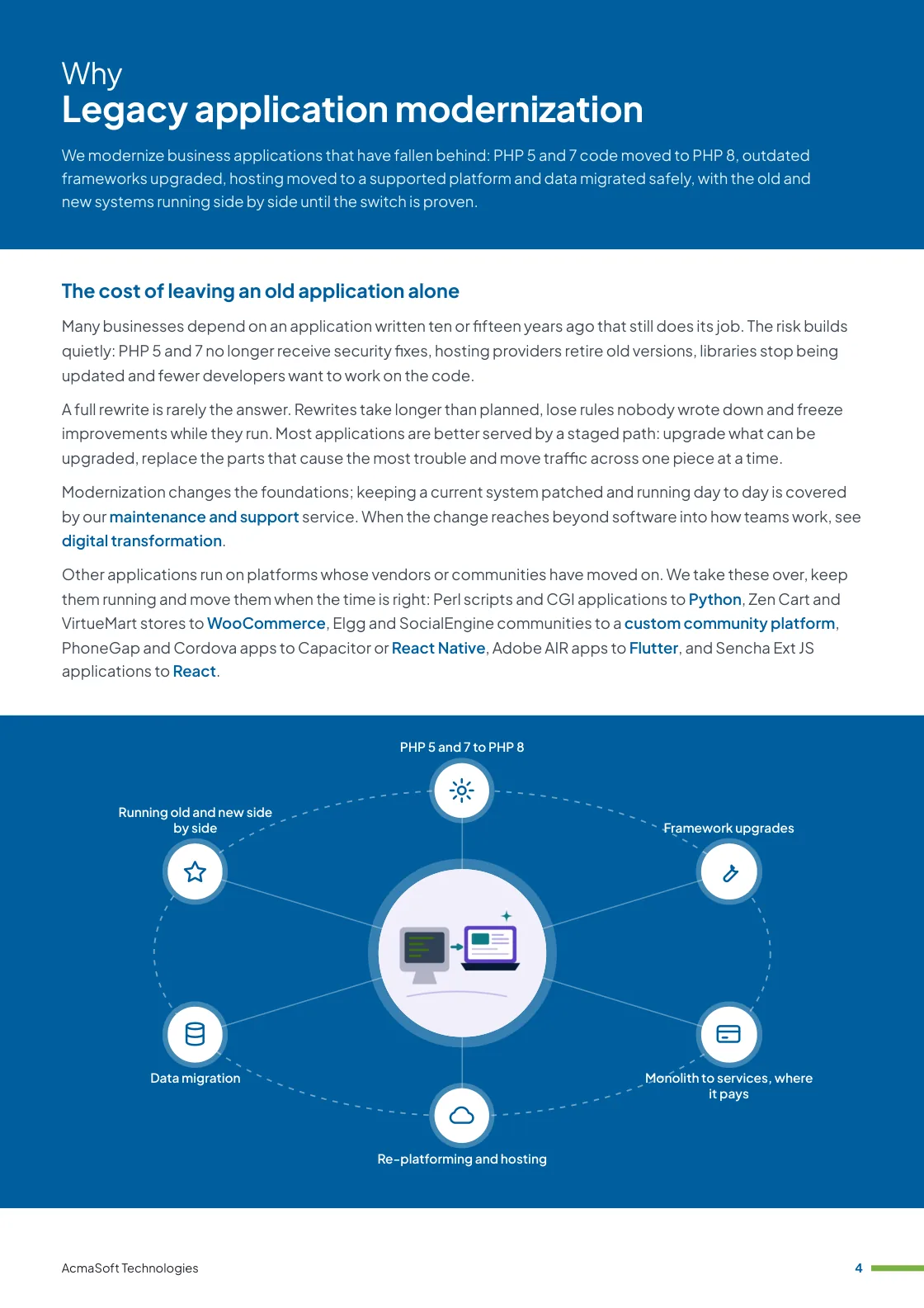
- PHP 5 and 7 to PHP 8
- Framework upgrades
- Monolith to services, where it pays
- Re-platforming and hosting
- Data migration
- One named lead from first call to launch
- Support and improvements after launch
More in Software and app development
Our legacy modernization services
Six routes to a supported, maintainable application, used alone or in combination.
-
PHP 5 and 7 to PHP 8
Back on a supported version
We run static analysis with tools such as PHPStan and Rector to find removed functions, changed behaviour and deprecated syntax, then fix them in small reviewed steps and test each step on PHP 8.
The upgrade also restores access to current library versions and their security fixes.
-
Framework upgrades
Catching up on missed versions
Upgrades across major versions of frameworks such as Laravel, Symfony, CodeIgniter, Angular and React, and migration away from discontinued ones such as AngularJS.
Where many versions were skipped we move one major version at a time, with tests at each stop.
-
Monolith to services, where it pays
Splitting only what benefits
We move a part into its own service when it needs to scale, release or change at a different pace from the rest, such as search, payments or reporting.
For most applications a well-structured monolith remains cheaper to run, and we will say so.
-
Re-platforming and hosting
Off ageing servers
Moving applications from old shared or self-managed servers to supported cloud or managed hosting, with containers such as Docker where they simplify deployment, plus automated builds and backups.
We keep code changes to a minimum during the move, so any problem has one clear cause.
-
Data migration
Moving records without losing them
Schema changes, character set fixes such as latin1 to UTF-8, cleaning of duplicate and orphaned records, and repeatable migration scripts rehearsed on copies of production data.
Row counts, totals and sample records are compared between old and new before anyone signs off.
-
Running old and new side by side
A gradual, reversible switch
Using the strangler pattern, new code takes over one route, screen or module at a time while the old application keeps serving the rest, and traffic moves back if a problem appears.
Users keep working throughout, and each part is retired only when its replacement has proved itself.
What to look for in a legacy modernization partner
Modernizing a system the business depends on calls for caution as much as skill. Look for:
-
Respect for the existing code
A team that reads the old application to understand the rules hidden in it, rather than dismissing it and starting over.
-
Tests before changes
A habit of adding tests around current behaviour first, so every change can be checked against what the system did before.
-
A reversible plan
Releases in small steps with a rollback route for each, and no single weekend on which everything must work.
Ways to work with us
Choose the model that fits your scope and budget for legacy application modernization. Many clients start with one and move to another as the work grows.
-
Fixed price
A defined scope delivered for an agreed price and timeline, in milestones you approve.
- Best for
- Clear requirements, a fixed budget and a firm deadline.
- How it is priced
- One agreed price, paid in instalments tied to milestones.
-
Dedicated team
A team with a project lead that works only on your product, on the priorities you set.
- Best for
- Long-term products and roadmaps that change often.
- How it is priced
- A monthly fee per team member, based on role and seniority.
-
Time and material
You pay for the hours worked and can change the scope as you learn, in short iterations.
- Best for
- Requirements that are hard to fix up front, and ongoing improvements.
- How it is priced
- Hourly or daily rates by role, invoiced monthly against logged time.
Need PHP developers to join your own team instead?
Hire PHP developersWhat our clients say
More client reviews-
Kudos to AcmaSoft for their innovative approach to software development. Their solutions are cutting-edge, providing a significant competitive advantage.
Aisha R Dubai -
AcmaSoft's agile development methods are a game-changer. The iterative approach allowed us to witness progress at every stage, ensuring our project's success.
Daniel K Chicago
Industries our software and app development team works in
Our software and app development team builds for businesses in these industries, and we adapt legacy application modernization to each one's rules, systems and customers.


Technologies we use
We choose the stack for your budget, goals and current systems. Each link explains how we work with that technology or product.
Front end
Not sure which technology fits your project? Ask one of our architects.
Talk to an architectWorking with international clients
Our team delivers remotely, so the questions that matter are when we can talk and how the work is run. Here are our office hours beside yours.
Our office hours Monday to Saturday, 9:30 am to 6:30 pm India time (IST)
Evening hours for North American clients, by arrangement: Monday to Friday, 6:30 pm to 9:30 pm India time
| Your region | Our hours in your time | Shared working hours |
|---|---|---|
| UKLondon | 4 am to 1 pm | 9 am to 1 pm |
| Central EuropeParis, Berlin | 5 am to 2 pm | 9 am to 2 pm |
| US EastNew York, Toronto | 11 pm to 8 am (next day) Evening hours to 11 am | 9 am to 11 am In our evening hours, by arrangement |
| US WestLos Angeles, Vancouver | 8 pm to 5 am (next day) Evening hours to 8 am | No overlap Early calls 7 am to 8 am, by arrangement |
| GulfDubai, Abu Dhabi | 8 am to 5 pm | 9 am to 5 pm |
| Singapore | 12 noon to 9 pm | 12 noon to 6 pm |
| Australia EastSydney, Melbourne | 3 pm to 12 midnight | 3 pm to 6 pm |
Our day ends before yours starts, so updates are waiting each morning and we agree call times with you.
Times follow daylight saving where your region uses it, against a working day of 9 am to 6 pm. Messages sent outside our hours are picked up when the team is back.
-
Remote delivery
Discovery, design, development and testing run remotely, with one named lead, a demo of working features at the end of each sprint and a staging site you can try.
-
How we stay in touch
Email, video calls and chat such as Slack, Microsoft Teams or WhatsApp, with the hours of overlap and meeting times agreed in the communication plan at the start.
-
Contracts and invoices
Proposals, contracts and invoices are in English and priced in US dollars, or in your own currency on request. A non-disclosure agreement can be signed before you share any details.
-
Privacy laws we design for
We design forms, consent and data handling with the law of your market in mind: GDPR and UK GDPR, CCPA and CPRA, PIPEDA, the UAE PDPL, the Australian Privacy Act, Singapore's PDPA and India's DPDP Act.
Questions about legacy application modernization
Something else on your mind? Ask us directly and a specialist will reply.
Ask a questionShould we rewrite our application from scratch?
Usually not. A rewrite repeats years of work and tends to lose business rules the old code applies quietly. We recommend one only when the existing code cannot be upgraded or tested at a reasonable cost, and even then we replace it in stages.
Is it risky to stay on PHP 5 or PHP 7?
Yes. Those versions no longer receive security fixes, current libraries have dropped support for them and hosting providers are removing them. The longer an upgrade waits, the more versions it has to cross.
Will users face downtime during modernization?
Most of the work happens without downtime, because old and new parts run side by side. Some steps, such as a final database switch, may need a short maintenance window, which we schedule with you for a quiet period.
Can you modernize an application with no tests or documentation?
Yes, and that is the usual starting point. We first record how the system behaves today and add tests around its most important flows, which then protect every later change.
Can we keep adding features during modernization?
Yes, with planning. We agree which areas are being changed at any time so feature work and modernization do not collide, and new features are often built directly on the parts already modernized.
Which older platforms do you support and migrate?
Besides PHP 5 and 7 applications and discontinued frameworks, we support and migrate Perl scripts and web applications, Zen Cart and VirtueMart stores, Elgg and SocialEngine communities, PhoneGap and Cordova apps, Adobe AIR apps and Sencha Ext JS applications. Each starts with a review of the code, hosting and open issues. We fix what is risky first so the system keeps running, then move it in stages to a current stack, comparing the new system against the original before each switch.
Related insights
All insights-
 16 Nov 2026
How to hire dedicated developers: models, vetting, contracts and costs
A buyer guide to hiring dedicated developers: choosing the engagement model, where to find developers, vetting and a scorecard, contract…
-
 16 Nov 2026
Custom software development: process, team, costs and contracts
How a custom software project should run, from discovery to support: the team at each phase, what drives the cost,…
-
 13 Nov 2026
Outsourcing vs in-house software development: how to decide
Compare in-house and outsourced software development on control, cost, skills and risk, with a decision flow, a three-year cost structure…
Legacy application modernization brochure
We modernize business applications that have fallen behind: PHP 5 and 7 code moved to PHP 8, outdated frameworks upgraded, hosting moved to a supported platform and data migrated safely, with the old and new systems running side by side until the switch is proven.
Inside this brochure
- The cost of leaving an old application alone
- Our legacy modernization services
- How a legacy modernization project runs
- Technologies and solutions
- 2.5 MB
- 10 pages
- Services
You have downloaded from us before, so this one needs no form.
Get the brochure
Tell us who you are and the download starts straight away. We remember you on this device for 90 days, so you only fill this in once.
Your download has started.
If it does not start, download the brochure here. The links work for 15 minutes.
- Your reference
- Brochure
What you can do next
- Read it and share itShare the brochure with your team before you get in touch. It is free to read and share.
- Get a quote when you are readySix short questions on our request a quote page, and a reply within one business day.
Start your Legacy application modernization project
Tell us what you are planning and a specialist will reply with next steps, a rough timeline and the questions we need answered.
- Emailsales@acmasoft.com
- Call+1 (707) 706 4092
- Prefer a call?
Thank you, your message is on its way.
It has reached our sales team, together with the page you sent it from.
- Your reference
- Budget
While we prepare your reply, here is the Legacy application modernization brochure.
Download the brochure, Legacy application modernization brochure, PDF, 2.5 MBWhat happens next
- A specialist gets in touchWithin one business day, by email or phone, with any questions about what you need.
- We talk it throughA short call about your goals, users, timeline and budget. We can sign an NDA first.
- You get a proposalScope, team, timeline and cost, with the engagement model that fits the work.