

Custom ERP development for growing manufacturers, distributors and service businesses
At AcmaSoft, we build ERP systems around how your business runs: inventory, purchasing, sales, production, accounts and HR in one place, either as a custom application or by tailoring open-source ERP such as Odoo or ERPNext.
- Years of experience
- 17+
- Clients served
- 650+
- Projects delivered
- 2,000+
- Products shipped
- 300+
One system instead of spreadsheets that disagree
Many growing businesses run on accounting software, a few spreadsheets and a lot of WhatsApp messages. Stock levels differ from one sheet to the next, purchase orders are approved by phone and nobody can say what a product really costs to make or deliver.
An ERP brings those records together so that a sale reduces stock, a low stock level suggests a purchase, a purchase updates costs and everything flows to the accounts. The hard part is fitting the system to your process, units, taxes and approvals without making it so complex that staff avoid it.
We start by asking whether an existing ERP can do the job with configuration. When your process is unusual or licences per user are too costly, we build the missing modules or a complete system. Internal tools that sit beside an existing ERP are covered under enterprise software development, and sales pipelines under custom CRM development.
What you get with custom ERP development
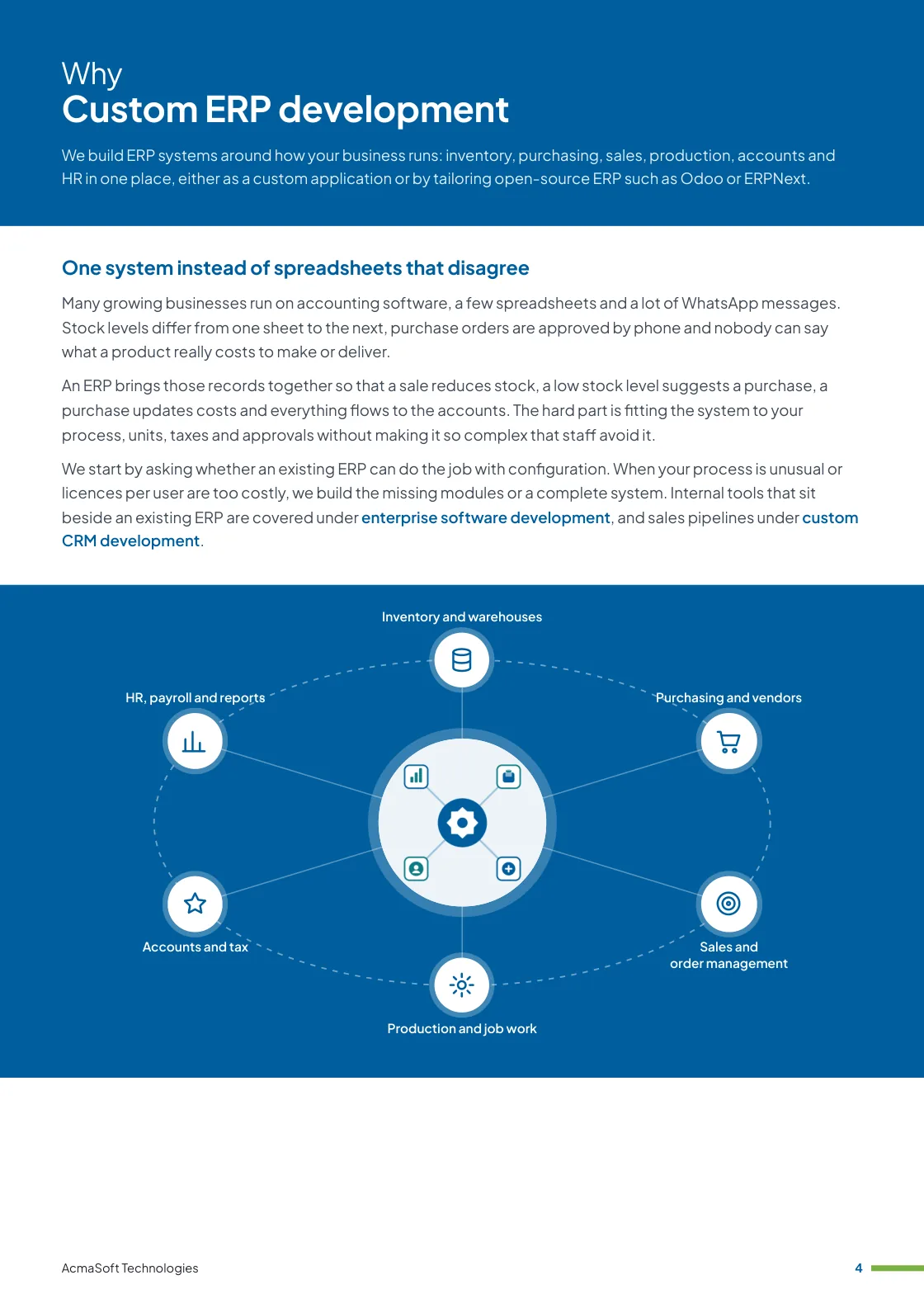
- Inventory and warehouses
- Purchasing and vendors
- Sales and order management
- Production and job work
- Accounts and tax
- One named lead from first call to launch
- Support and improvements after launch
More in Software and app development
ERP modules we build and customise
Six areas most growing businesses need, built or configured to match how you work.
-
Inventory and warehouses
Stock you can trust
Stock by item, batch, serial number and location, transfers between warehouses, reorder levels, barcode scanning and stock counts.
Every movement is recorded with who made it and why.
-
Purchasing and vendors
From request to payment
Purchase requests, approvals by amount, purchase orders, goods receipt, vendor bills and three-way matching.
Buyers see vendor history, lead times and open orders on one screen.
-
Sales and order management
Quote to cash
Quotes, sales orders, price lists, credit limits, dispatch, e-invoices and payment tracking, connected to your CRM and online store.
Orders reserve stock as soon as they are confirmed.
-
Production and job work
For manufacturers
Bills of materials, work orders, routing, material issue, job work with subcontractors, scrap and finished goods entries.
Costing shows material, labour and overheads per order.
-
Accounts and tax
Books that match operations
Ledgers, receivables, payables and the data for VAT, sales tax or GST returns, e-invoicing where your country requires it and e-way bills in India, or a two-way sync with Xero, QuickBooks, Sage, Tally or Zoho Books if you keep your current accounting.
Accountants spend less time re-entering data.
-
HR, payroll and reports
People and performance
Employee records, attendance, leave, payroll inputs and role-based access, plus dashboards for stock, sales, purchases and margins.
Managers get the numbers they need on desktop and phone.
What to look for in an ERP development partner
An ERP touches every team. Choose a partner who offers:
-
Build or configure advice
An honest comparison of Odoo, ERPNext, packaged ERPs and a custom build, with costs over several years.
-
Tax and invoicing rules built in
Invoices and tax reports set up for the rules you trade under, such as VAT, US sales tax or GST with e-way bills, and checked with your accountant.
-
Phased rollout
A plan that moves one module or location at a time, with data migration and training for each.
Ways to work with us
Choose the model that fits your scope and budget for custom ERP development. Many clients start with one and move to another as the work grows.
-
Fixed price
A defined scope delivered for an agreed price and timeline, in milestones you approve.
- Best for
- Clear requirements, a fixed budget and a firm deadline.
- How it is priced
- One agreed price, paid in instalments tied to milestones.
-
Dedicated team
A team with a project lead that works only on your product, on the priorities you set.
- Best for
- Long-term products and roadmaps that change often.
- How it is priced
- A monthly fee per team member, based on role and seniority.
-
Time and material
You pay for the hours worked and can change the scope as you learn, in short iterations.
- Best for
- Requirements that are hard to fix up front, and ongoing improvements.
- How it is priced
- Hourly or daily rates by role, invoiced monthly against logged time.
Need full-stack developers to join your own team instead?
Hire full-stack developersWhat our clients say
More client reviews-
The adaptive nature of AcmaSoft's agile development is commendable. Changes are seamlessly incorporated, ensuring our project stays on track and meets our evolving needs.
Mei Ling Singapore -
Collaborating with AcmaSoft using agile methods has been a pleasure. Their team's adaptability and communication ensure a smooth development journey.
Rahul S Bangalore
Industries we serve
We deliver custom ERP development for businesses in these industries, and adapt it to the rules, systems and customers of each one.


Ready-made solutions
We choose the stack for your budget, goals and current systems. Each link explains how we work with that technology or product.
Ready-made solutions
Not sure which technology fits your project? Ask one of our architects.
Talk to an architectWorking with international clients
Our team delivers remotely, so the questions that matter are when we can talk and how the work is run. Here are our office hours beside yours.
Our office hours Monday to Saturday, 9:30 am to 6:30 pm India time (IST)
Evening hours for North American clients, by arrangement: Monday to Friday, 6:30 pm to 9:30 pm India time
| Your region | Our hours in your time | Shared working hours |
|---|---|---|
| UKLondon | 4 am to 1 pm | 9 am to 1 pm |
| Central EuropeParis, Berlin | 5 am to 2 pm | 9 am to 2 pm |
| US EastNew York, Toronto | 11 pm to 8 am (next day) Evening hours to 11 am | 9 am to 11 am In our evening hours, by arrangement |
| US WestLos Angeles, Vancouver | 8 pm to 5 am (next day) Evening hours to 8 am | No overlap Early calls 7 am to 8 am, by arrangement |
| GulfDubai, Abu Dhabi | 8 am to 5 pm | 9 am to 5 pm |
| Singapore | 12 noon to 9 pm | 12 noon to 6 pm |
| Australia EastSydney, Melbourne | 3 pm to 12 midnight | 3 pm to 6 pm |
Our day ends before yours starts, so updates are waiting each morning and we agree call times with you.
Times follow daylight saving where your region uses it, against a working day of 9 am to 6 pm. Messages sent outside our hours are picked up when the team is back.
-
Remote delivery
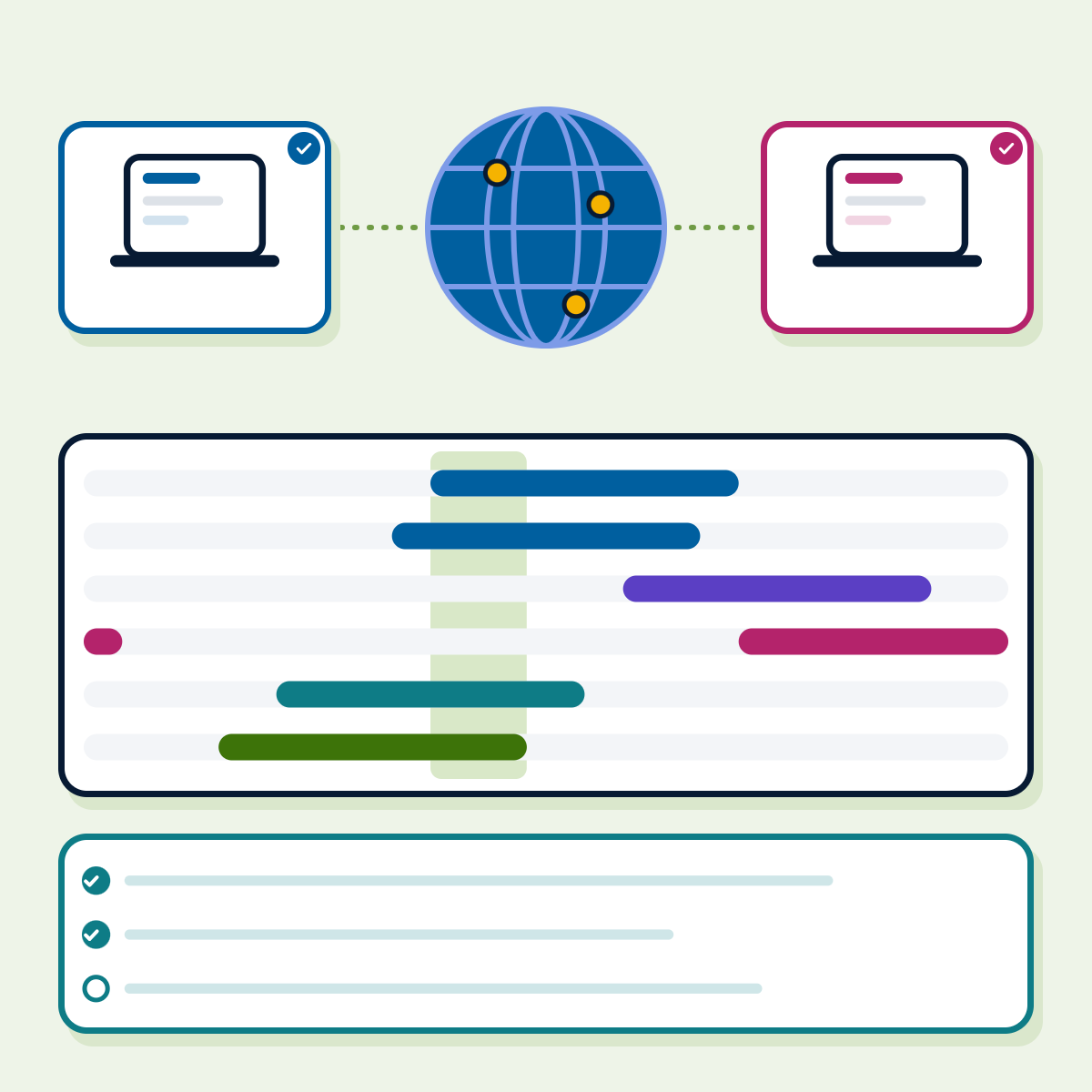
Discovery, design, development and testing run remotely, with one named lead, a demo of working features at the end of each sprint and a staging site you can try.
-
How we stay in touch
Email, video calls and chat such as Slack, Microsoft Teams or WhatsApp, with the hours of overlap and meeting times agreed in the communication plan at the start.
-
Contracts and invoices
Proposals, contracts and invoices are in English and priced in US dollars, or in your own currency on request. A non-disclosure agreement can be signed before you share any details.
-
Privacy laws we design for
We design forms, consent and data handling with the law of your market in mind: GDPR and UK GDPR, CCPA and CPRA, PIPEDA, the UAE PDPL, the Australian Privacy Act, Singapore's PDPA and India's DPDP Act.
Questions about custom ERP development
Something else on your mind? Ask us directly and a specialist will reply.
Ask a questionShould we build a custom ERP or use Odoo or ERPNext?
Open-source ERPs such as Odoo and ERPNext cover standard inventory, sales, purchasing and accounts well, and configuring them is usually faster than building. A custom ERP makes sense when your process is unusual, you need tight integration with your own products or licence and hosting costs of other options are too high. We compare the routes before recommending one.
Can the ERP handle VAT, GST and e-invoicing?
Yes. We set up invoices and tax reports for the rules you trade under, such as VAT in the UK, the EU and the UAE, US sales tax, or GST in India with e-invoicing through a GSP and e-way bills, and check the output with your accountant.
Can we keep our accounting software?
Yes. Many businesses run operations in the ERP and keep Xero, QuickBooks, Sage or Tally for accounts. We sync invoices, receipts, purchases and ledgers so data is entered once.
How do you move data from our current system?
We extract items, customers, vendors, opening stock and balances, clean and de-duplicate them, import them into a test system and reconcile totals with your team before go-live.
Can staff use the ERP on phones?
Yes. Screens are built to work on phones and tablets, and warehouse and field staff can use barcode scanning and mobile approvals.
Related insights
All insights-
 16 Nov 2026
How to hire dedicated developers: models, vetting, contracts and costs
A buyer guide to hiring dedicated developers: choosing the engagement model, where to find developers, vetting and a scorecard, contract…
-
 16 Nov 2026
Custom software development: process, team, costs and contracts
How a custom software project should run, from discovery to support: the team at each phase, what drives the cost,…
-
 13 Nov 2026
Outsourcing vs in-house software development: how to decide
Compare in-house and outsourced software development on control, cost, skills and risk, with a decision flow, a three-year cost structure…
Custom ERP development brochure
We build ERP systems around how your business runs: inventory, purchasing, sales, production, accounts and HR in one place, either as a custom application or by tailoring open-source ERP such as Odoo or ERPNext.
Inside this brochure
- One system instead of spreadsheets that disagree
- ERP modules we build and customise
- How an ERP project runs
- Technologies and solutions
- 2.7 MB
- 10 pages
- Services
You have downloaded from us before, so this one needs no form.
Get the brochure
Tell us who you are and the download starts straight away. We remember you on this device for 90 days, so you only fill this in once.
Your download has started.
If it does not start, download the brochure here. The links work for 15 minutes.
- Your reference
- Brochure
What you can do next
- Read it and share itShare the brochure with your team before you get in touch. It is free to read and share.
- Get a quote when you are readySix short questions on our request a quote page, and a reply within one business day.
Start your Custom ERP development project
Tell us what you are planning and a specialist will reply with next steps, a rough timeline and the questions we need answered.
- Emailsales@acmasoft.com
- Call+1 (707) 706 4092
- Prefer a call?
Thank you, your message is on its way.
It has reached our sales team, together with the page you sent it from.
- Your reference
- Budget
While we prepare your reply, here is the Custom ERP development brochure.
Download the brochure, Custom ERP development brochure, PDF, 2.7 MBWhat happens next
- A specialist gets in touchWithin one business day, by email or phone, with any questions about what you need.
- We talk it throughA short call about your goals, users, timeline and budget. We can sign an NDA first.
- You get a proposalScope, team, timeline and cost, with the engagement model that fits the work.