

AI in manufacturing: use cases, benefits and adoption
AcmaSoft develops AI for factories that catches defects, prevents breakdowns and plans production, from vision inspection and predictive maintenance to forecasting and operations agents.

AI use cases in manufacturing
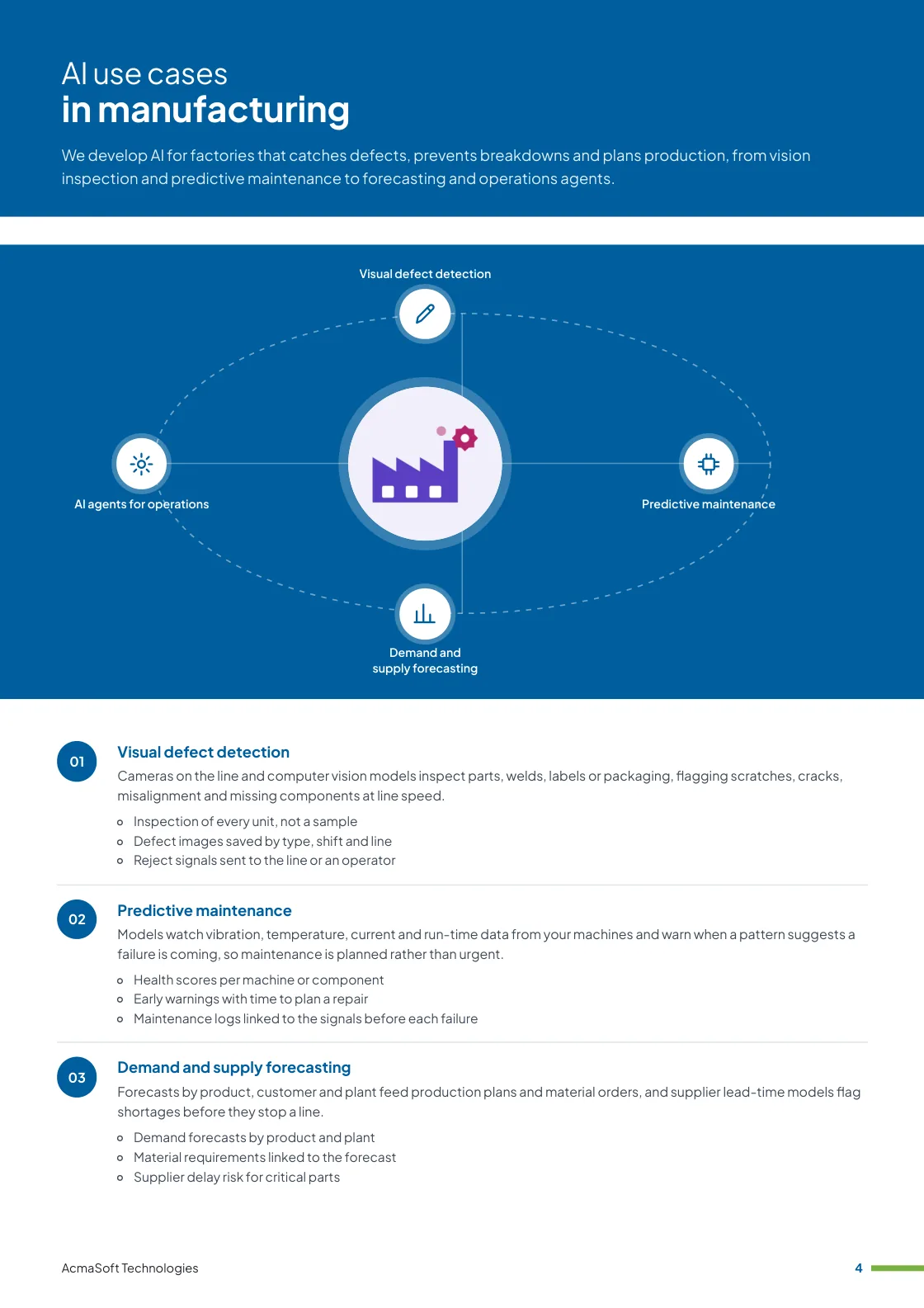
Four places AI is proving useful in manufacturing today, what each one needs from your data and where people stay in charge.
-
Visual defect detection
Cameras on the line and computer vision models inspect parts, welds, labels or packaging, flagging scratches, cracks, misalignment and missing components at line speed.
- Inspection of every unit, not a sample
- Defect images saved by type, shift and line
- Reject signals sent to the line or an operator
-
Predictive maintenance
Models watch vibration, temperature, current and run-time data from your machines and warn when a pattern suggests a failure is coming, so maintenance is planned rather than urgent.
- Health scores per machine or component
- Early warnings with time to plan a repair
- Maintenance logs linked to the signals before each failure
-
Demand and supply forecasting
Forecasts by product, customer and plant feed production plans and material orders, and supplier lead-time models flag shortages before they stop a line.
- Demand forecasts by product and plant
- Material requirements linked to the forecast
- Supplier delay risk for critical parts
-
AI agents for operations
Agents connected to your ERP, MES and documents answer questions, draft shift reports, raise maintenance tickets and chase overdue orders, cutting the admin around production.
- Plain-language questions on stock, orders and output
- Shift and downtime reports drafted from line data
- Standard operating procedures searchable on the shop floor
Safety and the shop floor
AI on a production line must never override safety systems. Our tools advise operators and planners or send signals to existing controls you approve, and they are tested on the line before they affect production. Quality standards your plant works to stay the responsibility of your quality team.
Benefits of AI in manufacturing
-
Fewer defects reaching customers
Every unit is inspected at line speed, with images to trace each defect back.
-
Less unplanned downtime
Early warnings turn breakdowns into planned repairs.
-
Steadier production plans
Better forecasts mean fewer rush orders and material shortages.
-
Less admin around production
Reports, tickets and look-ups happen without manual chasing.
Not sure your data is ready for AI? Start with a short readiness check.
Take the AI readiness assessmentAI adoption challenges in manufacturing and how we address them
Most AI projects that stall do so for the same few reasons. These are the ones we plan for from the first review.
Too few defect examples
Good lines produce few defects to train on.
- Anomaly models that learn from good parts
- Defect samples collected during the pilot
- Image augmentation to widen the training set
Old machines and scattered data
Many machines have no sensors or data connection.
- Retrofit sensors and edge gateways where needed
- Data from PLCs, SCADA and MES brought together
- Start on the machines that cost most when they stop
Changing conditions
New products, lighting or materials can confuse models.
- Models retrained when products or setups change
- Accuracy tracked per line and product
- Quick ways for operators to flag mistakes
Shop-floor trust
Operators will not rely on a tool that cries wolf.
- Alert thresholds tuned with operators
- Simple screens at the line
- Results shown against real outcomes
AI technologies behind these use cases
The building blocks we combine for each use case, and the service that delivers them.
-
Computer vision
Image classification, detection and anomaly models for inspection.
Computer vision development -
Time-series models
Sensor-based failure prediction and demand forecasting.
Machine learning development -
AI agents
Assistants that read and act across ERP, MES and documents.
AI agents and agentic automation -
Industrial analytics
Dashboards for output, downtime, quality and OEE.
Data Analytics and BI
Working with international clients
Our team delivers remotely, so the questions that matter are when we can talk and how the work is run. Here are our office hours beside yours.
Our office hours Monday to Saturday, 9:30 am to 6:30 pm India time (IST)
Evening hours for North American clients, by arrangement: Monday to Friday, 6:30 pm to 9:30 pm India time
| Your region | Our hours in your time | Shared working hours |
|---|---|---|
| UKLondon | 4 am to 1 pm | 9 am to 1 pm |
| Central EuropeParis, Berlin | 5 am to 2 pm | 9 am to 2 pm |
| US EastNew York, Toronto | 11 pm to 8 am (next day) Evening hours to 11 am | 9 am to 11 am In our evening hours, by arrangement |
| US WestLos Angeles, Vancouver | 8 pm to 5 am (next day) Evening hours to 8 am | No overlap Early calls 7 am to 8 am, by arrangement |
| GulfDubai, Abu Dhabi | 8 am to 5 pm | 9 am to 5 pm |
| Singapore | 12 noon to 9 pm | 12 noon to 6 pm |
| Australia EastSydney, Melbourne | 3 pm to 12 midnight | 3 pm to 6 pm |
Our day ends before yours starts, so updates are waiting each morning and we agree call times with you.
Times follow daylight saving where your region uses it, against a working day of 9 am to 6 pm. Messages sent outside our hours are picked up when the team is back.
-
Remote delivery
Discovery, design, development and testing run remotely, with one named lead, a demo of working features at the end of each sprint and a staging site you can try.
-
How we stay in touch
Email, video calls and chat such as Slack, Microsoft Teams or WhatsApp, with the hours of overlap and meeting times agreed in the communication plan at the start.
-
Contracts and invoices
Proposals, contracts and invoices are in English and priced in US dollars, or in your own currency on request. A non-disclosure agreement can be signed before you share any details.
-
Privacy laws we design for
We design forms, consent and data handling with the law of your market in mind: GDPR and UK GDPR, CCPA and CPRA, PIPEDA, the UAE PDPL, the Australian Privacy Act, Singapore's PDPA and India's DPDP Act.
How we implement AI in manufacturing
Five stages, each ending in something you can review before you commit to the next.
-
Use case and data review
We agree which task or decision AI should support, look at the data you hold and set the measure of success before any build starts.
You get A scoped use case and a go or no-go decision
-
Prototype on your data
A small working model or assistant is tested on real samples of your data and compared with the way the task is done today.
You get Measured results you can judge
-
Pilot with people in the loop
A small team uses it on live work while every output is reviewed, so errors and gaps surface before wider use.
You get An error log and user feedback
-
Integration and launch
We connect it to your systems with access control, logging and a manual fallback, then roll it out in stages.
You get A production system your team can run
-
Monitoring and improvement
Accuracy, cost and usage are tracked after launch, and models are retrained or adjusted as your data changes.
You get Monthly reports and a change plan
What our clients say
More client reviews-
AcmaSoft's agile development methods are a game-changer. The iterative approach allowed us to witness progress at every stage, ensuring our project's success.
Daniel K Chicago -
The adaptive nature of AcmaSoft's agile development is commendable. Changes are seamlessly incorporated, ensuring our project stays on track and meets our evolving needs.
Mei Ling Singapore
Questions about AI in manufacturing
Have a question we have not covered? An AI consultant will answer it directly.
Ask an AI consultantDo we need new cameras or sensors?
Sometimes. Vision inspection needs cameras and lighting suited to the defect, and older machines may need retrofit sensors. We review what you already have first and only add hardware where the use case needs it.
How many defect images are needed to train a model?
It depends on the defect and the part. Where defects are rare, we start with anomaly detection trained on good parts and collect defect images during the pilot to improve it.
Can AI connect to our ERP, MES or SCADA?
Yes, through their APIs, databases or industrial protocols such as OPC UA where available. We read data first and only write back to systems where you approve it.
Will AI stop the line on its own?
Only if you decide it should. Most plants start with alerts to operators and add automatic reject or stop signals once results are proven on the line.
AI in manufacturing brochure
We develop AI for factories that catches defects, prevents breakdowns and plans production, from vision inspection and predictive maintenance to forecasting and operations agents.
Inside this brochure
- AI use cases in manufacturing
- What each use case needs
- Benefits of AI in manufacturing
- AI adoption challenges in manufacturing and how we address them
- 3.2 MB
- 12 pages
- AI and automation
You have downloaded from us before, so this one needs no form.
Get the brochure
Tell us who you are and the download starts straight away. We remember you on this device for 90 days, so you only fill this in once.
Your download has started.
If it does not start, download the brochure here. The links work for 15 minutes.
- Your reference
- Brochure
What you can do next
- Read it and share itShare the brochure with your team before you get in touch. It is free to read and share.
- Get a quote when you are readySix short questions on our request a quote page, and a reply within one business day.
Plan your first AI project in manufacturing
Describe the task or decision you want AI to help with. An AI consultant will reply with questions about your data and a suggested first step.
- Emailsales@acmasoft.com
- Call+1 (707) 706 4092
- Prefer a call?
Thank you, your message is on its way.
It has reached our sales team, together with the page you sent it from.
- Your reference
- Budget
While we prepare your reply, here is the AI in manufacturing brochure.
Download the brochure, AI in manufacturing brochure, PDF, 3.2 MBWhat happens next
- A specialist gets in touchWithin one business day, by email or phone, with any questions about what you need.
- We talk it throughA short call about your goals, users, timeline and budget. We can sign an NDA first.
- You get a proposalScope, team, timeline and cost, with the engagement model that fits the work.