

Progressive web app development for phones, tablets and desktops
At AcmaSoft, we build progressive web apps: installable web apps with offline pages, web push and fast loading on mobile networks, from one code base that runs in every current browser and can be packaged for the App Store and Google Play with Capacitor.

- Years of experience
- 17+
- Clients served
- 650+
- Projects delivered
- 2,000+
- Products shipped
- 300+
One web app for every device, with what an app needs
A progressive web app is a website that behaves like an installed app. A service worker keeps key screens and data available offline or on a weak signal, a web app manifest lets people add it to their home screen, and web push brings them back with notifications they asked for. Updates reach every user on their next visit, with no app store review in between.
We build progressive web apps in React, Next.js, Angular or Vue.js with TypeScript, using Workbox or the framework’s own service worker tools for caching and background sync. Each app is measured against Core Web Vitals on mid-range phones and mobile data, and tested with keyboards and screen readers against WCAG 2.2 AA.
When the app also has to be in the App Store and Google Play, we package the same web code with Capacitor and add native plugins for the camera, files, notifications and secure storage, and we move older PhoneGap and Cordova apps to the same set-up. If your product depends on heavy device features or native performance, our mobile app development service builds native and cross-platform apps instead, and we tell you which suits your users.
What you get with progressive web app development
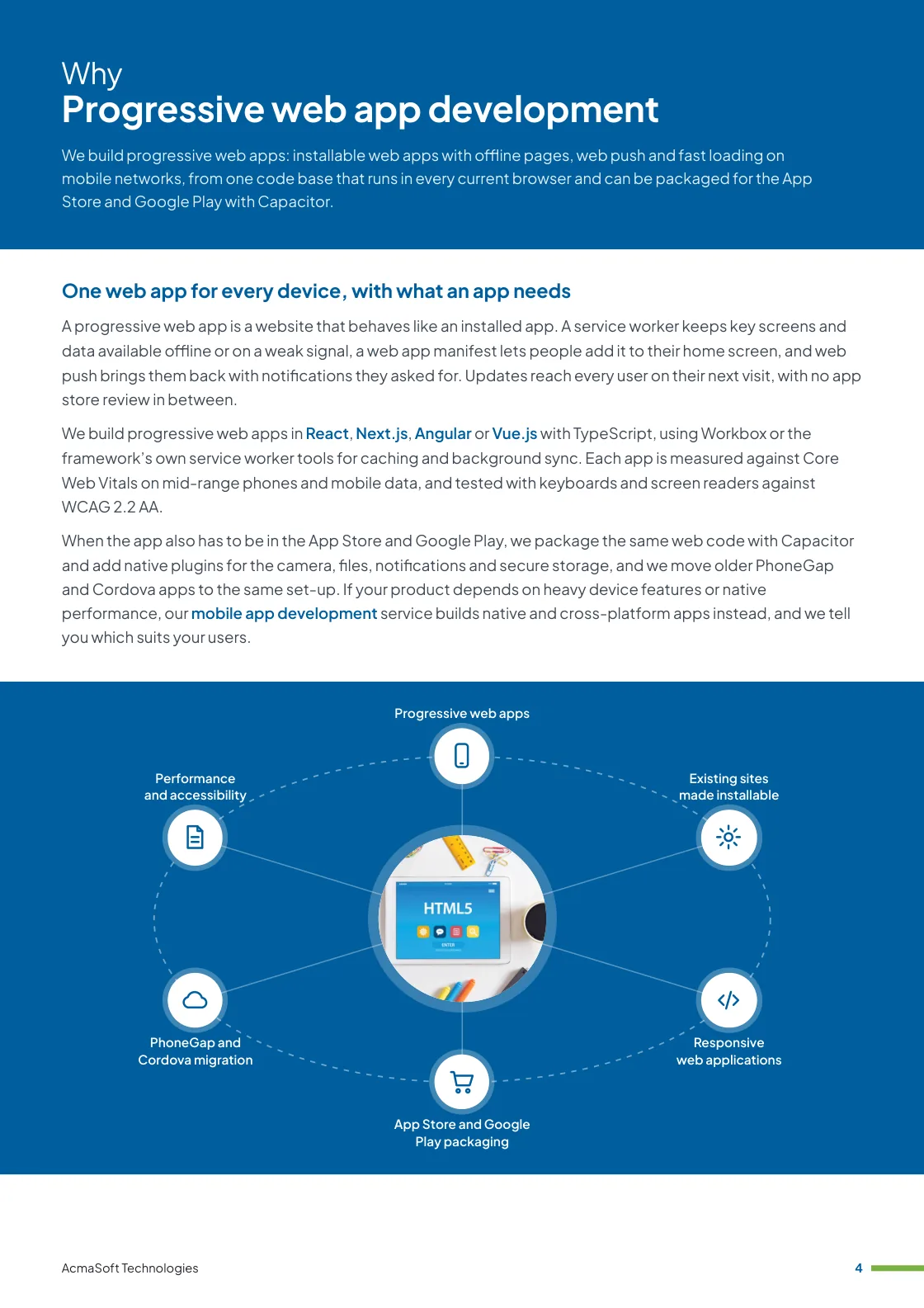
- Progressive web apps
- Existing sites made installable
- Responsive web applications
- App Store and Google Play packaging
- PhoneGap and Cordova migration
- One named lead from first call to launch
- Support and improvements after launch
More in Software and app development
Our progressive web app services
The web app work we take on, from a new progressive web app to store packaging and the move away from older hybrid apps.
-

Progressive web apps
Installable, offline-ready web apps
New web apps with a web app manifest, a service worker for offline pages and background sync, an install prompt and web push, tuned for slow and patchy connections.
-

Existing sites made installable
App features for a site you already run
A service worker, manifest, offline page and web push added to an existing React, Angular, Vue or server-rendered site, without rebuilding it.
-

Responsive web applications
One interface from small phones to large screens
Customer apps, portals and dashboards built with semantic HTML, modern CSS layout and a component framework, so one code base serves every screen size.
-

App Store and Google Play packaging
The same code in the stores
The web code wrapped with Capacitor for iOS and Android, with native plugins for the camera, files, notifications and secure storage, and store listings prepared for review.
-

PhoneGap and Cordova migration
Older hybrid apps on current tooling
PhoneGap and Cordova apps moved to Capacitor and current web tooling, abandoned plugins replaced and store requirements brought up to date, keeping the web code you already have.
-

Performance and accessibility
Fast and usable for everyone
Core Web Vitals checks on mid-range phones, image and script budgets, and keyboard and screen reader testing against WCAG 2.2 AA.
What to look for in a progressive web app partner
A progressive web app pays off only when offline use, speed and installation work on your users' own devices. Before you choose a partner, look for:
-
Honest platform advice
A partner who tells you when a native or Flutter app would serve your users better than a web app, and which features iPhones still limit for web apps.
-
Offline and sync designed in
A clear plan for what works without a connection, how changes made offline are sent once the connection returns, and how conflicts are resolved.
-
Testing on real phones and networks
Loading, install and offline use checked on mid-range Android phones and iPhones over mobile data, not only on office broadband.
Ways to work with us
Choose the model that fits your scope and budget for progressive web app development. Many clients start with one and move to another as the work grows.
-
Fixed price
A defined scope delivered for an agreed price and timeline, in milestones you approve.
- Best for
- Clear requirements, a fixed budget and a firm deadline.
- How it is priced
- One agreed price, paid in instalments tied to milestones.
-
Dedicated team
A team with a project lead that works only on your product, on the priorities you set.
- Best for
- Long-term products and roadmaps that change often.
- How it is priced
- A monthly fee per team member, based on role and seniority.
-
Time and material
You pay for the hours worked and can change the scope as you learn, in short iterations.
- Best for
- Requirements that are hard to fix up front, and ongoing improvements.
- How it is priced
- Hourly or daily rates by role, invoiced monthly against logged time.
Need HTML5 developers to join your own team instead?
Hire HTML5 developersWhat our clients say
More client reviews-
The AcmaSoft team provided exceptional web development service, ensuring our website is not only visually stunning but also highly responsive. A reliable partner indeed.
Ahmed R Dubai -
Our e-commerce platform developed by AcmaSoft Technologies has transformed our online presence. Sales are up, and our customers love the new interface. Thank you!
Sophie M Paris
Industries our software and app development team works in
Our software and app development team builds for businesses in these industries, and we adapt progressive web app development to each one's rules, systems and customers.


Technologies we use
We choose the stack for your budget, goals and current systems. Each link explains how we work with that technology or product.
Not sure which technology fits your project? Ask one of our architects.
Talk to an architectWorking with international clients
Our team delivers remotely, so the questions that matter are when we can talk and how the work is run. Here are our office hours beside yours.
Our office hours Monday to Saturday, 9:30 am to 6:30 pm India time (IST)
Evening hours for North American clients, by arrangement: Monday to Friday, 6:30 pm to 9:30 pm India time
| Your region | Our hours in your time | Shared working hours |
|---|---|---|
| UKLondon | 4 am to 1 pm | 9 am to 1 pm |
| Central EuropeParis, Berlin | 5 am to 2 pm | 9 am to 2 pm |
| US EastNew York, Toronto | 11 pm to 8 am (next day) Evening hours to 11 am | 9 am to 11 am In our evening hours, by arrangement |
| US WestLos Angeles, Vancouver | 8 pm to 5 am (next day) Evening hours to 8 am | No overlap Early calls 7 am to 8 am, by arrangement |
| GulfDubai, Abu Dhabi | 8 am to 5 pm | 9 am to 5 pm |
| Singapore | 12 noon to 9 pm | 12 noon to 6 pm |
| Australia EastSydney, Melbourne | 3 pm to 12 midnight | 3 pm to 6 pm |
Our day ends before yours starts, so updates are waiting each morning and we agree call times with you.
Times follow daylight saving where your region uses it, against a working day of 9 am to 6 pm. Messages sent outside our hours are picked up when the team is back.
-
Remote delivery
Discovery, design, development and testing run remotely, with one named lead, a demo of working features at the end of each sprint and a staging site you can try.
-
How we stay in touch
Email, video calls and chat such as Slack, Microsoft Teams or WhatsApp, with the hours of overlap and meeting times agreed in the communication plan at the start.
-
Contracts and invoices
Proposals, contracts and invoices are in English and priced in US dollars, or in your own currency on request. A non-disclosure agreement can be signed before you share any details.
-
Privacy laws we design for
We design forms, consent and data handling with the law of your market in mind: GDPR and UK GDPR, CCPA and CPRA, PIPEDA, the UAE PDPL, the Australian Privacy Act, Singapore's PDPA and India's DPDP Act.
Questions about progressive web app development
Something else on your mind? Ask us directly and a specialist will reply.
Ask a questionHow much does progressive web app development cost?
Cost depends mainly on the number of screens and user roles, how much must work offline and how changes sync back, web push and its sending rules, the back end and integrations such as payments, sign-in or your CRM, and whether you also want App Store and Google Play builds with Capacitor. Adding offline support and push to an existing site usually costs less than a new app. After a discovery call we send a written proposal with an itemised estimate, as a fixed price or a monthly team.
How long does a progressive web app take?
Discovery decides what the first release must do and what must work offline, then design and a working prototype you open on your own phone from a link. Development runs in sprints of one or two weeks, each ending with a preview link. Testing on real devices, offline and on slow networks comes before launch, and store builds follow when they are part of the plan. The proposal sets milestones and a start date.
Progressive web app or native app: which should we build?
A progressive web app suits products that people reach through search or a link, use now and then, or need on many kinds of device, such as customer portals, booking and ordering apps, field forms and internal tools. A native or cross-platform app suits products that rely on heavy device features, long background tasks or the best possible performance. Many products start as a progressive web app and add store builds with Capacitor later. We recommend one after looking at your users, features and budget.
Do progressive web apps work on iPhone?
Yes, in Safari and the other iPhone browsers. People add the app to their home screen from the Share menu, because iOS shows no automatic install prompt. Since iOS 16.4, web apps added to the home screen can receive web push notifications once the user allows them. Some device features, such as Bluetooth and NFC, are not available to web apps on iOS, so we check your feature list against what Safari supports before the build and suggest Capacitor packaging where a feature needs native code.
Can you turn our existing website or web app into a progressive web app?
Yes, in most cases without a rebuild. We review the site's framework, hosting, sign-in and data, then add a web app manifest, a service worker with a caching plan, an offline page, install support and, where you want it, web push. Pages that change often are fetched fresh, so visitors never see old prices or stock. We measure Core Web Vitals before and after.
Do you still build HTML5 apps, and can you move our PhoneGap or Cordova app?
Yes. HTML5 app development today usually means a progressive web app: one code base in React, Angular or Vue with a service worker for offline use, an install prompt, web push and fast loading on slow connections. Adobe ended PhoneGap in 2020, so we move PhoneGap and Cordova apps to Capacitor, which keeps your web code in a current native shell, replace abandoned plugins and bring the store builds up to date. Whether the app then stays in the stores, runs only in the browser or both is your choice.
How do we get started?
Book a discovery call or send the form on this page. A specialist replies with the questions we need answered, then a proposal, and work starts once you are happy with the plan.

Progressive web app development brochure
We build progressive web apps: installable web apps with offline pages, web push and fast loading on mobile networks, from one code base that runs in every current browser and can be packaged for the App Store and Google Play with Capacitor.
Inside this brochure
- One web app for every device, with what an app needs
- Our progressive web app services
- How a progressive web app project runs
- Technologies and solutions
- 2.8 MB
- 10 pages
- Services
You have downloaded from us before, so this one needs no form.
Get the brochure
Tell us who you are and the download starts straight away. We remember you on this device for 90 days, so you only fill this in once.
Your download has started.
If it does not start, download the brochure here. The links work for 15 minutes.
- Your reference
- Brochure
What you can do next
- Read it and share itShare the brochure with your team before you get in touch. It is free to read and share.
- Get a quote when you are readySix short questions on our request a quote page, and a reply within one business day.
Start your Progressive Web App Development project
Tell us what you are planning and a specialist will reply with next steps, a rough timeline and the questions we need answered.
- Emailsales@acmasoft.com
- Call+1 (707) 706 4092
- Prefer a call?
Thank you, your message is on its way.
It has reached our sales team, together with the page you sent it from.
- Your reference
- Budget
While we prepare your reply, here is the Progressive web app development brochure.
Download the brochure, Progressive web app development brochure, PDF, 2.8 MBWhat happens next
- A specialist gets in touchWithin one business day, by email or phone, with any questions about what you need.
- We talk it throughA short call about your goals, users, timeline and budget. We can sign an NDA first.
- You get a proposalScope, team, timeline and cost, with the engagement model that fits the work.