

Headless and composable commerce development with decoupled storefronts
At AcmaSoft, we build headless commerce storefronts with frameworks such as Next.js on commerce back ends such as Shopify, Magento or commercetools, connect a CMS for content, and tell you plainly when a standard theme would serve you better.
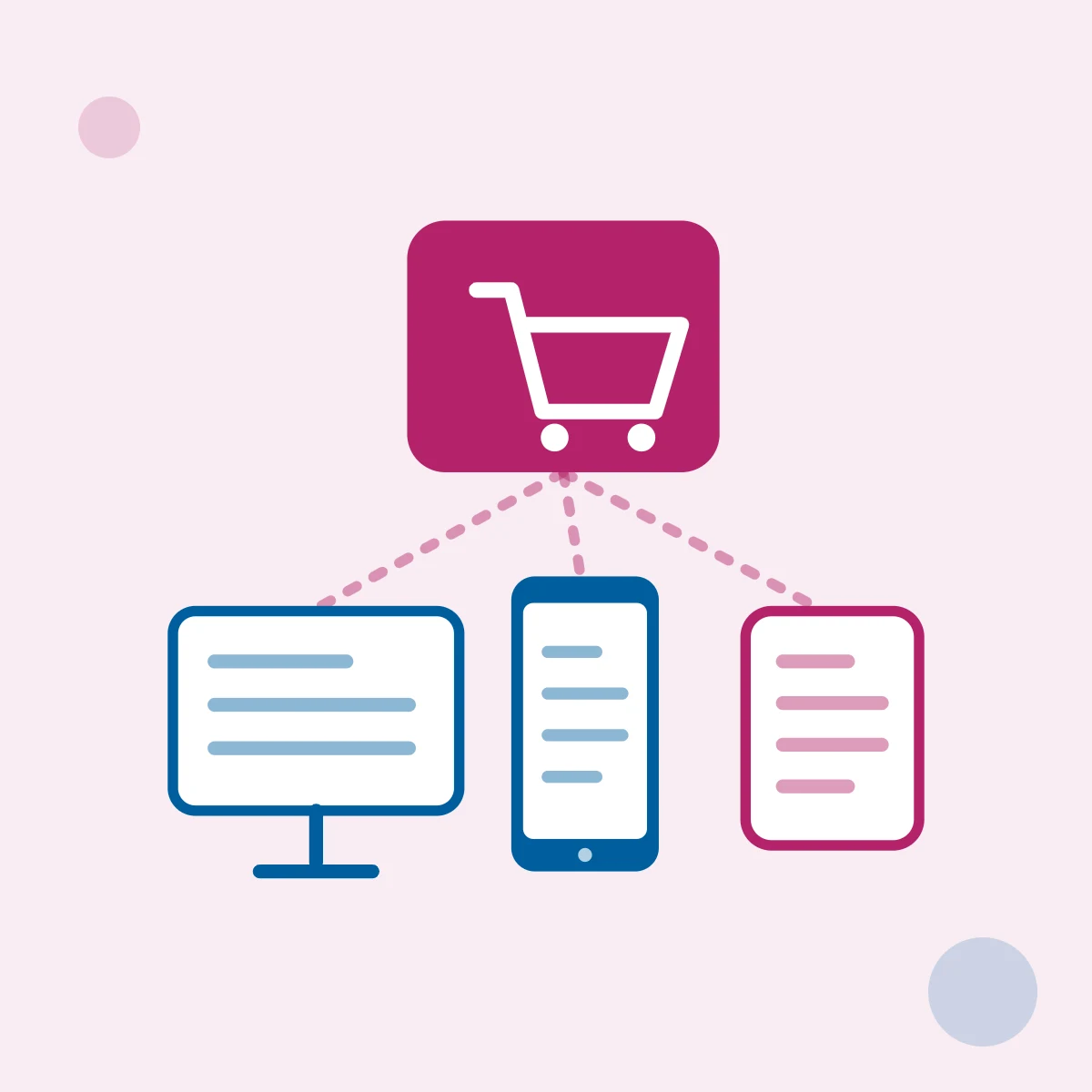
- Years of experience
- 17+
- Clients served
- 650+
- Projects delivered
- 2,000+
- Products shipped
- 300+
What headless commerce means
In a traditional online store, the storefront and the commerce engine are one system: the theme that displays products is tied to the platform that holds the catalogue, basket and orders. That is simple to run, but changing the front end means working within what the theme layer allows.
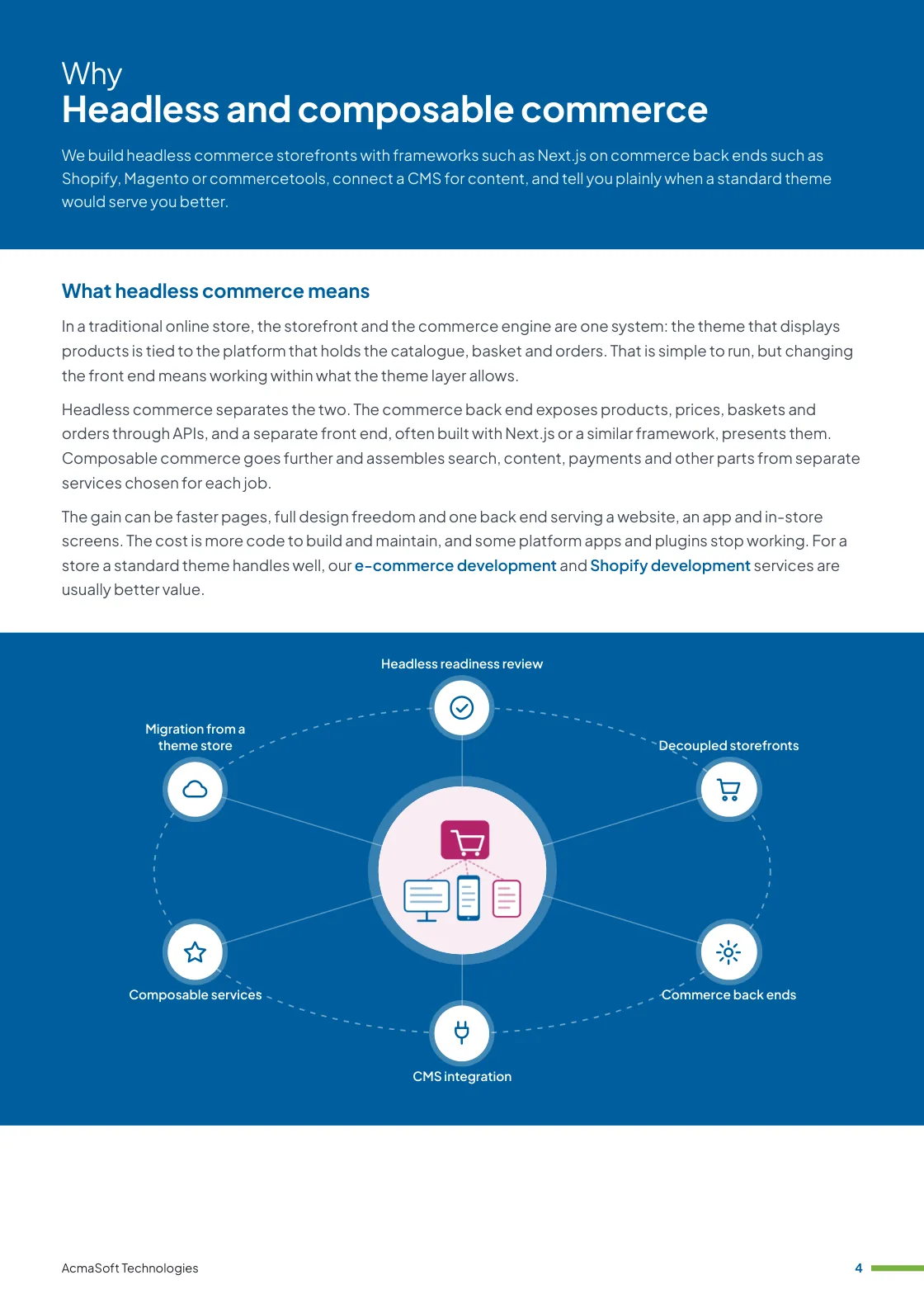
Headless commerce separates the two. The commerce back end exposes products, prices, baskets and orders through APIs, and a separate front end, often built with Next.js or a similar framework, presents them. Composable commerce goes further and assembles search, content, payments and other parts from separate services chosen for each job.
The gain can be faster pages, full design freedom and one back end serving a website, an app and in-store screens. The cost is more code to build and maintain, and some platform apps and plugins stop working. For a store a standard theme handles well, our e-commerce development and Shopify development services are usually better value.
What you get with headless and composable commerce
- Headless readiness review
- Decoupled storefronts
- Commerce back ends
- CMS integration
- Composable services
- One named lead from first call to launch
- Support and improvements after launch
More in Software and app development
Our headless commerce services
Six parts of a headless build, starting with an honest check of whether it suits you.
-
Headless readiness review
When it is worth it and when it is not
Headless tends to pay off when you sell across several channels, need content-rich or very custom pages, have reached the limits of your theme or want to change front end and back end on separate schedules.
It rarely pays off for a small catalogue with a standard design and no developers on hand, and we will tell you so.
-
Decoupled storefronts
Fast pages in your own design
Storefronts in Next.js or a similar framework, with server rendering and static generation for fast, indexable pages, image optimisation and structured data for search engines.
Basket, checkout and account pages connect to the commerce back end through its API.
-
Commerce back ends
The engine behind the store
We work with platforms such as Shopify through its Storefront API, Magento Open Source and Adobe Commerce through GraphQL, and API-first engines such as commercetools.
The choice depends on catalogue size, B2B needs, licence cost and the team that will run it.
-
CMS integration
Editors publish without developers
A headless CMS such as Contentful, Sanity, Strapi or WordPress holds landing pages, buying guides and campaign content, with product data pulled in from the commerce platform.
Editors preview pages before publishing without asking a developer.
-
Composable services
A suitable tool for each part
Search, reviews, payments, tax, loyalty and personalisation can each come from a separate service, connected through APIs and a small integration layer that you own.
We keep the number of services in proportion to the value each one adds.
-
Migration from a theme store
Moving without losing traffic
We can move an existing store to headless in stages, one page type at a time, keeping URLs, redirects and structured data to protect search rankings.
Analytics, tracking and marketing tags are rebuilt and checked before each stage goes live.
What to look for in a headless commerce development company
Headless moves work from the platform into your own code. Choose a provider with:
-
Honest advice on fit
Willingness to recommend a standard theme when headless would add cost without a clear return.
-
Front-end and commerce skills
Experience with modern JavaScript frameworks as well as the commerce platform, its APIs and their limits.
-
A plan for ownership
Clear answers on who hosts, updates and monitors the storefront after launch, and what that costs each month.
Ways to work with us
Choose the model that fits your scope and budget for headless and composable commerce. Many clients start with one and move to another as the work grows.
-
Fixed price
A defined scope delivered for an agreed price and timeline, in milestones you approve.
- Best for
- Clear requirements, a fixed budget and a firm deadline.
- How it is priced
- One agreed price, paid in instalments tied to milestones.
-
Dedicated team
A team with a project lead that works only on your product, on the priorities you set.
- Best for
- Long-term products and roadmaps that change often.
- How it is priced
- A monthly fee per team member, based on role and seniority.
-
Time and material
You pay for the hours worked and can change the scope as you learn, in short iterations.
- Best for
- Requirements that are hard to fix up front, and ongoing improvements.
- How it is priced
- Hourly or daily rates by role, invoiced monthly against logged time.
Need Next.js developers to join your own team instead?
Hire Next.js developersWhat our clients say
More client reviews-
The AcmaSoft team provided exceptional web development service, ensuring our website is not only visually stunning but also highly responsive. A reliable partner indeed.
Ahmed R Dubai -
Our e-commerce platform developed by AcmaSoft Technologies has transformed our online presence. Sales are up, and our customers love the new interface. Thank you!
Sophie M Paris
Industries our software and app development team works in
Our software and app development team builds for businesses in these industries, and we adapt headless and composable commerce to each one's rules, systems and customers.


Technologies we use
We choose the stack for your budget, goals and current systems. Each link explains how we work with that technology or product.
Front end
E-commerce
Not sure which technology fits your project? Ask one of our architects.
Talk to an architectWorking with international clients
Our team delivers remotely, so the questions that matter are when we can talk and how the work is run. Here are our office hours beside yours.
Our office hours Monday to Saturday, 9:30 am to 6:30 pm India time (IST)
Evening hours for North American clients, by arrangement: Monday to Friday, 6:30 pm to 9:30 pm India time
| Your region | Our hours in your time | Shared working hours |
|---|---|---|
| UKLondon | 4 am to 1 pm | 9 am to 1 pm |
| Central EuropeParis, Berlin | 5 am to 2 pm | 9 am to 2 pm |
| US EastNew York, Toronto | 11 pm to 8 am (next day) Evening hours to 11 am | 9 am to 11 am In our evening hours, by arrangement |
| US WestLos Angeles, Vancouver | 8 pm to 5 am (next day) Evening hours to 8 am | No overlap Early calls 7 am to 8 am, by arrangement |
| GulfDubai, Abu Dhabi | 8 am to 5 pm | 9 am to 5 pm |
| Singapore | 12 noon to 9 pm | 12 noon to 6 pm |
| Australia EastSydney, Melbourne | 3 pm to 12 midnight | 3 pm to 6 pm |
Our day ends before yours starts, so updates are waiting each morning and we agree call times with you.
Times follow daylight saving where your region uses it, against a working day of 9 am to 6 pm. Messages sent outside our hours are picked up when the team is back.
-
Remote delivery
Discovery, design, development and testing run remotely, with one named lead, a demo of working features at the end of each sprint and a staging site you can try.
-
How we stay in touch
Email, video calls and chat such as Slack, Microsoft Teams or WhatsApp, with the hours of overlap and meeting times agreed in the communication plan at the start.
-
Contracts and invoices
Proposals, contracts and invoices are in English and priced in US dollars, or in your own currency on request. A non-disclosure agreement can be signed before you share any details.
-
Privacy laws we design for
We design forms, consent and data handling with the law of your market in mind: GDPR and UK GDPR, CCPA and CPRA, PIPEDA, the UAE PDPL, the Australian Privacy Act, Singapore's PDPA and India's DPDP Act.
Questions about headless and composable commerce
Something else on your mind? Ask us directly and a specialist will reply.
Ask a questionWhat is headless commerce?
An approach in which the storefront customers see is a separate application from the commerce platform that manages products, baskets and orders. The two communicate through APIs, so either can be changed or replaced without rebuilding the other.
What is the difference between headless and composable commerce?
Headless separates the front end from the commerce back end. Composable commerce also splits the back end into separate services, such as search, content, payments and promotions, each chosen and replaced on its own. Composable gives more choice and adds more integration work.
Is headless commerce worth it for a small store?
Usually not. A well-built theme on Shopify, WooCommerce or Magento costs less to build and run and needs fewer developers. Headless becomes worth considering when you sell through several channels, need very custom content pages or have reached the limits of your theme.
Will a headless store be faster?
It can be, because pages can be pre-rendered and served from a CDN, but speed depends on how the storefront is built. A poorly built headless store can be slower than a good theme, so we measure page speed against your current store throughout the project.
Can we keep our current Shopify or Magento store?
Yes. Both can act as the back end, so orders, products and admin stay where your team already works. Some apps and extensions that change the storefront will need replacing, and we list those before you commit.
Related insights
All insights-
 16 Nov 2026
E-commerce development guide: platforms, costs and a launch plan
How to build an online store: choosing the platform, what drives build and running costs, payments and PCI DSS, selling…
-
 16 Nov 2026
Shopify vs WooCommerce vs Magento (Adobe Commerce): which platform in 2026
Shopify, WooCommerce and Magento compared on fees, licences, hosting, updates and skills, with each vendor's published prices as of November…
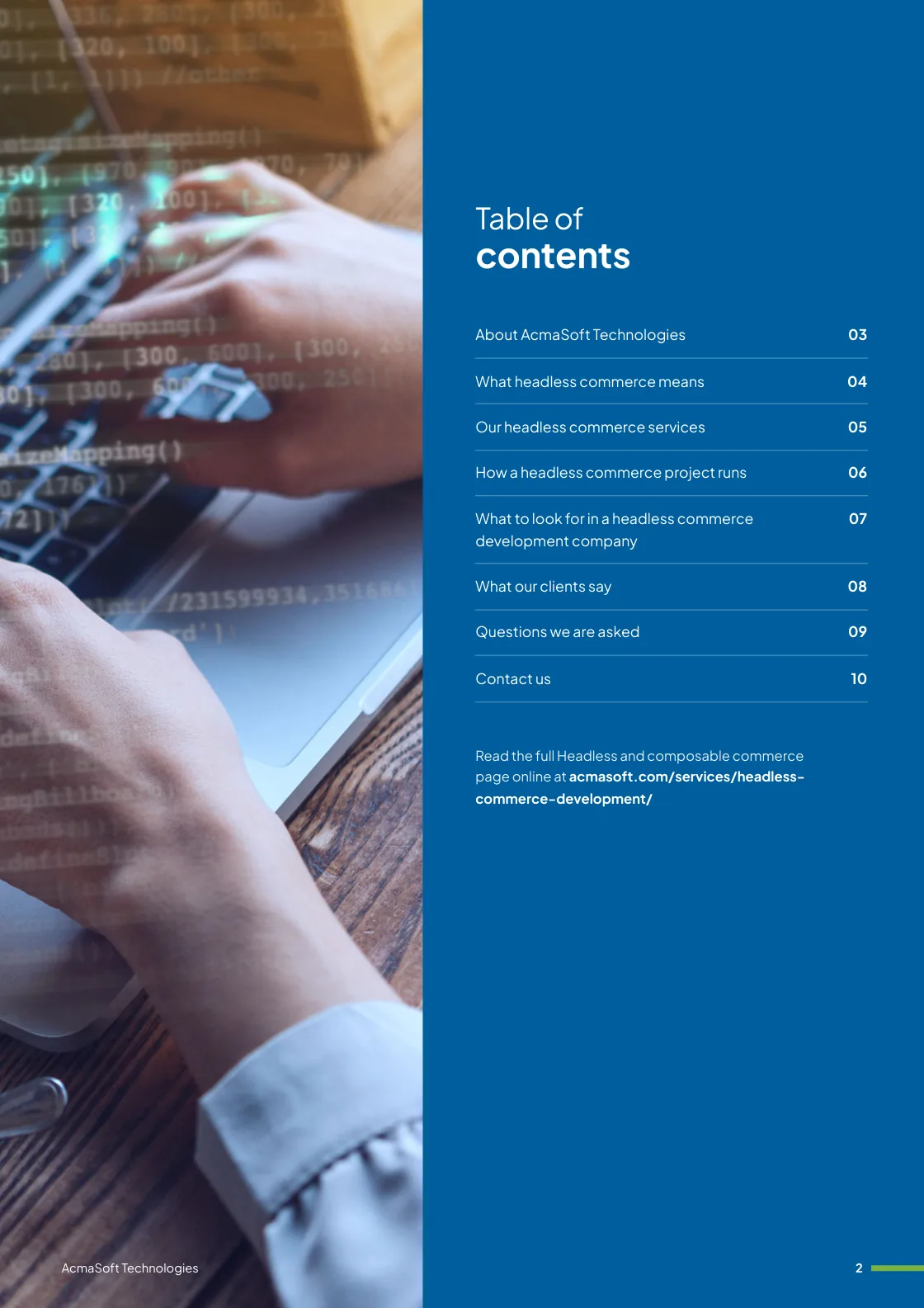
Headless and composable commerce brochure
We build headless commerce storefronts with frameworks such as Next.js on commerce back ends such as Shopify, Magento or commercetools, connect a CMS for content, and tell you plainly when a standard theme would serve you better.
Inside this brochure
- What headless commerce means
- Our headless commerce services
- How a headless commerce project runs
- Technologies and solutions
- 2.5 MB
- 10 pages
- Services
You have downloaded from us before, so this one needs no form.
Get the brochure
Tell us who you are and the download starts straight away. We remember you on this device for 90 days, so you only fill this in once.
Your download has started.
If it does not start, download the brochure here. The links work for 15 minutes.
- Your reference
- Brochure
What you can do next
- Read it and share itShare the brochure with your team before you get in touch. It is free to read and share.
- Get a quote when you are readySix short questions on our request a quote page, and a reply within one business day.
Start your Headless and composable commerce project
Tell us what you are planning and a specialist will reply with next steps, a rough timeline and the questions we need answered.
- Emailsales@acmasoft.com
- Call+1 (707) 706 4092
- Prefer a call?
Thank you, your message is on its way.
It has reached our sales team, together with the page you sent it from.
- Your reference
- Budget
While we prepare your reply, here is the Headless and composable commerce brochure.
Download the brochure, Headless and composable commerce brochure, PDF, 2.5 MBWhat happens next
- A specialist gets in touchWithin one business day, by email or phone, with any questions about what you need.
- We talk it throughA short call about your goals, users, timeline and budget. We can sign an NDA first.
- You get a proposalScope, team, timeline and cost, with the engagement model that fits the work.