

Web portal development for customers, partners, members and staff
At AcmaSoft, we build secure web portals where each user signs in and sees what matters to them: orders, bookings, documents, invoices, requests and reports, connected to the systems you already run.
- Years of experience
- 17+
- Clients served
- 650+
- Projects delivered
- 2,000+
- Products shipped
- 300+
One place for people to help themselves
A portal replaces emails, phone calls and spreadsheets with a single sign-in. Customers check an order or download an invoice without calling you, dealers place orders at any hour, members renew and book online and staff find the policy or form they need.
What makes a portal work is not the login screen. It is showing each person exactly the records they may see, keeping that data in step with your accounting, CRM or ERP system and making the common tasks quicker than the old way.
For portals that are mainly about ordering, see B2B e-commerce development. Large internal systems with complex approvals sit under enterprise software development, and connections to other systems under API development and integration.
What you get with web portal development
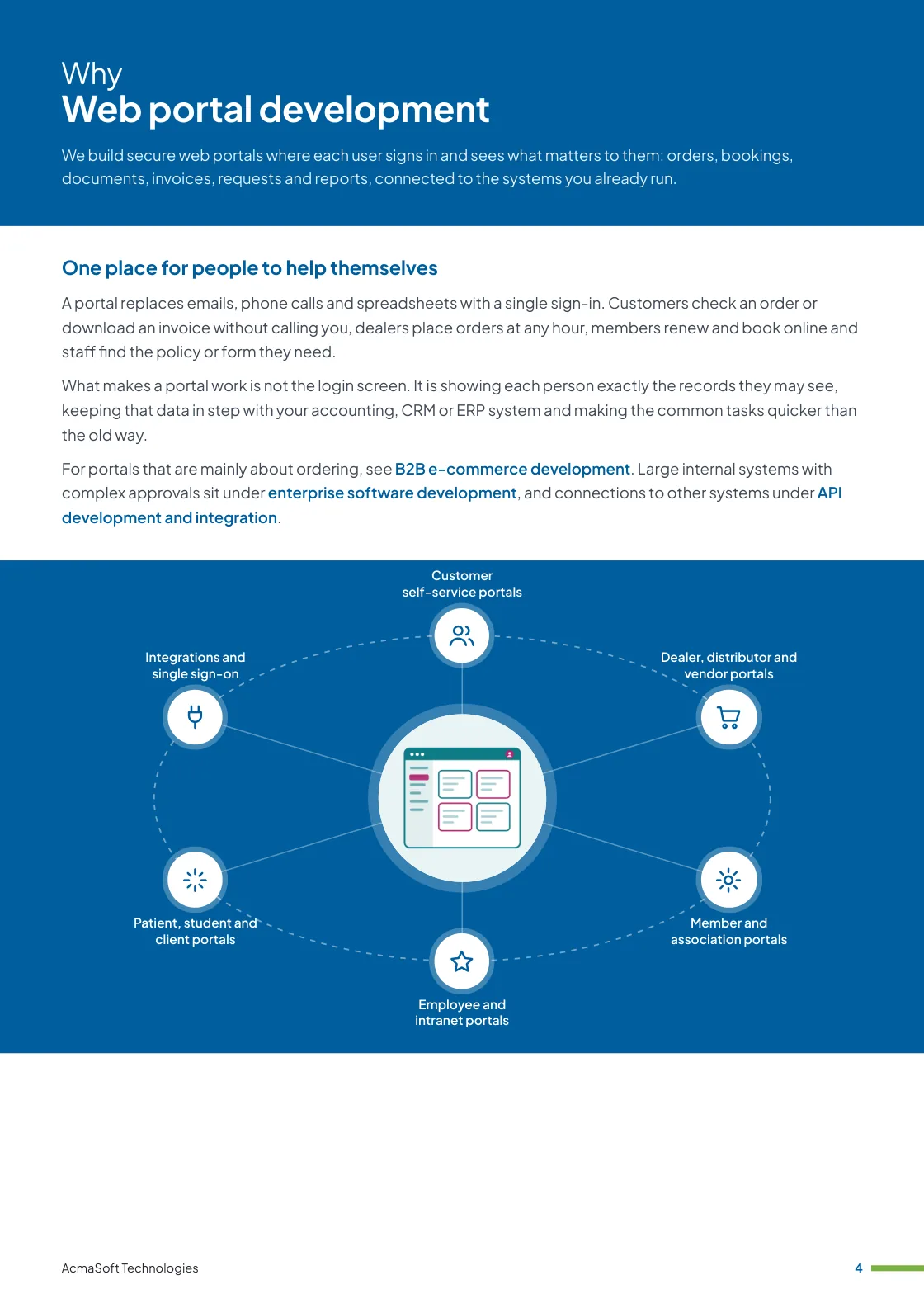
- Customer self-service portals
- Dealer, distributor and vendor portals
- Member and association portals
- Employee and intranet portals
- Patient, student and client portals
- One named lead from first call to launch
- Support and improvements after launch
More in Software and app development
Web portals we build
Six portal types, each built around the people who use it and the records they need.
-
Customer self-service portals
Fewer calls, faster answers
Customers see their orders, bookings, tickets, invoices and documents, raise requests and update their details.
Frequent questions get answered on screen instead of by your support team.
-
Dealer, distributor and vendor portals
Business partners online
Partners place orders, check stock and pricing, track shipments, download marketing material and submit claims or invoices.
Each partner sees only its own prices, orders and documents.
-
Member and association portals
Join, renew and take part
Membership sign-up and renewal with online payment, directories, event booking, certificates and member-only content.
Admins manage members and payments without spreadsheets.
-
Employee and intranet portals
Everything staff need in one place
Policies, forms, leave and expense requests, announcements and links to internal systems, with sign-in through your company account.
Content is easy for HR and admin teams to update.
-
Patient, student and client portals
Records and appointments online
Booking, reports, results, course material, fee payments and messages for clinics, schools, training providers and professional firms.
Personal data is protected with strong sign-in and access logs.
-
Integrations and single sign-on
Connected to your systems
Portals read from and write to accounting, CRM, ERP, LMS or practice systems such as Tally, Zoho, Salesforce or SAP through their APIs.
Users can sign in with Google, Microsoft or a one-time code sent to their phone.
What to look for in a web portal development company
A portal holds your customers' and staff data. Choose a partner who offers:
-
Security by design
Role-based access checked on every request, audit logs, encryption and regular dependency updates.
-
Integration experience
A record of connecting portals to accounting, CRM and ERP systems without duplicate or missing data.
-
Usability for non-technical users
Simple journeys tested with real users, accessible design and clear help text.
Ways to work with us
Choose the model that fits your scope and budget for web portal development. Many clients start with one and move to another as the work grows.
-
Fixed price
A defined scope delivered for an agreed price and timeline, in milestones you approve.
- Best for
- Clear requirements, a fixed budget and a firm deadline.
- How it is priced
- One agreed price, paid in instalments tied to milestones.
-
Dedicated team
A team with a project lead that works only on your product, on the priorities you set.
- Best for
- Long-term products and roadmaps that change often.
- How it is priced
- A monthly fee per team member, based on role and seniority.
-
Time and material
You pay for the hours worked and can change the scope as you learn, in short iterations.
- Best for
- Requirements that are hard to fix up front, and ongoing improvements.
- How it is priced
- Hourly or daily rates by role, invoiced monthly against logged time.
Need full-stack developers to join your own team instead?
Hire full-stack developersWhat our clients say
More client reviews-
Collaborating with AcmaSoft using agile methods has been a pleasure. Their team's adaptability and communication ensure a smooth development journey.
Rahul S Bangalore -
Working with AcmaSoft has been a game-changer for our business. Their web development team exceeded our expectations, delivering a seamless and user-friendly platform. Kudos from London!
John D London


Industries we serve
We deliver web portal development for businesses in these industries, and adapt it to the rules, systems and customers of each one.






Technology we use
We choose the stack for your budget, goals and current systems. Each link explains how we work with that technology or product.
Front end
Not sure which technology fits your project? Ask one of our architects.
Talk to an architectWorking with international clients
Our team delivers remotely, so the questions that matter are when we can talk and how the work is run. Here are our office hours beside yours.
Our office hours Monday to Saturday, 9:30 am to 6:30 pm India time (IST)
Evening hours for North American clients, by arrangement: Monday to Friday, 6:30 pm to 9:30 pm India time
| Your region | Our hours in your time | Shared working hours |
|---|---|---|
| UKLondon | 4 am to 1 pm | 9 am to 1 pm |
| Central EuropeParis, Berlin | 5 am to 2 pm | 9 am to 2 pm |
| US EastNew York, Toronto | 11 pm to 8 am (next day) Evening hours to 11 am | 9 am to 11 am In our evening hours, by arrangement |
| US WestLos Angeles, Vancouver | 8 pm to 5 am (next day) Evening hours to 8 am | No overlap Early calls 7 am to 8 am, by arrangement |
| GulfDubai, Abu Dhabi | 8 am to 5 pm | 9 am to 5 pm |
| Singapore | 12 noon to 9 pm | 12 noon to 6 pm |
| Australia EastSydney, Melbourne | 3 pm to 12 midnight | 3 pm to 6 pm |
Our day ends before yours starts, so updates are waiting each morning and we agree call times with you.
Times follow daylight saving where your region uses it, against a working day of 9 am to 6 pm. Messages sent outside our hours are picked up when the team is back.
-
Remote delivery
Discovery, design, development and testing run remotely, with one named lead, a demo of working features at the end of each sprint and a staging site you can try.
-
How we stay in touch
Email, video calls and chat such as Slack, Microsoft Teams or WhatsApp, with the hours of overlap and meeting times agreed in the communication plan at the start.
-
Contracts and invoices
Proposals, contracts and invoices are in English and priced in US dollars, or in your own currency on request. A non-disclosure agreement can be signed before you share any details.
-
Privacy laws we design for
We design forms, consent and data handling with the law of your market in mind: GDPR and UK GDPR, CCPA and CPRA, PIPEDA, the UAE PDPL, the Australian Privacy Act, Singapore's PDPA and India's DPDP Act.
Questions about web portal development
Something else on your mind? Ask us directly and a specialist will reply.
Ask a questionShould we build a portal or buy a ready-made one?
Ready-made portals that come with your CRM, ERP or practice software are worth using when they cover your journeys. A custom portal makes sense when users need data from several systems, your process differs from the vendor's or licence costs per user are high. We compare both before recommending one.
How do you keep each user's data private?
Every request checks who the user is and which records they may see, at the server rather than only on screen. We add audit logs, encryption in transit and at rest, strong sign-in options and regular security updates.
Can users sign in without a password?
Yes. Portals can use one-time codes sent by SMS, WhatsApp or email, sign-in with Google or Microsoft, or single sign-on with your company directory.
Can the portal work on phones?
Yes. We design portals mobile first, and can add an installable web app or a native app when users need offline access or notifications.
Can you add a portal to our existing website?
Yes. The portal can sit on a subdomain or a section of your current site, using your branding, while running as a separate application that is easier to secure and update.
Web portal development brochure
We build secure web portals where each user signs in and sees what matters to them: orders, bookings, documents, invoices, requests and reports, connected to the systems you already run.
Inside this brochure
- One place for people to help themselves
- Web portals we build
- How a web portal project runs
- Technologies and solutions
- 2.6 MB
- 10 pages
- Services
You have downloaded from us before, so this one needs no form.
Get the brochure
Tell us who you are and the download starts straight away. We remember you on this device for 90 days, so you only fill this in once.
Your download has started.
If it does not start, download the brochure here. The links work for 15 minutes.
- Your reference
- Brochure
What you can do next
- Read it and share itShare the brochure with your team before you get in touch. It is free to read and share.
- Get a quote when you are readySix short questions on our request a quote page, and a reply within one business day.
Start your Web portal development project
Tell us what you are planning and a specialist will reply with next steps, a rough timeline and the questions we need answered.
- Emailsales@acmasoft.com
- Call+1 (707) 706 4092
- Prefer a call?
Thank you, your message is on its way.
It has reached our sales team, together with the page you sent it from.
- Your reference
- Budget
While we prepare your reply, here is the Web portal development brochure.
Download the brochure, Web portal development brochure, PDF, 2.6 MBWhat happens next
- A specialist gets in touchWithin one business day, by email or phone, with any questions about what you need.
- We talk it throughA short call about your goals, users, timeline and budget. We can sign an NDA first.
- You get a proposalScope, team, timeline and cost, with the engagement model that fits the work.