

Multi-vendor marketplace development for platforms where many sellers trade
At AcmaSoft, we build multi-vendor marketplaces with seller onboarding and verification, commission rules, split payments and payouts, product moderation, reviews and dispute handling, on a platform chosen for your business model.

- Years of experience
- 17+
- Clients served
- 650+
- Projects delivered
- 2,000+
- Products shipped
- 300+
What a marketplace has to manage
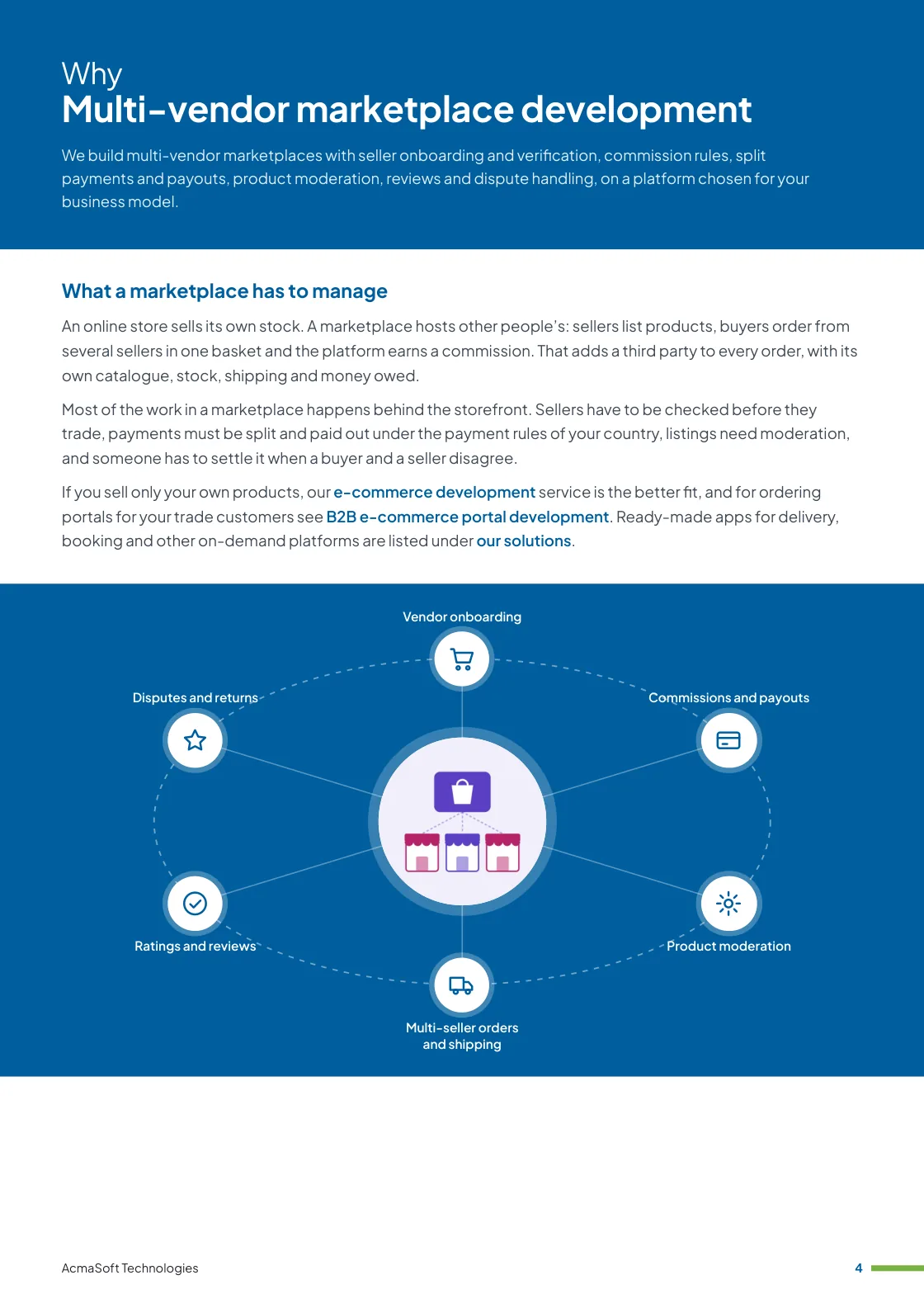
An online store sells its own stock. A marketplace hosts other people’s: sellers list products, buyers order from several sellers in one basket and the platform earns a commission. That adds a third party to every order, with its own catalogue, stock, shipping and money owed.
Most of the work in a marketplace happens behind the storefront. Sellers have to be checked before they trade, payments must be split and paid out under the payment rules of your country, listings need moderation, and someone has to settle it when a buyer and a seller disagree.
If you sell only your own products, our e-commerce development service is the better fit, and for ordering portals for your trade customers see B2B e-commerce portal development. Ready-made apps for delivery, booking and other on-demand platforms are listed under our solutions.
What you get with multi-vendor marketplace development
- Vendor onboarding
- Commissions and payouts
- Product moderation
- Multi-seller orders and shipping
- Ratings and reviews
- One named lead from first call to launch
- Support and improvements after launch
More in Software and app development
What we build for multi-vendor marketplaces
Six parts of a marketplace that keep sellers, buyers and your operations team working together.
-
Vendor onboarding
Sellers checked before they sell
Seller sign-up with business, tax and bank details and document upload, followed by review and approval by your team, with identity checks through your payment provider where its rules require them.
A seller dashboard covers listings, stock, orders, returns and earnings.
-
Commissions and payouts
Everyone paid correctly
Commission rules by category, seller or plan, plus subscription or listing fees if your model uses them, applied to every order line.
Split payments and scheduled payouts run through marketplace payment services such as Stripe Connect or Razorpay Route, with statements sellers can reconcile.
-
Product moderation
A catalogue buyers can trust
Listing rules, approval queues and checks for prohibited products, plus matching so that several sellers offering the same item can share one product page where your model calls for it.
Bulk upload by spreadsheet or API lets larger sellers list their full range.
-
Multi-seller orders and shipping
One basket, several sellers
A basket with items from several sellers is split into sub-orders, each with its own shipping rules, tracking and returns.
Sellers can ship themselves or use the shipping services you integrate, such as ShipStation or EasyPost, Shiprocket in India, or the carriers’ own APIs.
-
Ratings and reviews
Feedback from real buyers
Product and seller reviews limited to buyers who completed an order, with reporting and moderation of abusive or fake reviews.
Seller ratings can feed into search ranking and into decisions about which sellers to promote or suspend.
-
Disputes and returns
Settling disagreements fairly
Buyers raise a problem from their order, the seller replies within a set time and your team steps in if they cannot agree, with refunds and payout holds applied from the same screen.
Every message and decision is kept on record.
What to look for in a marketplace development company
A marketplace has more moving parts than a single store. Look for a provider with:
-
Knowledge of payment rules
An understanding of how split payments, seller verification and payouts work with the payment providers in your markets.
-
Advice on build or buy
A fair comparison of marketplace platforms, extensions and a custom build, based on your commission model and expected growth.
-
Tools for your operations team
Admin screens for approving sellers, moderating listings and resolving disputes, not only a storefront.
Ways to work with us
Choose the model that fits your scope and budget for multi-vendor marketplace development. Many clients start with one and move to another as the work grows.
-
Fixed price
A defined scope delivered for an agreed price and timeline, in milestones you approve.
- Best for
- Clear requirements, a fixed budget and a firm deadline.
- How it is priced
- One agreed price, paid in instalments tied to milestones.
-
Dedicated team
A team with a project lead that works only on your product, on the priorities you set.
- Best for
- Long-term products and roadmaps that change often.
- How it is priced
- A monthly fee per team member, based on role and seniority.
-
Time and material
You pay for the hours worked and can change the scope as you learn, in short iterations.
- Best for
- Requirements that are hard to fix up front, and ongoing improvements.
- How it is priced
- Hourly or daily rates by role, invoiced monthly against logged time.
Need full-stack developers to join your own team instead?
Hire full-stack developersWhat our clients say
More client reviews-
Our e-commerce platform developed by AcmaSoft Technologies has transformed our online presence. Sales are up, and our customers love the new interface. Thank you!
Sophie M Paris -
Working with AcmaSoft has been a game-changer for our business. Their web development team exceeded our expectations, delivering a seamless and user-friendly platform. Kudos from London!
John D London
Industries our software and app development team works in
Our software and app development team builds for businesses in these industries, and we adapt multi-vendor marketplace development to each one's rules, systems and customers.


Technologies we use
We choose the stack for your budget, goals and current systems. Each link explains how we work with that technology or product.
Back end
E-commerce
Not sure which technology fits your project? Ask one of our architects.
Talk to an architectWorking with international clients
Our team delivers remotely, so the questions that matter are when we can talk and how the work is run. Here are our office hours beside yours.
Our office hours Monday to Saturday, 9:30 am to 6:30 pm India time (IST)
Evening hours for North American clients, by arrangement: Monday to Friday, 6:30 pm to 9:30 pm India time
| Your region | Our hours in your time | Shared working hours |
|---|---|---|
| UKLondon | 4 am to 1 pm | 9 am to 1 pm |
| Central EuropeParis, Berlin | 5 am to 2 pm | 9 am to 2 pm |
| US EastNew York, Toronto | 11 pm to 8 am (next day) Evening hours to 11 am | 9 am to 11 am In our evening hours, by arrangement |
| US WestLos Angeles, Vancouver | 8 pm to 5 am (next day) Evening hours to 8 am | No overlap Early calls 7 am to 8 am, by arrangement |
| GulfDubai, Abu Dhabi | 8 am to 5 pm | 9 am to 5 pm |
| Singapore | 12 noon to 9 pm | 12 noon to 6 pm |
| Australia EastSydney, Melbourne | 3 pm to 12 midnight | 3 pm to 6 pm |
Our day ends before yours starts, so updates are waiting each morning and we agree call times with you.
Times follow daylight saving where your region uses it, against a working day of 9 am to 6 pm. Messages sent outside our hours are picked up when the team is back.
-
Remote delivery
Discovery, design, development and testing run remotely, with one named lead, a demo of working features at the end of each sprint and a staging site you can try.
-
How we stay in touch
Email, video calls and chat such as Slack, Microsoft Teams or WhatsApp, with the hours of overlap and meeting times agreed in the communication plan at the start.
-
Contracts and invoices
Proposals, contracts and invoices are in English and priced in US dollars, or in your own currency on request. A non-disclosure agreement can be signed before you share any details.
-
Privacy laws we design for
We design forms, consent and data handling with the law of your market in mind: GDPR and UK GDPR, CCPA and CPRA, PIPEDA, the UAE PDPL, the Australian Privacy Act, Singapore's PDPA and India's DPDP Act.
Questions about multi-vendor marketplace development
Something else on your mind? Ask us directly and a specialist will reply.
Ask a questionHow do commissions and seller payouts work?
The buyer pays the platform, the payment provider splits the amount between seller and platform according to your commission rules, and sellers are paid on a schedule you set. Services such as Stripe Connect or Razorpay Route handle the split and the seller checks their rules require.
Should we build a marketplace from scratch or use an existing platform?
A marketplace platform or extension, for example on WooCommerce or Magento, launches sooner and suits a standard commission model. A custom build makes sense for unusual business rules, high expected volume or features the platforms do not support. We compare cost and time for both before you decide.
How are sellers verified?
Sellers supply business, tax and bank details with supporting documents, which your team reviews in the admin panel. Identity and bank checks for payouts are usually carried out by the payment provider, as the regulations in your market require.
How are disputes between buyers and sellers handled?
Buyers open a case from their order, the seller has a set time to respond and your team decides if they cannot agree. Refunds, partial refunds and payout holds are applied from the case screen, and the full history is kept.
Can the marketplace have mobile apps as well?
Yes. The marketplace exposes its features through an API, so iOS and Android apps for buyers, and for sellers if needed, share the same back end. Launching on the web first and adding apps once demand is clear keeps the first release smaller.
Can you build a group buying, deal or voucher platform?
Yes, as a custom marketplace. The model behind the daily deal sites now runs local experience marketplaces, membership discount schemes, employee perks programmes and merchant networks that sell vouchers. Merchants publish offers with terms, quantity limits, dates and a minimum number of buyers for group deals. Customers buy vouchers with their own codes or QR codes, merchants redeem them from an app or a web screen with checks that stop double use, and payouts follow your commission rules. Search by city, category and price, alerts for new offers, referral credits and promo codes complete the platform.
Do you build penny auction or bid-to-win platforms?
Yes, built around your products and market. The auction engine runs countdowns, bid increments and timer extensions on the server, so every bidder sees the same state, and records every bid. Bid packages and a user wallet, optional auto-bid with limits set by the user, rate limits, device checks and audit logs that flag automated or shill bidding, published auction rules and winner checkout are part of the build. Rules on penny auctions differ by country and can fall under gambling, lottery or consumer protection law, so we ask you to take local legal advice before launch.
Related insights
All insights-
 16 Nov 2026
Shopify vs WooCommerce vs Magento (Adobe Commerce): which platform in 2026
Shopify, WooCommerce and Magento compared on fees, licences, hosting, updates and skills, with each vendor's published prices as of November…
-
 16 Nov 2026
E-commerce development guide: platforms, costs and a launch plan
How to build an online store: choosing the platform, what drives build and running costs, payments and PCI DSS, selling…

Multi-vendor marketplace development brochure
We build multi-vendor marketplaces with seller onboarding and verification, commission rules, split payments and payouts, product moderation, reviews and dispute handling, on a platform chosen for your business model.
Inside this brochure
- What a marketplace has to manage
- What we build for multi-vendor marketplaces
- How a marketplace project runs
- Technologies and solutions
- 2.9 MB
- 10 pages
- Services
You have downloaded from us before, so this one needs no form.
Get the brochure
Tell us who you are and the download starts straight away. We remember you on this device for 90 days, so you only fill this in once.
Your download has started.
If it does not start, download the brochure here. The links work for 15 minutes.
- Your reference
- Brochure
What you can do next
- Read it and share itShare the brochure with your team before you get in touch. It is free to read and share.
- Get a quote when you are readySix short questions on our request a quote page, and a reply within one business day.
Start your Multi-vendor marketplace development project
Tell us what you are planning and a specialist will reply with next steps, a rough timeline and the questions we need answered.
- Emailsales@acmasoft.com
- Call+1 (707) 706 4092
- Prefer a call?
Thank you, your message is on its way.
It has reached our sales team, together with the page you sent it from.
- Your reference
- Budget
While we prepare your reply, here is the Multi-vendor marketplace development brochure.
Download the brochure, Multi-vendor marketplace development brochure, PDF, 2.9 MBWhat happens next
- A specialist gets in touchWithin one business day, by email or phone, with any questions about what you need.
- We talk it throughA short call about your goals, users, timeline and budget. We can sign an NDA first.
- You get a proposalScope, team, timeline and cost, with the engagement model that fits the work.