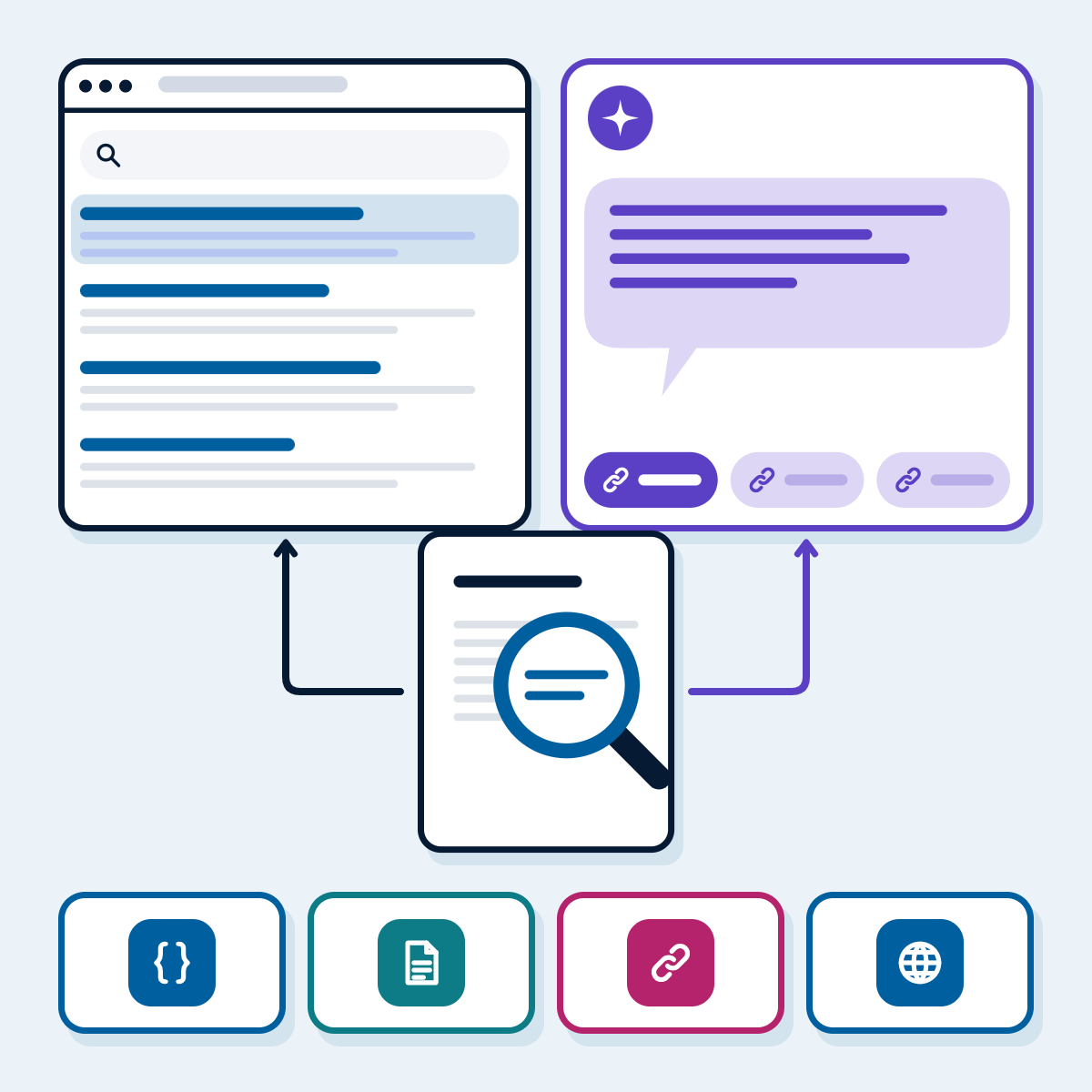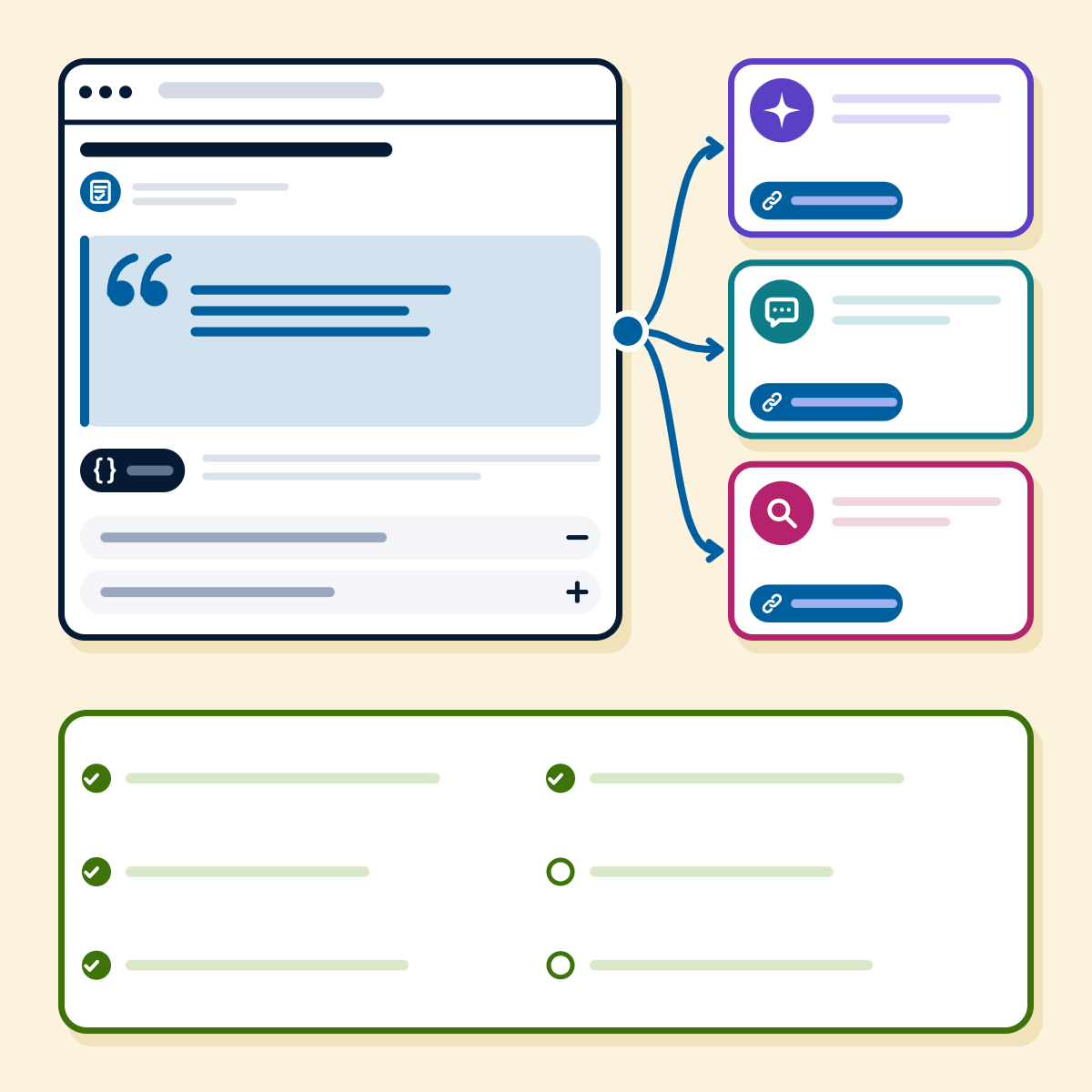
A five-part checklist for being cited in AI answers, built from what Google, OpenAI, Perplexity and Microsoft publish: crawler access, indexing, content worth quoting, authorship and real mentions.
When a buyer asks Google, ChatGPT or Perplexity “which company should I use for this?” or “how much does this cost?”, the answer names a handful of sources. Being one of them is now worth as much as a first-page ranking. Nobody can promise you a citation, and anyone who does is guessing. What you can do is remove every reason an AI search product has to skip your page.
This is the practical checklist we use, built from what Google, OpenAI, Perplexity and Microsoft publish about their own systems, each source checked on 13 Nov 2026. It is the hands-on companion to our pillar guide on SEO in the age of AI search, which explains how AI answers are built and why classic SEO still decides most of the outcome.
Key takeaways
- Every AI search product cites pages from a search index, so a page has to be crawlable and indexed by that product's crawler before anything else matters.
- Each product has its own crawler: Googlebot for AI Overviews and AI Mode, OAI-SearchBot for ChatGPT search, PerplexityBot for Perplexity and Bingbot for Copilot.
- Pages that get cited answer a specific question early, with first-hand detail, dated figures and named sources.
- Structured data must match the visible page; Google says no special markup is needed for AI features, and it stopped showing FAQ rich results on 7 May 2026.
- Test with a fixed list of real buyer questions every month, and treat any promise of guaranteed AI placement as a warning sign.
How each AI search product picks its sources
The products differ in whose index they use and how you control access. The table summarises what each company documents.
| Product | Crawler to allow | What the company says it needs | Useful detail |
|---|---|---|---|
| Google AI Overviews and AI Mode | Googlebot | Indexed and eligible to show a snippet; no extra requirements or special markup | Counted in Search Console's Performance report; a Generative AI performance report covers AI features |
| ChatGPT search | OAI-SearchBot | Allow OAI-SearchBot in robots.txt and requests from OpenAI's published IP ranges | Robots.txt changes take about 24 hours to apply; GPTBot (training) is a separate choice |
| Perplexity | PerplexityBot | Allow PerplexityBot and its published IP ranges, including in your firewall | PerplexityBot is not used for training; Perplexity-User fetches pages a user asks about |
| Microsoft Copilot | Bingbot | Bing index; IndexNow recommended for new, changed and deleted URLs | New AI Training and AI Grounding preferences honoured from 1 Feb 2027 |
Source: Google: AI features and your website; OpenAI crawlers documentation; Perplexity crawlers documentation; Bing webmaster guidelines and Microsoft announcement of 30 Oct 2026; all checked 13 Nov 2026
Two lessons follow. First, an AI product cannot cite a page its crawler cannot read, so access is step one for each product separately. Second, Google’s position is explicit: “There are no additional requirements to appear in AI Overviews or AI Mode, nor other special optimizations necessary.” The work is mostly making good pages easy to reach and worth quoting.
Part 1: let each crawler in
The cause of a missing citation is often mundane: a firewall rule, a CDN bot setting or a robots.txt line written years ago. Check access first, with evidence from your server logs rather than assumptions.
Crawler access
- robots.txt allows Googlebot, Bingbot, OAI-SearchBot and PerplexityBot on the pages you want cited
- CDN, firewall and bot-protection rules let those crawlers through, using each company's published IP ranges where offered
- Server logs show each crawler fetching your key pages and receiving a 200 status
- Key content is in the HTML or renders without errors; it is not only in images, PDFs or behind a login
- Pages do not use noindex, nosnippet or a very low max-snippet unless you mean them to
- Training crawlers (GPTBot, Google-Extended) are allowed or blocked on purpose, as a separate decision
Blocking a training crawler does not remove you from AI search. Google states that Google-Extended “does not impact a site’s inclusion in Google Search”, and OpenAI describes OAI-SearchBot and GPTBot as independent settings. The full table of crawler tokens is in our SEO and AI search guide.
Part 2: get indexed and stay fresh
Indexing and freshness
- The page is indexed in Google (URL Inspection in Search Console) and in Bing (Bing Webmaster Tools)
- Your site is included in the Search generative AI features setting in Search Console
- Each page has one canonical URL; duplicates and parameter versions point to it
- Internal links from related pages make the page easy to find
- The XML sitemap lists the page with an accurate last-modified date
- IndexNow (for Bing and Copilot) or sitemap pings are sent when you add, change or delete a page
- Outdated pages are updated or redirected, so AI answers do not repeat old prices or policies
Part 3: write a page that is worth citing
Google’s guide to generative AI features says unique, useful content “will likely influence your website’s presence in generative AI search in the long run more than any of the other suggestions” in it. It distinguishes “commodity” content, based on common knowledge, from “non-commodity” content that offers expert or first-hand experience. AI answers already contain the common knowledge; what they need from a source is the specific detail they cannot produce themselves.
Content that gets quoted
- The page targets one clear question, and the first paragraph answers it in plain words
- Claims are specific: your prices, timelines, steps, limits and decisions, with the date they apply
- Every figure from elsewhere names its source and links to it
- First-hand evidence appears where it exists: your process, real project examples, what you would advise against
- Comparisons use a table with the criteria a buyer actually weighs
- Headings say what the section answers, so a reader scanning the page finds it
- Terms are defined the first time they appear
- The page says what it does not cover and links to the page that does
Here is the difference in practice. A commodity sentence reads: “Cloud migration can reduce costs and improve scalability.” Any AI model can write that, so it has no reason to cite you. A non-commodity version reads like this, from our own cloud migration page: copying servers across unchanged “is quick but can cost more each month than the hosting it replaces”, and for a typical business website, managed hosting “can be simpler and cheaper, and we will tell you when that is the better answer”. It states a position, a trade-off and what the company will actually do.
Google also warns against overdoing it. Writing separate pages for every variation of a question, mainly to influence AI answers, breaks its scaled content abuse policy, and there is no need to break content into small “chunks” for AI. Write for the reader; organise with clear headings and paragraphs, which Google says people appreciate.
Want a second opinion on your plans?
Tell us what you are working on. A specialist will look at it and reply with practical next steps.
Get in touchPart 4: show who is behind the page
Google’s helpful content guidance asks site owners to consider “Who, How, and Why”: is it clear who created the content, how it was made, and why it exists? Of the qualities Google groups as E-E-A-T (experience, expertise, authoritativeness and trustworthiness), it says trust is the most important.
Authorship and trust
- Articles carry a byline with the author's name and role
- The byline links to an author page with real background, areas of expertise and credentials
- The page shows a published date and, where it applies, a last reviewed date
- Your About, contact and company details are easy to find and match your Business Profile
- Policies, prices and terms that buyers ask about are published, not hidden behind a form
- Corrections are made in the page and the reviewed date updated
Structured data that matches the page
Structured data is not required for AI features. Google says there is “no special schema.org structured data that you need to add”. It still helps search engines connect a page to its author and organisation, and Google’s Article documentation describes the properties it uses. A minimal Article block with a named author looks like this:
{
  "@context": "https://schema.org",
  "@type": "Article",
  "headline": "How much does a cloud migration cost?",
  "datePublished": "2026-12-01T09:00:00+00:00",
  "dateModified": "2027-03-01T09:00:00+00:00",
  "author": [{
    "@type": "Person",
    "name": "Author Name",
    "jobTitle": "Head of Cloud",
    "url": "https://www.example.com/author/author-name/"
  }],
  "publisher": {
    "@type": "Organization",
    "name": "Example Ltd",
    "url": "https://www.example.com/"
  }
}
Google recommends that when the author URL is an internal profile page, that page carries profile page markup. Two rules matter more than any property: the markup must describe what is visible on the page, and dates must be real. If you have FAQPage markup, keep it only where the questions and answers are visible; it remains valid schema.org, but Google stopped showing the FAQ rich result on 7 May 2026.
Part 5: earn real mentions and keep facts consistent
AI answers describe businesses using what is said about them across the web, and Google’s guide names Merchant Center feeds and Business Profiles as sources for product and local business details. It also says that “seeking inauthentic ‘mentions'” is not as helpful as it might seem, because its core ranking and spam systems apply to AI features too.
Off-site signals
- Business name, address, phone, services and hours match across your site, Google Business Profile and directories
- Product data in Merchant Center or other feeds matches the prices and stock on your pages
- Your experts publish or speak where your buyers already read: industry media, events, podcasts
- Original research or useful tools give others a reason to cite you on their own
- Reviews are collected from real customers on the platforms buyers check
- No paid link schemes, planted forum posts or fake reviews
Our digital PR team works on the earned side of this list, and our content marketing team on the research and articles that give others something worth citing.
What not to do
Do not hide text for crawlers, show bots different content from people, or mass-produce near-identical pages for every question variation. Google's spam policies name hidden text, cloaking and scaled content abuse, and they apply to its generative AI responses as well as its classic results. Be wary of anyone promising guaranteed placement in AI answers: Google says no third-party tool has access to its internal ranking or AI systems.
How to test whether you are cited
There is no single report that shows every AI citation. A simple, repeatable routine works better than any score:
Step 1: Write the question list
Collect 20 to 50 questions from sales calls, support tickets and Search Console queries, in your buyers' own words. Include questions with your brand name and without it.
Step 2: Run it monthly in each product
Ask each question in Google (AI Overviews and AI Mode where shown), ChatGPT search, Perplexity and Copilot. Use a clean browser profile and note the country, because answers can vary by location.
Step 3: Record what you see
For each answer, record whether you are mentioned, cited with a link, or missing, and which sources appear instead.
Step 4: Compare with your analytics
Check Search Console's Generative AI performance report and referral visits from AI assistants, and track conversions from those visits.
Step 5: Change one thing at a time
Improve the page that should answer a question you are missing from, note the date, and recheck next month.
| Question | Product | Cited? | Sources shown instead | Page to improve |
|---|---|---|---|---|
| How long does a cloud migration take? | Perplexity | No | Two vendor blogs, one forum thread | /cloud-migration-guide/ |
| Cloud migration company for a UK retailer | ChatGPT search | Mentioned, no link | Directory listing | /services/cloud-migration/ |
Source: AcmaSoft working template
The rows above show the layout only; they are not results. Keep the log in a shared sheet so marketing and sales can add questions as they hear them.
How we approach AI citations at AcmaSoft
Our answer engine optimisation service follows the order of this checklist: an AI visibility audit with the questions your buyers ask, crawler and firewall access, structured data that matches your pages, consistent business facts across your site and profiles, and content rewritten around first-hand answers. We report against the same fixed question list every month, so progress is measured on what buyers actually ask. We do not promise placement, because no one can.
We use the same approach on our own site: one international page per topic for buyers in the UK, USA, Canada, UAE, Australia, India, Singapore and Europe, bylines from real staff profiles, and figures that name their source and date, as in this article.
Find out where you stand in AI answers
- We run your buyers' questions through Google, ChatGPT, Perplexity and Copilot, check crawler access and indexing, and give you a prioritised list of pages to fix. See our answer engine optimisation service.
Get new guides by email
Articles and guides from our team, and company news. Unsubscribe at any time.
About AcmaSoft
AcmaSoft designs and builds websites, mobile apps and custom software, and runs SEO and digital marketing for its clients.
- Years of experience
- 17+
- Clients served
- 650+
- Projects delivered
- 2,000+
- Products shipped
- 300+