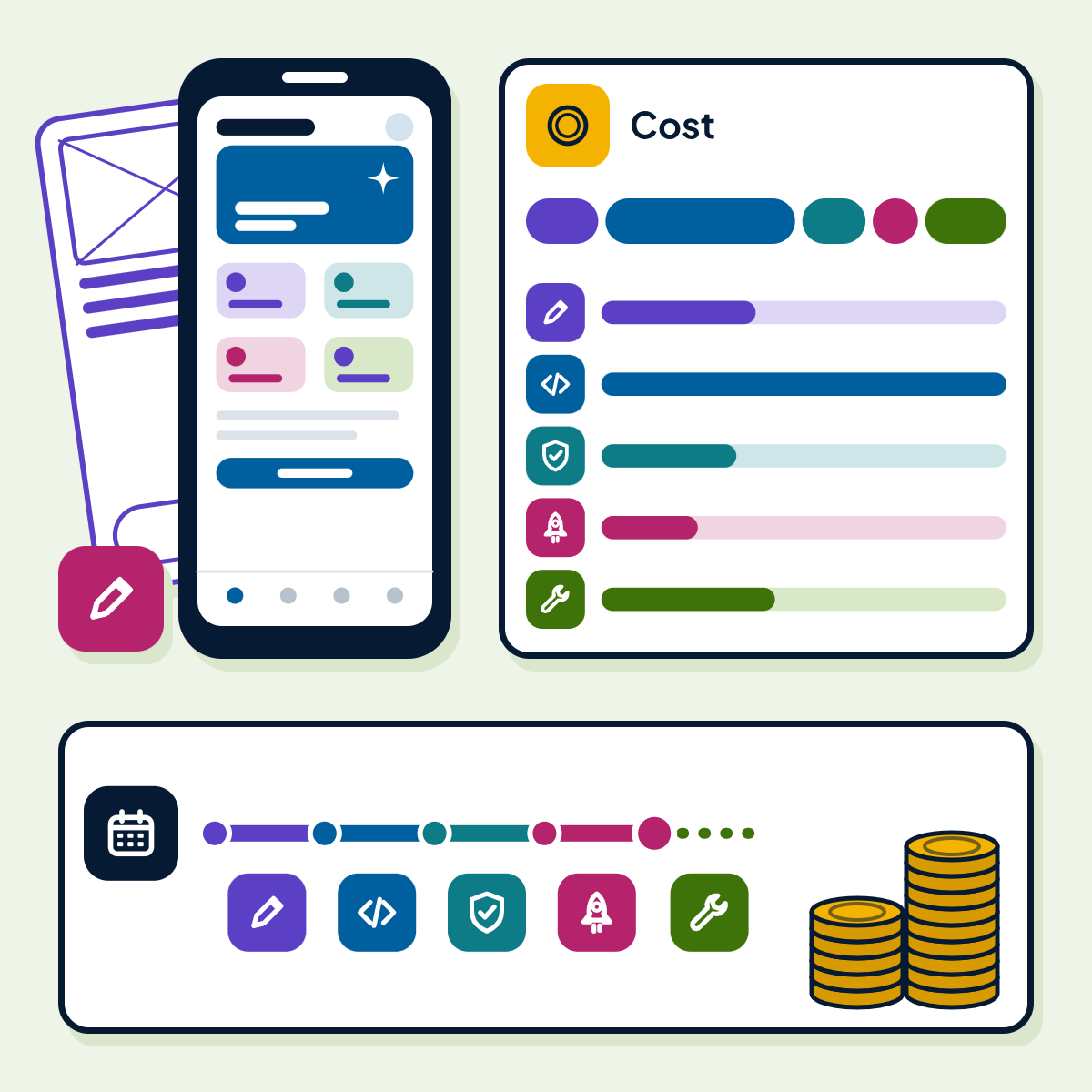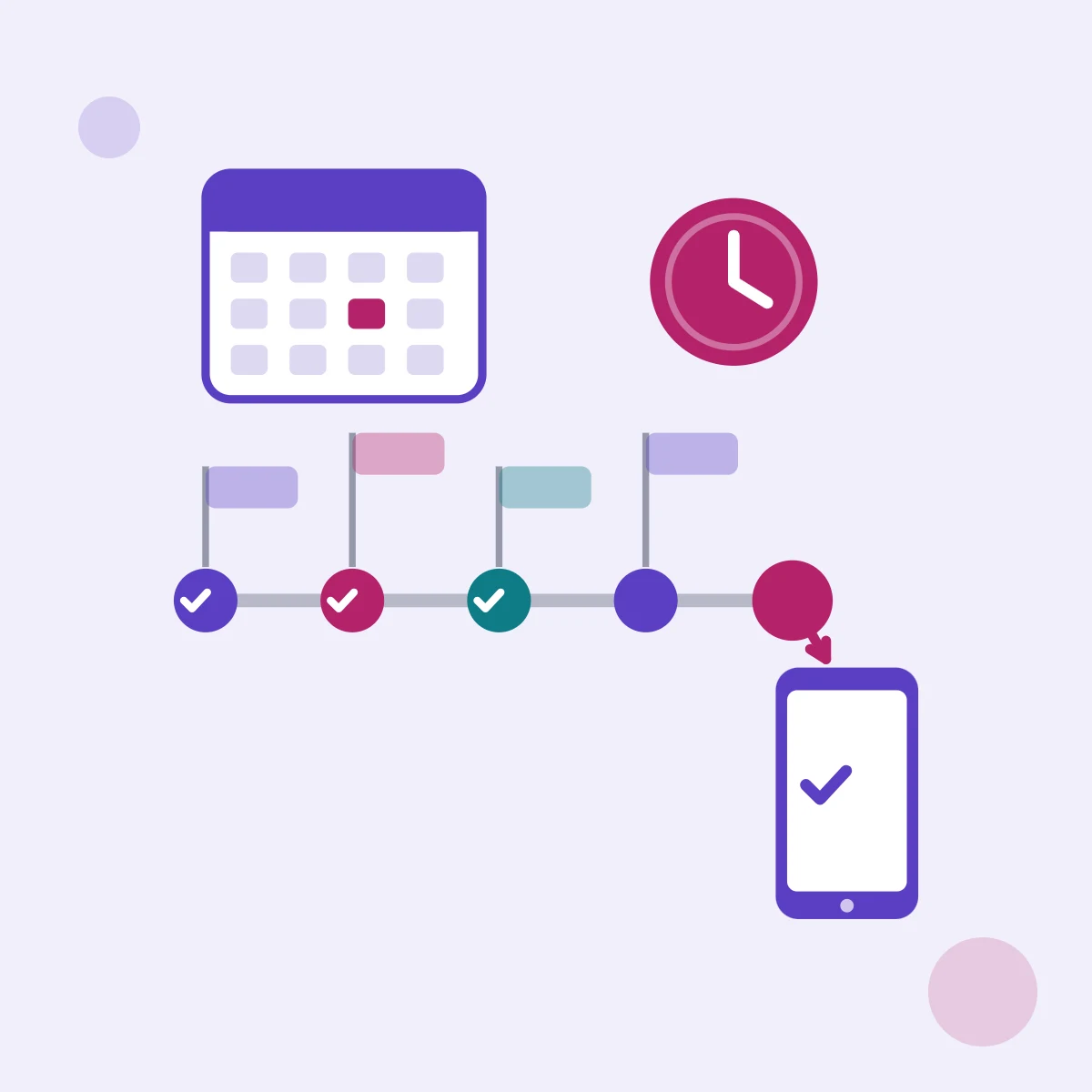
An app project broken into its seven stages, with planning ranges by app size, what Apple and Google say about store review times, what makes apps run late and how to ship sooner without cutting corners.
“How long will the app take?” is one of the first questions every founder and product manager asks, and one of the hardest to answer before the scope is clear. A booking app with a customer app and an admin panel is a different project from a field service platform with offline sync, payments and three user roles. Both are “an app”; their timelines can differ by months.
This guide breaks an app project into its stages, explains what each one produces and what moves it to the short or long end, and sets out what Apple and Google themselves say about store review times. The durations in it are planning assumptions to help you sanity-check a plan, not measured data and not a quote: a written timeline always follows a review of your own scope. Time and budget move together, so read it alongside our breakdown of what it costs to build an app.
Key takeaways
- An app timeline is the sum of seven stages: discovery, design, technical planning, development, testing, store submission and the work after launch.
- Scope decides the length more than anything else: the number of user roles, integrations and offline or real-time features.
- Apple says it typically reviews at least 50% of submissions in under 24 hours and 90% in under 48 hours; Google says some reviews can take up to seven days or longer in exceptional cases.
- New personal Google Play developer accounts must run a closed test with at least 12 testers for 14 days before production, so plan it into the first release.
- The fastest safe route is a narrow first release, one cross-platform code base where it fits, and one decision maker on your side.
Why app timelines vary so much
Three things decide most of the length of an app project. The first is scope: how many screens, user roles and journeys the first release must support. The second is integration: every payment provider, ERP, CRM, map service or legacy database the app talks to brings access requests, test environments and someone else’s timetable. The third is decision speed: how quickly designs, test builds and changes are approved on your side.
Team size matters less than people expect: adding developers helps only when the work splits cleanly, and every extra person adds coordination.
Planning ranges by app size
The table gives the ranges we use as starting assumptions when a client asks for a rough plan before a scope exists. They are planning assumptions, not measured delivery data, and they assume a cross-platform build, a steady team and feedback within two working days. Your own plan replaces them as soon as the scope is written.
| Stage | Simple app | Medium app | Complex app |
|---|---|---|---|
| Discovery and scope | 1 to 2 | 2 to 3 | 3 to 4 |
| UX and UI design | 2 to 3 | 3 to 5 | 5 to 8 |
| Technical planning | Under 1 | 1 to 2 | 2 |
| Development | 6 to 10 | 12 to 20 | 24 or more |
| Focused testing before release | 1 to 2 | 2 to 4 | 4 to 6 |
| Store submission and launch | 1 | 1 to 2 | 2 |
Source: AcmaSoft planning assumptions for early conversations; not measured delivery data and not a quote
Stages overlap in practice: design continues while development starts on agreed flows, and testing runs in every sprint, not only at the end. So the total is shorter than the sum of the column. As a rough guide in the same spirit, a simple app (a content or catalogue app, a single-purpose tool, an internal form app) often reaches a first release in two to three months; a medium app (booking, ordering or membership with payments, an admin panel and notifications) in three to six months; and a complex app (a marketplace, an on-demand platform with several apps, fintech, or field operations with offline sync and integrations) in six to twelve months or more.
An MVP of a complex idea can often ship in the simple or medium range, because it covers one journey rather than the whole product. Our guide to MVP development covers how to choose that journey.
The stages, one by one
Step 1: Discovery and scope
Workshops on goals, users and the journeys the first release must support; a review of every system the app must connect to; and a written scope with a must-have list and a later list. This is the stage most often rushed and the one that saves the most time later.
Step 2: UX and UI design
User flows, wireframes, the visual design of key screens and a clickable prototype that real users can try. Time depends on the number of screens and user roles, and on how quickly feedback comes back.
Step 3: Technical planning
Native or cross-platform, back end, hosting and third-party services, plus a plan for data, security and integrations. Integration access is requested now, because it is often the slowest item.
Step 4: Development
Usually run in one or two week sprints with a test build after each: the mobile apps, the back end and APIs, the admin panel and every integration.
Step 5: Testing
Functional testing on real devices and operating system versions, performance and security checks, and acceptance testing by your team. Testing runs in every sprint, with a focused round before release.
Step 6: Store submission and launch
Store listings, screenshots, privacy details, closed testing where required, review and a staged release.
Step 7: After launch
Monitoring, crash fixes, operating system updates and the next features from the later list.
Discovery and scope
A week or two of discovery feels like a delay to many founders. It is the opposite. Discovery turns “a booking app” into a list of screens, roles, rules and integrations that a team can estimate and a client can approve. It is also where the first release is cut down to what proves the idea. Every extra week of unclear scope at this stage tends to cost several in development, because work gets built, changed and rebuilt.
UX and UI design
Design time depends less on visual polish than on the number of distinct screens and user roles. A clickable prototype tested with five or six real users catches the expensive misunderstandings before any code is written. Our article on the UX design process covers the steps in more detail.
Technical planning
The main decision here is whether to build two native apps or one cross-platform app. A cross-platform framework such as Flutter or React Native shares most of the code between Android and iOS, which usually shortens the build. Native apps make sense when the product depends heavily on platform-specific features. Our comparisons of Flutter and React Native and of native and cross-platform apps cover the choice.
Development
Development is the longest stage. Short sprints with a test build at the end of each let you see progress every week or two and catch misunderstandings early. Testing runs inside every sprint, with a focused round before release, and your team’s acceptance testing needs people and dates booked in advance.
Want a second opinion on your plans?
Tell us what you are working on. A specialist will look at it and reply with practical next steps.
Get in touchStore review: what Apple and Google say
Store review is the one stage you do not control, so it is worth knowing what the stores state themselves rather than relying on rumours.
| Store | What the store states |
|---|---|
| Apple App Store | App Review "typically" reviews at least 50% of submissions in less than 24 hours and 90% in less than 48 hours; incomplete submissions may be delayed or rejected |
| Apple expedited review | Can be requested in extenuating circumstances, such as fixing a critical bug or releasing for an event you are directly associated with |
| Google Play | For certain developer accounts Google takes more time to review, which "may result in review times of up to seven days or longer in exceptional cases" |
| Google Play, new personal accounts | Personal developer accounts created after 13 Nov 2023 must run a closed test with at least 12 testers opted in continuously for at least 14 days before publishing to production |
Source: Apple Developer, App Review; Google Play Console Help; checked 13 Nov 2026
Sources: Apple’s App Review page, Google’s guidance on preparing an app for review and its testing requirements for new personal developer accounts.
Two planning points follow. If you publish under a new personal Google Play account, the 14-day closed test sits on the critical path of your first release, so start it as soon as you have a stable build. The requirement applies to personal accounts; a business publishing under an organisation account is not covered by it. And a rejection adds a fix and another review on either store, usually over privacy details, sign-in, payments or incomplete information. Submitting a test build early through TestFlight and a Google Play testing track, and following the store guidelines from the design stage, avoids most of these. We plan app store optimisation (listing copy, screenshots and keywords) during development so it is ready before submission.
What makes an app take longer
- Unclear or changing scope. New features mid-sprint reset estimates and testing.
- Several user roles. A customer app, a staff or driver app and an admin panel are three products that must work together.
- Integrations. Payment gateways, ERPs, telephony, government or bank APIs and legacy systems each bring access, testing and approval steps.
- Offline working and real-time features. Sync, live tracking and chat need more design and more testing than simple screens.
- Regulation and security reviews. Finance and healthcare apps need extra documentation, audits and sign-offs.
- Slow feedback. Waiting a week for each approval can add months over a project.
How to ship sooner without cutting corners
Ways to shorten an app timeline safely
- Release one complete journey first and keep a written later list for everything else
- Use one cross-platform code base for Android and iOS where the features allow it
- Start from proven modules for booking, delivery, payments and admin panels instead of building them again
- Use managed services for sign-in, notifications, email and hosting
- Request access to every integration during technical planning, not in the sprint that needs it
- Name one decision maker on your side who can approve designs and builds within two working days
- Book your team's acceptance testing dates at the start of the project
- Open the store developer accounts early, as an organisation, and start closed testing on the first stable build
Our ready-made solutions start from that base of proven modules for common app types, which shortens the build for products that fit them.
How we plan app timelines at AcmaSoft
Our own products are built the way this guide describes. attpro CollectOS, our platform for lenders in India, includes the Collbox field app for Android and iOS, with offline capture, location, photos and signatures for field visits. Offline capture is a good example of a feature that adds design and testing time in any app, because every screen has to work without a connection and sync cleanly afterwards.
On client projects, every estimate we send lists what is delivered in each phase, the assumptions behind it and what would change the dates. Our app development team covers discovery, design, development, testing and store submission, and our development methodology page shows how the stages fit together. If you already have a product team and need extra capacity, you can hire mobile developers who join your sprints. For the full journey from idea to launch, read our mobile app development process guide, and if your app includes AI features, our guide to AI development cost covers that part of the budget.
Want a phased plan for your app?
- Send us your idea or your current scope. We will reply with a phased timeline, the assumptions behind each phase and what would move the dates. Request a quote.
Get new guides by email
Articles and guides from our team, and company news. Unsubscribe at any time.
About AcmaSoft
AcmaSoft designs and builds websites, mobile apps and custom software, and runs SEO and digital marketing for its clients.
- Years of experience
- 17+
- Clients served
- 650+
- Projects delivered
- 2,000+
- Products shipped
- 300+