What decides the cost of an app in 2026: platforms, features, integrations, design, team and contract model, with Apple and Google store fees, mobile OS share in eight markets and a scoping checklist for an accurate estimate.
Ask five companies what an app costs and you will get five numbers that do not agree. That is not because four of them are wrong. An app quote is a sum of decisions: which platforms, which features, which integrations, who builds it and how the contract handles change. Until those decisions are written down, any price is a guess.
This guide walks through those decisions in the order they affect the budget, so you can judge a quote, cut scope without breaking the product and know which costs continue after launch. It is written for buyers in the UK, the USA, Canada, the UAE, Australia, India, Singapore and Europe, and it uses only published fees and data, each with its source and date. We do not print a price list for our own work: the last section explains how to get an itemised estimate for your app.
Key takeaways
- An app budget is decided by six things: platforms, features, integrations, design depth, the team and the contract model.
- Platform choice depends on where your users are: in October 2026 iOS led in Canada and Australia, Android in India, the UAE, Singapore and Europe, and the UK and USA were close to even.
- Store fees are small next to build cost: Apple charges 99 USD a year and Google Play 25 USD once, plus a commission on paid apps and in-app sales.
- Running costs continue after launch: hosting, third-party services, store commissions, OS updates and support.
- A written scope with screens, user roles and integrations is what turns a guess into a fixed price or a reliable estimate.
Why app quotes differ so much
Two quotes for “a booking app” can describe different products. One assumes a single app for customers with bookings stored in a spreadsheet; the other includes a partner app, an admin panel, payments, notifications and reports. Both are booking apps. The gap in price is the gap in scope.
Quotes also differ in what they include. Some cover design, testing, store submission and a support period; others price development only and leave the rest to you. Some assume a cross-platform build, others two native apps. Before comparing numbers, put the quotes side by side on the points in the checklist later in this guide and ask each supplier to fill the gaps.
The third source of difference is risk. A fixed price must include an allowance for what is still unknown, so a vague brief produces a higher fixed price. A time and material quote has no allowance but moves with the scope. Our engagement models page explains how each model treats change.
The six drivers of app development cost
Every app estimate, ours included, is built from the same inputs. The table shows what pushes each one up and what keeps it under control.
| Driver | What raises the cost | What keeps it down |
|---|---|---|
| Platforms | Separate native apps for iOS and Android, plus a web app and a tablet layout | One cross-platform code base, or one platform first where your users are |
| Features | Real-time features, offline mode, video, maps with live tracking, complex search | A first release with the few features users need to complete the main task |
| Integrations | Your ERP, CRM, payment providers, legacy databases, hardware | Standard APIs with good documentation, and one integration at a time |
| Design depth | Custom animation, illustrations, many user roles, accessibility retrofits | A small design system reused across screens, accessibility planned from the start |
| Back end and admin | Custom admin panel, reports, roles and permissions, multi-tenant data | Managed services for sign-in, storage and notifications where they fit |
| Team and contract | Senior specialists for every role, a fixed price on an unclear scope | A team sized to the phase, and a paid discovery before a fixed price |
Platforms
Building for iOS and Android is the first fork in any estimate. Two native apps (Swift for iOS, Kotlin for Android) mean two code bases, two sets of tests and two release pipelines. A cross-platform framework such as Flutter or React Native shares most of the code and usually costs less to build and maintain, with native code only where a device feature needs it. Our comparison of Flutter and React Native covers the framework choice in detail.
Features
Features are not equal. A settings screen takes hours; a chat with read receipts, push notifications and moderation takes weeks. The features that move an estimate most are listed in a table further down.
Integrations
Integrations are where estimates most often go wrong, because the other system’s quality is outside the developer’s control. An integration with a payment provider that has current documentation and a test environment is predictable. An integration with an in-house system that has no API, or an API nobody has documented, needs discovery time before anyone can price it.
Design depth
A clean interface built from a small set of reusable components is quicker to design, build and test than a screen-by-screen custom design. Accessibility costs least when it is planned from the first wireframe: colour contrast, text sizes and screen reader labels are cheap to get right early and expensive to retrofit.
Back end and admin
Most apps need a server: user accounts, data, notifications, an admin panel for your staff and reports. Managed services can replace parts of a custom back end, which lowers build cost but adds a monthly fee and some lock-in. A custom back end costs more up front and gives you full control of data and hosting.
Team and contract
The same scope costs different amounts depending on who builds it, where they are based and how the contract handles change. Both are covered in their own sections below.
App types and what each usually involves
The type of app tells you which parts of the table above will dominate. The descriptions below are typical scopes, not fixed packages.
| App type | Usual parts | Main cost risk |
|---|---|---|
| Content or catalogue app | Screens fed from a CMS, search, favourites, push notifications | Offline content and media handling |
| Booking or service app | Customer app, availability, payments, reminders, admin panel, often a partner app | Calendar rules, cancellations and refunds |
| On-demand or delivery app | Customer, partner and admin apps, live maps, dispatch, payments, ratings | Real-time location and the three-app structure |
| Marketplace app | Buyer and seller roles, listings, search, payments split between parties, disputes | Payment splitting and seller onboarding |
| Business or field app | Sign-in for staff, forms, offline sync, photos, integration with your systems | Offline sync and the integration with your back office |
| Healthcare or finance app | Accounts, sensitive data, audit logs, consent, integration with records or payments | Data protection rules in each market and security testing |
Features that move the estimate most
If the budget is tight, look at this list first. Each feature can often be delivered in a simpler form for the first release and extended later.
| Feature | Why it costs more | A simpler first version |
|---|---|---|
| Real-time chat | Delivery receipts, notifications, moderation and storage of messages | Messages by email or a contact form, chat in release two |
| Live location tracking | Background location, battery use, maps fees and privacy prompts | Status updates at key steps instead of a live map |
| Offline mode with sync | Conflict handling when two devices change the same record | Read-only offline access to recent data |
| Payments and payouts | Provider integration, refunds, receipts, reconciliation, and splits in marketplaces | A single payment provider's hosted checkout |
| Video calls or streaming | Media servers or third-party fees, bandwidth and device testing | A link to an existing video service |
| AI features | Model costs per request, evaluation and safeguards | One well-defined AI task with a human check |
| Multiple user roles | Each role adds screens, permissions and tests | Two roles in the first release |
Apple’s App Review Guidelines also shape scope. They expect an app to offer more than a website in a wrapper (“Your app should include features, content, and UI that elevate it beyond a repackaged website”, guideline 4.2), and if your app lets people create an account it must also let them delete it inside the app (guideline 5.1.1(v)). Both rules are in the App Store Review Guidelines as of 13 Nov 2026. Plan for them in the first estimate rather than after a rejection.
iOS, Android or both: what the market share says
Where your users are decides which platform comes first, or whether a cross-platform build is the only sensible option. Mobile operating system share differs sharply across our eight markets.
In October 2026 iOS had about 65% of mobile use in Canada and 62% in Australia, while Android had about 95% in India and 81% in the UAE (StatCounter Global Stats). The UK and the USA were close to even. These figures measure web traffic from devices, not app spending, so treat them as a guide to reach, not revenue. If you sell in more than one of these markets, you almost certainly need both platforms, which is the strongest argument for a cross-platform build.
How the budget splits across the project
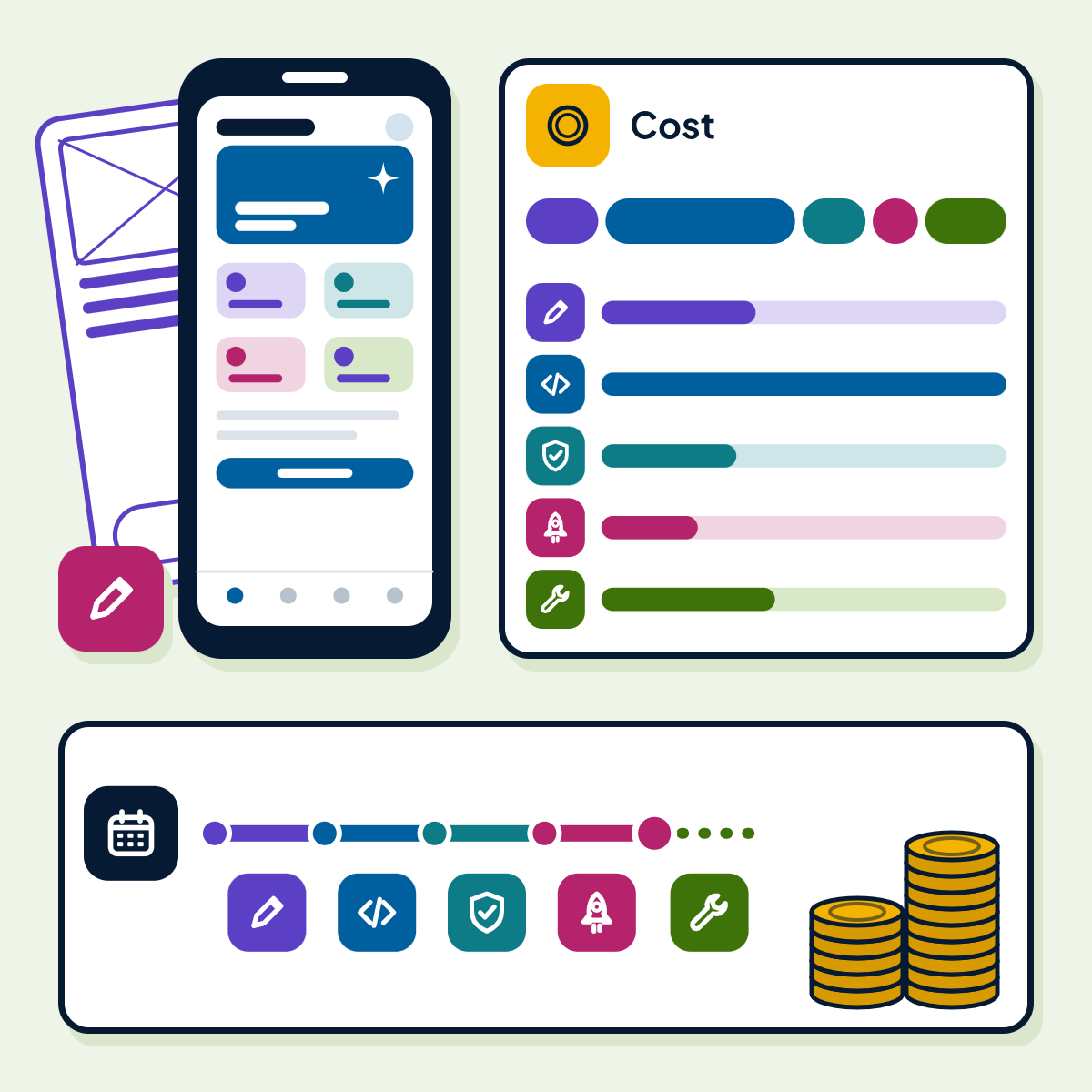
An app project runs in phases, and each phase has its own cost. We do not publish a percentage split, because it changes with the app type and the team, but the order and the outputs are the same on every project. Our development methodology describes the six phases we run.
Step 1: Discovery
Workshops and interviews turn the idea into user stories, acceptance criteria, an integration list and a written estimate. This is the cheapest place to remove risk.
Step 2: Design
User flows, wireframes and a clickable prototype, then the visual design. Changes here cost hours; the same change after the build costs days.
Step 3: Build
The team builds in sprints of one to two weeks, with a working build to review at the end of each one.
Step 4: Testing
Functional, regression, device and security checks run alongside the build, then user acceptance testing with you.
Step 5: Launch
Store listings, privacy details, review submission, production hosting and monitoring.
Step 6: Support
Fixes, OS updates, security patches and the next features, under a support agreement or a monthly team.
The calendar time for each phase is covered in our guide to how long it takes to build an app. If the aim is to test an idea with real users before committing the full budget, a lean first release through our MVP development service keeps the first spend small and the code reusable.
Want a second opinion on your plans?
Tell us what you are working on. A specialist will look at it and reply with practical next steps.
Get in touchTeam shape and where the team sits
A typical app team has a project manager, a designer, mobile developers, a back-end developer and a tester, with a solutions architect or a DevOps engineer for part of the time. Small apps combine roles; large ones add a second developer per platform, a business analyst and a dedicated QA lead.
| App size | Typical team | Notes |
|---|---|---|
| Small first release | Project manager, designer, one or two cross-platform developers, one back-end developer, a tester part time | Roles are often combined; a fixed price is common |
| Medium product | The above plus a second mobile developer, a full-time tester and an architect for the early sprints | Usually a fixed price for release one, then a monthly team |
| Large or regulated product | Separate iOS and Android developers or a larger cross-platform team, back-end team, QA lead, DevOps, security review | A dedicated team with a product owner on your side |
In-house, freelancers or a development partner
Hiring your own team gives you full control but takes months and carries the cost whether the team is busy or not. For reference, the median annual pay of software developers in the USA was 135,980 USD in May 2025 (US Bureau of Labor Statistics, Occupational Outlook Handbook), before benefits, equipment, recruitment and management. Freelancers cost less to start but leave you to coordinate design, back end, testing and releases yourself. A development partner supplies the whole team and the process, at a rate that depends on its location and the seniority you need.
The trade-offs are covered in our article on outsourcing versus in-house development, and our guide to hiring dedicated developers explains how to vet a remote team. Our custom software development guide covers the process, roles and contract types in more depth. If you want individual specialists rather than a project, you can hire mobile app developers who work in your tools and hours.
Contract models and their effect on price
| Point | Fixed price | Time and material | Dedicated team |
|---|---|---|---|
| How you pay | One price in milestone instalments | Hours or days by role, invoiced monthly | A monthly fee per team member |
| Scope changes | Through written change requests | Possible at any time | Absorbed in the backlog |
| Allowance for risk | Included in the price | None, cost follows the work | None, you set the priorities |
| Best for | A clear first release with a fixed budget | Evolving requirements and ongoing work | Long-term products with frequent releases |
Source: AcmaSoft engagement models page, 13 Nov 2026
Costs after launch
Launch is not the end of the spending. Budget for these from the first estimate, so the app is not left without updates in its second year.
App store fees
| Fee | Apple App Store | Google Play |
|---|---|---|
| Developer account | 99 USD per membership year, or local currency where available; fee waiver for eligible nonprofits, accredited education and government bodies | 25 USD one-time registration fee |
| Commission on paid apps and in-app purchases | 15% under the Small Business Program for developers with up to 1 million USD proceeds in the prior calendar year; the standard rate above that | Outside the regional rollout: 15% on the first 1 million USD of earnings each year, 30% above |
| Subscriptions | Set out on Apple's Small Business Program page, including a lower rate after a subscription's first year | 15% outside the regional rollout; 10% plus a 5% billing fee in Australia, the EEA, Japan, the UK and the USA |
| Changes in 2026 | None listed on the pages checked | New fees for installs from 30 Jun 2026 (EEA, UK, USA) and 30 Sep 2026 (Australia, Japan) |
Source: Apple Developer Program and App Store Small Business Program pages; Google Play Console Help, registration and service fees (all fetched 13 Nov 2026)
The sources are Apple’s Developer Program page, the App Store Small Business Program, Google’s Play Console registration help and its service fees page. Google’s fees now depend on the user’s region and the install date, so check the current page for your markets before you set prices. Commissions apply to digital goods sold in the app; physical goods and services paid through your own payment provider follow the stores’ separate rules.
Running costs
Running costs to include in the budget
- Hosting for the back end, database and file storage, which grows with users and data
- Third-party services: maps, SMS, email, push notifications, video, AI model calls, analytics
- Payment provider fees on every transaction
- Store commissions on digital sales and subscriptions
- Updates for each new iOS and Android version and for retired SDKs
- Security patches for the server, libraries and frameworks
- Monitoring, backups and support with agreed response times
- The next features, which most successful apps keep adding
How pricing and contracts differ by market
We work with buyers in all eight markets from one team, so the build cost does not change with the buyer’s country. What changes is the currency, the data protection law your app must respect, the platform mix and the hours of overlap with our team.
| Market | Leading mobile OS, Oct 2026 | Data protection law to plan for | Currency we can invoice in |
|---|---|---|---|
| UK | Close to even | UK GDPR and the Data Protection Act 2018 | GBP or USD |
| USA | Close to even | State laws such as the CCPA in California; HIPAA where it applies to health data | USD |
| Canada | iOS | PIPEDA | CAD or USD |
| UAE | Android | UAE Personal Data Protection Law | AED or USD |
| Australia | iOS | Privacy Act 1988 | AUD or USD |
| India | Android | Digital Personal Data Protection Act 2023 | INR or USD |
| Singapore | Android | Personal Data Protection Act 2012 | SGD or USD |
| Europe (EU) | Android | GDPR | EUR or USD |
Source: Mobile share: StatCounter, October 2026. Laws: the official sources linked in the text, checked 13 Nov 2026.
The laws named are the main ones regulators list for each market: the GDPR, the UK Data Protection Act 2018, the CCPA, PIPEDA, the UAE data protection laws, the Australian Privacy Act, Singapore’s PDPA and India’s data protection framework. Which of them apply depends on where your users are and what data the app collects, not where the developer sits. This is a planning list, not legal advice: confirm the obligations for your app with your own adviser.
On invoicing, our proposals are priced in US dollars, or in your own currency on request, and the quote form accepts a budget in USD, GBP, EUR, CAD, AUD, AED, SGD or INR. Sales tax or VAT on services depends on where you and the supplier are registered, so ask your accountant how a cross-border invoice is treated in your country.
How to get an accurate estimate
The more of this list you can answer, the narrower the estimate. You do not need all of it: a good supplier will help you fill the gaps in discovery.
Scoping checklist for an app estimate
- Who the users are, and the one task each type of user must complete
- Platforms: iOS, Android, web, tablet, and which comes first
- The screens you expect, even as rough sketches or a list
- User roles and what each role can see and change
- Integrations: payments, maps, your CRM or ERP, sign-in providers, hardware
- Data: what you store, where users are, and any sensitive data such as health or financial records
- Content: who writes it and how it is updated after launch
- Languages and markets at launch
- Apps you like and why, and apps your users already use
- The date that matters and the budget range you are working to
- Who signs off each stage on your side
Red flags in an app quote
Questions to ask when a quote looks too good
- Does it include design, testing, store submission and a support period, or development only?
- Does it name the platforms, the screens and the integrations it covers?
- Who owns the source code, designs and store accounts, and when?
- How are changes priced, and what happens to the timeline when they are approved?
- Will you see a working build regularly, or only at the end?
- Who are the people doing the work, and can you speak to them before signing?
- What happens after launch: who fixes defects, and for how long?
Apps we have shipped
Two of the apps we built are live on both Google Play and the App Store. mediSuggest is the patient app for a healthcare guide to hospitals and specialists in India: patients search by symptom or browse surgeries, treatments and diagnostics, compare hospitals and book a free consultation in the app, with partner and admin apps behind it. Chirayu Care is the hospital management app we built for Chirayu SuperSpeciality Hospital: staff keep patient records, billing and schedules in one place behind a secure sign-in. mediSuggest shows the multi-app structure (customer, partner and admin) that drives the cost of many service apps; Chirayu Care shows the business app pattern of staff roles and sensitive records.
If you are planning an app, our app development team works across native and cross-platform builds, from the first release to store submission and support.
Get an estimate: describe your app in the quote form and a specialist replies within one business day with questions, an approach and a cost range, then a proposal with the scope, team, timeline and an itemised cost.
Get new guides by email
Articles and guides from our team, and company news. Unsubscribe at any time.
About AcmaSoft
AcmaSoft designs and builds websites, mobile apps and custom software, and runs SEO and digital marketing for its clients.
- Years of experience
- 17+
- Clients served
- 650+
- Projects delivered
- 2,000+
- Products shipped
- 300+