GPT, Claude, Gemini, Llama and Mistral compared on what decides a business project: price per million tokens, context, tool use, data residency in eight markets and self-hosting, with prices dated 13 Nov 2026.
Most businesses that ask us “which LLM should we use?” have already read three rankings that disagree. Benchmarks move every few weeks, and none of them knows where your data is allowed to go, how many requests you will send or which languages your customers speak. This guide compares the five model families buyers ask about most, OpenAI’s GPT, Anthropic’s Claude, Google’s Gemini, Meta’s Llama (now alongside its newer Muse models) and Mistral, on the things that decide a business project: price per million tokens, context size, tool use, data residency in our eight markets and whether you can run the model yourself.
It sits under our guide to building an LLM application, which covers the architecture around the model. Every price, context size and licence term below comes from the vendor’s own documentation or pricing page, fetched on 13 Nov 2026. Vendors change these often, sometimes monthly, so check the linked page before you sign anything. We review this article every quarter.
Key takeaways
- There is no single best LLM for business. The right model depends on the task, your data rules and your volume, and most products end up using two or three.
- List prices differ by a factor of 100 between the cheapest and the most capable models of the same vendor, so the tier matters more than the brand.
- Data residency options differ sharply by market: in-region processing is available for some vendors in the EU, US and UAE, and for far fewer in the UK, Canada and Singapore.
- Open-weight models (Llama 4, Muse Spark Open, Mistral Small 4) let you choose the region and keep data on your own servers, at the cost of running the hardware.
- Pick on a test set of your own real questions, put a gateway between your code and the vendor, and expect to switch models at least once a year.
What a business should compare, and what to ignore
Public leaderboards rank models on exams, coding puzzles and chat preferences. They are useful for spotting which models are worth testing, but they rarely predict how a model performs on your documents, your customers’ questions or your languages.
For a buying decision, five things matter more than a leaderboard position:
- Cost at your volume: the price per million tokens, multiplied by how many tokens each task really uses, including the hidden “thinking” tokens that reasoning models bill as output.
- Where data is processed and stored: which regions the vendor offers, whether that covers processing or only storage, and what it costs extra.
- Context size: how much text the model can read in one request, which decides whether you can pass a whole contract or need retrieval.
- Tool use: whether the model can call your functions and APIs reliably, which every agent or integration needs.
- Control: whether you can run the model on your own servers, and what the licence allows.
The five families at a glance (as of 13 Nov 2026)
Each vendor now sells a ladder of models: a most capable tier, a balanced tier and a fast, cheap tier. The names change with every release, so think in tiers first and names second.
| Vendor | Most capable | Balanced | Fast and low cost | Context window | Open weights |
|---|---|---|---|---|---|
| OpenAI (GPT) | GPT-6 Astra | GPT-6.1 Sol, GPT-6.1 Terra | GPT-6 Luna | 1.05M tokens | Not for these models |
| Anthropic (Claude) | Claude Fable 5.2, Claude Opus 5.5 | Claude Sonnet 5.5 | Claude Haiku 5.5 | 1M tokens | No |
| Google (Gemini) | Gemini 4 Carbon | Gemini 4 Argon, Gemini 4 Hydrogen | Gemini 3.5 Flash-Lite | 1M tokens (Gemini 4) | No |
| Meta (Llama and Muse) | Muse Wonder (API) | Muse Spark 1.3 (API) | Muse Ember (API) | 1M tokens (API models); Llama 4 Scout up to 10M | Llama 4, Muse Spark Open |
| Mistral | Mistral Large 4 | Mistral Small 4 | Ministral 3 (3B, 8B, 14B) | 1M (Large 4), 256k (Small 4) | Yes, for most models |
Source: OpenAI models page; Anthropic models overview; Google Gemini API models page; Mistral models overview; Meta Model API and Muse Spark Open documentation; all fetched 13 Nov 2026
A note on Meta: the Llama name is still used for the open-weight Llama 4 family (Scout and Maverick), which Meta continues to offer for download. Meta’s hosted API now serves its newer Muse models, and its most capable open-weight release is Muse Spark Open. When a buyer says “Llama” today, they usually mean “an open model we can host ourselves”, so we cover both.
Price per million tokens
All five vendors price their APIs per million tokens, with input (what you send) and output (what the model writes) priced separately. Token counts for the same meaning differ between languages and between vendors’ tokenisers, so measure with your own text.
| Model | Input | Cached input | Output |
|---|---|---|---|
| GPT-6 Astra | $10.00 | $1.00 | $50.00 |
| GPT-6.1 Sol | $2.00 | $0.10 | $10.00 |
| GPT-6 Luna | $0.10 | $0.01 | $0.50 |
| Claude Opus 5.5 | $4.00 | $0.20 | $20.00 |
| Claude Sonnet 5.5 | $2.00 | $0.10 | $10.00 |
| Claude Haiku 5.5 (prompts up to 100,000 tokens) | $0.10 | $0.01 | $0.50 |
| Gemini 4 Carbon (from 1 Dec 2026) | $4.00 | $0.20 | $20.00 |
| Gemini 4 Hydrogen | $1.50 | $0.075 | $7.50 |
| Gemini 3.5 Flash-Lite | $0.30 | $0.03 | $2.50 |
| Mistral Large 4 | $0.70 | $0.07 | $2.10 |
| Mistral Small 4 | $0.15 | $0.015 | $0.60 |
| Muse Spark 1.3 (Meta Model API) | $1.25 | $0.15 | $4.25 |
| Muse Ember (prompts under 200k tokens) | $0.10 | $0.004 | $0.50 |
Source: OpenAI API pricing; Anthropic pricing documentation; Google Gemini API pricing; Mistral API pricing; Meta Model API pricing; all fetched 13 Nov 2026. Prices change often: check the vendor page before relying on them.
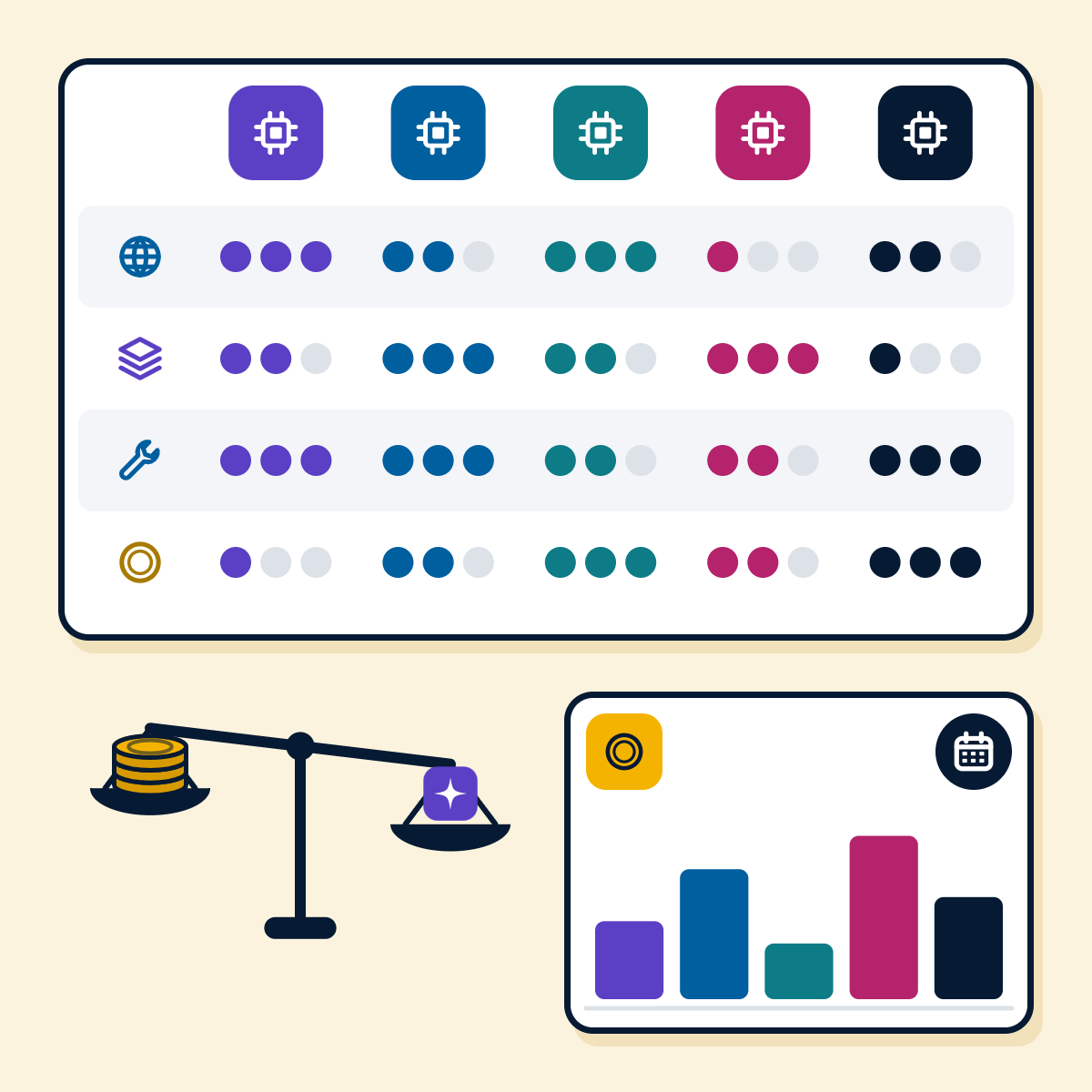
Per-token prices are hard to compare in your head, so the chart turns them into the cost of one realistic workload: 1,000 requests, each sending 2,000 tokens (a question plus some retrieved context) and receiving 500 tokens back.
Five details that change the real bill
- Thinking tokens are output tokens. Google’s pricing page states that its output prices include thinking tokens. Treat every reasoning model the same way until you have measured it: higher reasoning settings write more tokens, and you pay for them. Measure output per task, not per visible answer.
- Caching cuts input cost sharply. When many requests share the same long instructions or documents, cached input is billed at a fraction of the normal rate (for GPT-6.1 Sol, $0.10 instead of $2.00 per million tokens).
- Batch work costs about half. OpenAI, Anthropic, Google and Mistral all publish batch or flex prices at roughly 50% of the standard rate for work that can wait, such as nightly classification or document processing.
- Long prompts can cost more. Claude Haiku 5.5 rises to $0.50 input and $2.50 output per million tokens above 100,000 tokens, and Muse Ember triples above 200,000 tokens.
- Some prices are temporary. Gemini 4 Carbon is listed at $2.00 input and $10.00 output until 30 Nov 2026, then $4.00 and $20.00 from 1 Dec 2026. We chart the later price because it is the one you will pay.
For a full worked monthly bill, with caching and routing, see our guide on what AI development costs, which separates build cost from running cost.
Want a second opinion on your plans?
Tell us what you are working on. A specialist will look at it and reply with practical next steps.
Get in touchData residency and data use in our eight markets
For many of our clients, this is the deciding factor. A model that is 10% better is no use if the data protection team cannot approve where prompts are processed. Two questions matter: where is the data stored, and where does the model actually run (processing)? Several vendors offer the first without the second.
| Vendor | Regional processing on the vendor's own API | Extra cost | Training on API data |
|---|---|---|---|
| OpenAI | Data residency controls for eligible customers (through sales). Storage in 10 regions; in-region processing in the US, Europe (EEA and Switzerland), UAE, and for GPT-6 Luna with zero data retention in Australia, India and Japan. Canada, Singapore, South Korea and the UK offer storage only. | 10% uplift for models released on or after 5 Mar 2026 | Not used for training unless you opt in |
| Anthropic | inference_geo set to "us" keeps inference in the US; the default "global" may run anywhere. Workspace storage is US only. Regional endpoints are also offered through Amazon Bedrock and Google Cloud, at their own prices. | 1.1 times standard for US-only inference | See Anthropic's commercial terms |
| Google (Gemini on Google Cloud) | US and EU multi-region endpoints and single-region endpoints, including Canada, the UK, Australia, India, Singapore and EU countries; coverage varies by model. Global endpoints give no residency guarantee. The EU endpoint excludes the UK and Switzerland. | Per Google Cloud pricing | Paid tier of the Gemini API: not used to improve products; free tier: used |
| Mistral | Optional EU or US regional endpoints. Batch, Agents and the Files API are not available on regional endpoints, and some account data stays global. | 1.1 times standard | See Mistral's terms; consumer plans allow opt-out |
| Meta (Model API) | No regional options published on the API pricing page | Not applicable | "Contributor" model tiers are used to improve Meta's products; standard tiers are not |
Source: OpenAI data controls guide; Anthropic data residency and pricing documentation; Google Cloud generative AI data residency page; Mistral regional inference documentation; all fetched 13 Nov 2026
The table below turns that into a view per market. It shows whether each vendor publishes an option that processes data inside that market (or bloc) on its own platform. It is not legal advice: whether you need in-region processing at all depends on your data, your contracts and the law that applies to you.
| Market | OpenAI | Claude (first-party) | Gemini on Google Cloud | Mistral |
|---|---|---|---|---|
| UK | Partly | No | Yes | No |
| USA | Yes | Yes | Yes | Yes |
| Canada | Partly | No | Yes | No |
| UAE | Yes | No | No | No |
| Australia | Partly | No | Yes | No |
| India | Partly | No | Yes | No |
| Singapore | Partly | No | Yes | No |
| EU | Yes | No | Yes | Yes |
Source: Vendor documentation listed above, fetched 13 Nov 2026. Partly: storage only, or only some models. Google lists the location; which Gemini models it covers varies, so check the per-model table. Self-hosted open models can run in any cloud region you choose.
Three points from this view are worth knowing before you shortlist:
- The EU and the US are well served. If your users are in the EU and the GDPR applies to the data you send, three vendors offer EU processing on their own platforms.
- The UK is not the EU. Google’s EU multi-region endpoint excludes the UK and Switzerland, and Mistral’s EU endpoint covers EU and EFTA countries. UK GDPR transfers need their own assessment, which the ICO’s international transfers guidance explains.
- Claude is available in more places through cloud partners. Anthropic’s documentation lists Claude on Amazon Bedrock, Google Cloud and Microsoft Foundry, each with its own regional endpoints. If your business already runs on AWS or Azure, check that provider’s region list for the model you want.
Open-weight models and self-hosting
Open-weight models give you the model file itself. You run it on your own servers or in your own cloud account, in the region you choose, and no prompt leaves your infrastructure. That solves the residency question in every market where a cloud region exists, and it makes cost predictable at high volume. It also makes you responsible for hardware, scaling, security patches and model updates.
| Model | Licence | Size and context | Points to check |
|---|---|---|---|
| Llama 4 Scout and Maverick | Llama 4 Community License | Scout supports up to 10M tokens of context | Companies with more than 700 million monthly active users need a separate licence from Meta; products must display "Built with Llama" |
| Muse Spark Open | Muse Model License, plus Meta's Acceptable Use Policy | 816B total parameters, 42B active; 1,048,576 tokens | Meta suggests budgeting roughly 2 TB of GPU memory to serve it at BF16 |
| Mistral Small 4 | Apache 2.0 | 119B parameters, 6.5B active; 256k tokens | A permissive licence; also available on Mistral's API at $0.15 and $0.60 |
| Ministral 3 (3B, 8B, 14B) | Apache 2.0 | Small models for text and vision | The smallest options in this list, for narrow, high-volume tasks |
| Mistral Large 4 | Mistral Ecosystem Open Weight License | 1.05T total parameters, 52B active; 1M tokens | Read the licence terms for your use before you deploy |
Source: Meta Llama 4 licence and model pages; Meta Muse Spark Open documentation; Mistral model pages; fetched 13 Nov 2026
Self-hosting an open model
- Data stays in your own servers and your chosen region
- Cost is the hardware, so it stays flat as volume grows
- You control when the model changes, so behaviour does not shift under you
- Fine-tuning on your own data is possible
Using a vendor API
- You pay for GPUs even when traffic is low
- You run scaling, monitoring, patching and upgrades yourself
- The largest open models need serious hardware to serve
- The top tiers of OpenAI, Anthropic and Google are API-only
A middle route is common: an open model hosted for you by a cloud provider’s model catalogue in your chosen region. Meta lists Muse Spark Open in the model catalogues of Amazon SageMaker AI, Google Cloud and Microsoft Foundry, for example.
Tool use, agents and other capabilities
Every current model family in this comparison supports tool use (also called function calling): the model returns a structured request to call one of your functions, your code runs it, and the model continues with the result. This is what lets an assistant check an order, book an appointment or update a CRM record. Differences now lie in the extras each vendor hosts for you:
- OpenAI lists functions, web search, file search and computer use for its current flagship models.
- Anthropic states that all current Claude models support text and image input, multilingual use, vision and tool use, with a 1M token context window and up to 128K output tokens.
- Google offers grounding with Google Search and Google Maps for Gemini: 5,000 requests a month free, then $14 per 1,000.
- Mistral supports function calling, structured outputs and an agents API; on its regional endpoints, function calling is the only supported tool.
- Meta offers web search grounding on its Model API and an OpenAI-compatible interface, so existing client code can point at it.
If you plan agents that act in your systems, test the full tool loop, not just the answers; our guide to AI agents for business covers how to design and govern them. Our guide to retrieval-augmented generation covers the other half: giving the model your own knowledge to work from.
A decision flow for shortlisting
Use this to narrow five families to two or three candidates. Then test those on your own data.
Which kind of model to shortlist
Question 1: Must prompts be processed inside one country or region?
Question 2: Does any vendor publish in-region processing for your market in the table above?
- YesGo to question 3
- NoShortlist open-weight models hosted in your own cloud region
Question 3: Is the in-region option available for the model tier you need?
- YesGo to question 4
- NoShortlist open-weight models, or a cloud partner endpoint in that region
Question 4: Will you send more than a few million requests a month with a stable task?
- YesGo to question 5
- NoShortlist a balanced API model from two vendors and compare them
Question 5: Can a small or mid-sized model meet your quality bar on your test set?
- YesUse the low-cost tier, or a self-hosted open model if volume is very high
- NoUse the most capable tier only for the hard steps and route the rest to a cheaper model
Checklist before you commit to a model
Model selection checklist
- Build a test set of 50 to 200 real questions or documents with the answers you expect
- Score at least two models from different vendors on that set, including your languages
- Measure tokens per task, including thinking tokens, and price the monthly volume
- Confirm where prompts are processed and stored, and whether that meets your data rules
- Read the data use terms: training, retention and abuse monitoring logs
- Check rate limits and whether batch or caching fits your workload
- Put a gateway or adapter between your code and the vendor so you can switch
- Record the model version you tested, and retest before every upgrade
- Set a review date: prices and models change at least quarterly
How we approach model choice at AcmaSoft
We are vendor-neutral and we do not resell any model. On client projects we start from the task, not the brand: we write the test set with the client’s team, run two or three candidate models against it, and present quality, cost per task and residency side by side. The decision is the client’s, made on their own data.
Three habits come from running AI in our own products. In AI Call Studio, our AI voice agent platform, every call is logged with its transcript, quality grade and cost, and each paid action shows its price before it runs. That discipline, measuring cost per task in production rather than estimating it once, is what we build into client systems too. Second, in the systems we build, model calls go through one interface, so moving a step to a cheaper or newer model is a configuration change and a test run, not a rewrite. Third, we keep the most capable model for the steps that need it and send routine steps such as classification, routing and summarising to a low-cost tier.
If you are integrating a model into an existing product, our ChatGPT and LLM integration work covers the same steps for any vendor, and our AI consulting team can run the comparison before you commit to a build.
Need a model comparison on your own data?
- We run a short, fixed-scope evaluation: your test set, two or three candidate models, and a written comparison of quality, cost per task and data residency for your markets. See our generative AI and LLM integration services to start.
Get new guides by email
Articles and guides from our team, and company news. Unsubscribe at any time.
About AcmaSoft
AcmaSoft designs and builds websites, mobile apps and custom software, and runs SEO and digital marketing for its clients.
- Years of experience
- 17+
- Clients served
- 650+
- Projects delivered
- 2,000+
- Products shipped
- 300+