A buyer guide to hiring dedicated developers: choosing the engagement model, where to find developers, vetting and a scorecard, contract and data protection terms, time-zone overlap, costs and onboarding.
Hiring dedicated developers means adding people who work only on your product, month after month, without putting them on your own payroll. Done well, it gives you a team in weeks instead of months and lets you grow or shrink it with your roadmap. Done badly, it gives you people you cannot manage, code you do not own and invoices you cannot check.
This guide covers the whole decision: which model to use, where to find developers, how to vet them, what the contract must say, how time zones work, what you actually pay for and how to run the team once it starts. It is written for companies in the UK, the USA, Canada, the UAE, Australia, India, Singapore and Europe, and it is based on how we provide developers to clients’ teams. Figures from outside sources carry their source and date.
Key takeaways
- A dedicated team suits products you will develop for six months or more; staff augmentation suits teams that already have a manager; fixed price suits a defined project.
- Vet the people, not the company brochure: interview each developer, check real code and run a short paid task on your own stack.
- The contract must settle code ownership, notice, replacements, timesheets, confidentiality and, where personal data is involved, data protection terms.
- Time-zone overlap is planned, not hoped for: agree shared hours and meeting times in a written communication plan.
- Compare costs on the full picture: an in-house hire carries salary, benefits, recruitment, equipment and idle time; a dedicated developer is a monthly fee for working time.
What “dedicated developers” means, and the models around it
“Dedicated” means the developer works only on your product for the length of the engagement, as part of your team, rather than splitting time across several clients. It is one of four common ways to work with an outside development company. The differences are who manages the work and how you pay. The descriptions below follow our engagement models.
| Point | Dedicated team | Staff augmentation | Time and material | Fixed price |
|---|---|---|---|---|
| What you get | Developers, designers, QA and a project lead working only on your product | Individual specialists who join your existing team | Hours worked on a scope that can change | A defined scope for an agreed price and timeline |
| Who runs the daily work | Our project lead | You | Shared with you | Our project manager |
| Pricing | Monthly fee per team member, by role and seniority | Monthly rate per specialist, full time or part time | Hourly or daily rates by role, invoiced monthly | One price in milestone instalments |
| Best for | Long-term products and frequent changes | Teams with their own manager and process | Requirements that are hard to fix up front | Clear requirements, fixed budget, firm deadline |
| Typical length | Six months or more | Any length | Any length | Weeks to a few months |
Source: AcmaSoft engagement models page, 13 Nov 2026
The first decision, whether to outsource at all, is covered in our article on outsourcing versus in-house development. This guide assumes you have decided to add outside developers and want to do it well.
Which model should you use?
Question 1: Is there a defined project with a clear scope and an end date?
- YesFixed price project
- NoGo to question 2
Question 2: Will the work continue for six months or more?
- YesGo to question 3
- NoTime and material
Question 3: Do you have a technical lead who will plan and review the work every day?
- YesStaff augmentation
- NoGo to question 4
Question 4: Do you need several roles, such as developers, QA and design, working together?
- YesDedicated team with a project lead
- NoA dedicated developer with a lead from the provider
When hiring dedicated developers makes sense
Good fit
- A product that will keep changing for months or years
- A roadmap that needs more people than you can hire in time
- Skills you need full time but cannot find locally, such as mobile, AI or DevOps
- A team that must grow or shrink with funding or seasons
Poor fit
- A one-off project with a fixed scope: a fixed price is simpler
- No one on your side to set priorities or review work
- Work that law or contracts require to stay inside your company
- A need for one hour a week of advice: a consultant fits better
Where to find dedicated developers
There are three main sources, and each shifts work and risk between you and the supplier.
| Source | What you manage | Main risk | Best for |
|---|---|---|---|
| Freelancers | Everything: hiring, contracts, payments, cover for holidays and sickness, coordination | One person leaving takes the knowledge with them | Short, well-defined tasks |
| Development company | Priorities and reviews; the company handles hiring, employment, equipment and replacements | Choosing a company that cannot staff your roles well | Ongoing products and teams of several roles |
| Your own remote hires | Hiring, employment, payroll and compliance in each country, or through an intermediary | Months to hire, and employment law in each country | Long-term core roles you want on your payroll |
Remote work is normal for developers now. In the Stack Overflow Developer Survey 2025, 32.4% of respondents described their work as remote and a further 37.1% as hybrid, with the remote share varying widely by country.
The chart shows five of the countries reported in the Stack Overflow Developer Survey 2025. It does not mean remote teams suit every company. It does mean many developers are used to remote rituals, and the practices below are well tested.
What you pay for, and how it compares with hiring
A dedicated developer is usually billed as a monthly fee per person, set by role and seniority, and invoiced monthly against approved timesheets. Our own rates depend on the roles, seniority and hours, so we put them in a written proposal rather than a price list; the quote form is the way to get one.
When you compare that fee with hiring, compare the full cost of employment. In the USA the median annual pay of software developers was 135,980 USD in May 2025 (US Bureau of Labor Statistics), and that is before benefits, payroll taxes, recruitment, equipment, software licences, office space and the management time a new hire needs.
| Cost | In-house hire | Dedicated developer from a provider |
|---|---|---|
| Salary or fee | Salary, paid whether the work is there or not | Monthly fee for the agreed hours |
| Benefits and payroll taxes | Yours | Included in the fee |
| Recruitment | Advertising, agency fees, interview time, months to hire | Interviews of a shortlist; the provider recruits |
| Equipment and software | Yours | Usually the provider's; your own tools and licences where you require them |
| Replacement when someone leaves | Another hiring round | The provider replaces, under the contract |
| Scaling down | Notice, redundancy rules and costs | The notice period in the agreement |
| Management | Your managers | You, or the provider's project lead in a dedicated team |
How to vet dedicated developers
A company’s portfolio tells you what it has done. The developers you get decide what it will do for you. Vet both.
Vetting the company
- Real, checkable work in your kind of product, with live apps or sites you can open
- How long the developers have been with the company, and who would replace one who leaves
- Who manages the team day to day, and how problems reach you
- Code review, testing and release practices, written down
- Security practices: access control, device policies, how access is removed at the end
- References from clients in your market, where they agree to speak
- A sample contract and a sample timesheet before you commit
Vetting each developer
- A video interview with the developer, not only with sales
- A walk-through of code they wrote and decisions they made
- A short, paid task on your stack, reviewed by your own lead
- English for daily stand-ups and written updates
- Experience with your tools: Git workflow, task tracker, CI and cloud
- The hours they will overlap with your team
A scorecard for interviews
Score every candidate from 1 to 5 on the same criteria, so the decision rests on evidence rather than on who interviewed last.
| Criterion | What good looks like | |
|---|---|---|
| Technical depth | Explains trade-offs in their own code; knows the framework's current version and its limits | |
| Problem solving | Asks clarifying questions before coding; breaks the task into steps | |
| Code quality | Readable code, tests where they matter, sensible naming and structure | |
| Communication | Clear written updates; says early when something is blocked | |
| Product sense | Asks who the user is and why the feature matters | |
| Working remotely | Uses the tracker and pull requests well; comfortable with async updates |
The paid test task
A small, paid task tells you more than any interview. Keep it to a few hours, set it on your own stack, and review it the way you would review a pull request: does it work, is it readable, are there tests, and did the developer ask the right questions? Paying for the task respects the developer’s time and gives you the right to use the result.
Want a second opinion on your plans?
Tell us what you are working on. A specialist will look at it and reply with practical next steps.
Get in touchContracts: what the agreement must cover
A services agreement for dedicated developers sets out the team, the rates, the payment schedule, the notice period and who owns the work. Have your lawyer review it; the list below is a buyer’s checklist, not legal advice.
Contract checklist for dedicated developers
- Roles, seniority, hours and the named people approved by you
- Monthly fee per person, invoicing dates, currency and payment terms
- Timesheets: how hours are logged, who approves them and when
- Replacement: how quickly a developer is replaced if they leave or are not a fit
- Ownership of code and work, and when it passes to you
- Confidentiality, with a non-disclosure agreement before you share details
- Access: which systems the team uses and how access is removed at the end
- Data protection terms where the team can access personal data
- Notice period for scaling down or ending the engagement
- Handover: code, documentation, credentials and knowledge transfer at exit
Data protection terms
If developers can access personal data in your systems, data protection law usually treats the provider as your processor. Under Article 28 of the GDPR and UK GDPR, the contract must cover the processing and include terms such as acting only on your documented instructions, confidentiality, security, rules for sub-processors, help with individuals’ rights, deletion or return of data at the end and audits (ICO, what needs to be included in the contract).
When the team is outside the EU or the UK, access to EU or UK personal data is a restricted transfer and needs a transfer mechanism. For EU data the usual one is the European Commission’s standard contractual clauses, adopted on 4 June 2021 (European Commission); for UK data, the ICO’s international data transfer agreement or its addendum to the EU clauses, in force since 21 March 2022 (ICO). Other markets have their own rules: PIPEDA in Canada, the Privacy Act in Australia, the PDPA in Singapore, the UAE Personal Data Protection Law and India’s Digital Personal Data Protection Act. The simplest control is to give developers test or anonymised data wherever possible. Our specialists work only with the access you grant and follow your security policies.
Invoicing by market
Our proposals set out a monthly fee per person by role and seniority, invoiced in US dollars, or in your own currency on request: GBP, EUR, CAD, AUD, AED, SGD or INR. How VAT, GST or sales tax applies to services bought from another country depends on your own registration, so confirm the treatment with your accountant before the first invoice.
Time zones and working hours
Overlap is the single biggest practical difference between remote teams in different regions. Our office hours are 9:30 am to 6:30 pm India time (IST), Monday to Saturday, with evening hours by arrangement. The table compares those hours with a 9 am to 6 pm working day in each region, outside daylight saving.
| Region | Our hours in your time | Shared working hours |
|---|---|---|
| UK (London) | 4 am to 1 pm | 9 am to 1 pm |
| Central Europe (Paris, Berlin) | 5 am to 2 pm | 9 am to 2 pm |
| Gulf (Dubai, Abu Dhabi) | 8 am to 5 pm | 9 am to 5 pm |
| Singapore | 12 noon to 9 pm | 12 noon to 6 pm |
| Australia East (Sydney, Melbourne) | 3 pm to 12 midnight | 3 pm to 6 pm |
| US East (New York, Toronto) | 11 pm to 8 am | 9 am to 11 am in our evening hours, by arrangement |
| US West (Los Angeles, Vancouver) | 8 pm to 5 am | Early calls 7 am to 8 am, by arrangement |
Source: AcmaSoft hire pages, international clients block, 13 Nov 2026
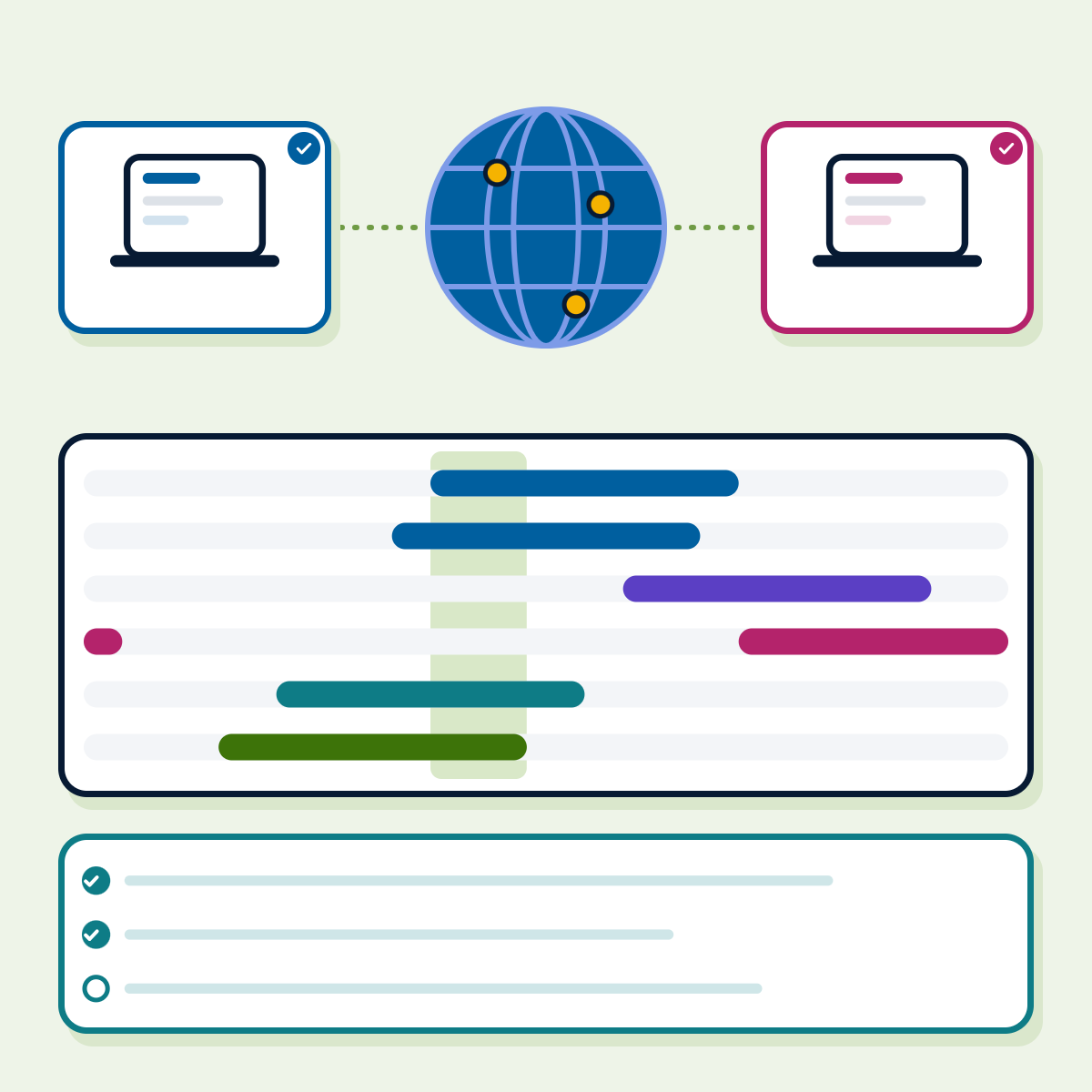
For the Gulf, Singapore, the UK and Europe, the overlap covers most of a working morning or day. For the US West Coast there is little or no overlap, so work is handed over at the end of each day: you write priorities in the evening, and updates are waiting each morning. Agree the overlap hours, the meeting times and the response times for urgent issues in a written communication plan before the team starts.
The first 30 days: onboarding steps
Step 1: Define the roles
Write down the skills, seniority, hours and overlap you need, and what the first month should deliver.
Step 2: Shortlist and interview
Review profiles, interview each developer and run a short paid task on your stack.
Step 3: Sign the agreement
Services agreement, NDA and data protection terms, with the people, rates, notice and replacement rules named.
Step 4: Grant access
Repositories, tracker, chat, staging and documentation, with the least access each role needs.
Step 5: Agree the communication plan
Overlap hours, stand-ups, sprint reviews, weekly reports and who to call when something is urgent.
Step 6: Start with a small, real task
A ticket that touches the main parts of the code base, so the developer learns the system and you see the work early.
Step 7: Review after the first sprint
Check the work, the communication and the hours, and adjust the team before it grows.
Running the team once it starts
Treat dedicated developers as part of your team, with the same rituals and the same standards. Sprints of one to two weeks, a backlog you prioritise and a demo at the end of every sprint keep everyone aligned. The Scrum Guide’s description of a team of typically 10 or fewer people with a product owner who orders the work is a useful reference even if you do not run Scrum by the book (The Scrum Guide).
What to expect every week
- Stand-ups in the agreed overlap hours
- Work tracked in your task board, with pull requests reviewed before merge
- A weekly timesheet for your approval
- A short written update: done, next, risks and decisions needed
- A demo of working software at the end of each sprint
- A monthly review of performance, team size and the roadmap
To see whether delivery is healthy, track a few simple measures such as how long a change takes to reach production, how often you release and how often a release goes wrong. These come from DORA’s research on software delivery (DORA metrics guide), and they work for a team of two as well as a team of twenty.
Scaling the team up or down
A dedicated team should change size with the roadmap. Add people one or two at a time, so each newcomer is onboarded by someone who already knows the code, and add a tester before a third or fourth developer, because untested code slows everyone down. When you scale down, keep the people who know the most critical parts of the system and ask for written handover notes from anyone who leaves.
Plan for knowledge to outlast any one person. Keep architecture decisions, setup steps and release procedures in your own documentation space, insist that every change goes through a reviewed pull request, and make sure at least two people can release the software. Then a holiday, an illness or a replacement is an inconvenience, not a crisis.
Red flags when hiring dedicated developers
Walk away, or ask hard questions, if you see these
- You cannot interview the people who will do the work
- The developer you interviewed is not the one who starts
- No timesheets, or timesheets you cannot match to work in the tracker
- Code kept in the provider's repositories with no date for transfer
- One developer quietly shared across several clients
- No named person to escalate to when something goes wrong
- Pressure to sign a long minimum term before any work is seen
How we provide dedicated developers
We provide specialists from our own team in 33 roles across mobile, web, e-commerce, design and marketing. You interview them before they start, they work in your tools and hours, and the engagement runs month to month so you can add people, change skills or reduce hours as plans change. A project lead can plan the work and report on progress, quality and hours when you want oversight. The code and project files are yours once the related invoices are paid.
Browse the roles on our hire dedicated developers page, or go straight to the most requested: full-stack developers, mobile app developers and AI and LLM developers. If your project is better run as a defined build, the custom software development guide covers fixed price projects, and our guide to app development cost explains how team shape affects an app budget.
Get profiles and a proposal: tell us the roles, skills and hours you need in the quote form. A specialist replies within one business day, and the proposal sets out the profiles, hours, engagement model and monthly cost.
Get new guides by email
Articles and guides from our team, and company news. Unsubscribe at any time.
About AcmaSoft
AcmaSoft designs and builds websites, mobile apps and custom software, and runs SEO and digital marketing for its clients.
- Years of experience
- 17+
- Clients served
- 650+
- Projects delivered
- 2,000+
- Products shipped
- 300+