How a custom software project should run, from discovery to support: the team at each phase, what drives the cost, fixed price, time and material or a dedicated team, and what the contract must cover for buyers in eight markets.
Custom software is built for one organisation’s way of working: its processes, its data and the systems it already runs. It can remove hours of manual work and give a company something competitors cannot buy. It can also become an expensive project that nobody finishes, when the scope is vague, the team is wrong for the job or the contract rewards the wrong behaviour.
This guide explains how a custom software project should run, who should be on the team, what drives the cost, which contract model fits which situation and what to ask a supplier before you sign. It is written for buyers in the UK, the USA, Canada, the UAE, Australia, India, Singapore and Europe, and it draws on how we have delivered software for 17+ years and 2,000+ projects. Where we cite a standard or a figure, the source and its date are given.
Key takeaways
- Build custom software when the process is a real advantage or no product fits; buy or extend a product when it does.
- A project should run in phases, each ending with something you approve: discovery, design, build in short sprints, testing, launch and support.
- Cost is set by scope, integrations, data migration, quality requirements, the team and the contract model, in roughly that order.
- Fixed price suits a clear scope; time and material suits changing requirements; a dedicated team suits a product you will develop for years.
- Your contract should settle code ownership, change control, acceptance, data protection, notice and handover before work starts.
Custom, off-the-shelf or extended: decide first
Custom software is not always the answer. Many needs are met by an existing product, configured well, or by a product extended with a few custom modules and integrations. Building from scratch makes sense when the work is central to how you compete, or when the products on the market force you to change a process that works.
Custom software
- Fits your process instead of changing it to fit the tool
- You own the code and decide the roadmap
- Integrates with your systems on your terms
- No per-user licence that grows with headcount
Off-the-shelf product
- Higher cost and time before the first release
- You carry maintenance, hosting and security
- Needs a product owner on your side who can make decisions
- Quality depends heavily on the team you choose
Should you build, buy or extend?
Question 1: Does a product on the market cover most of what you need without changing a process that matters?
Question 2: Can the gaps be closed with configuration, integrations or a few custom modules?
- YesBuy the product and extend it
- NoGo to question 3
Question 3: Is the process a real advantage, or will you develop the software for years?
- YesBuild custom software with a long-term team
- NoGo to question 4
Question 4: Is the need temporary or limited to one team?
- YesUse a low-code tool or a simple product for now
- NoBuild a focused first release and review after launch
If you are unsure, an independent review of your options is cheaper than a wrong build. Our solutions architecture service maps your systems, data and integrations and recommends a route before any code is written.
The custom software development process, step by step
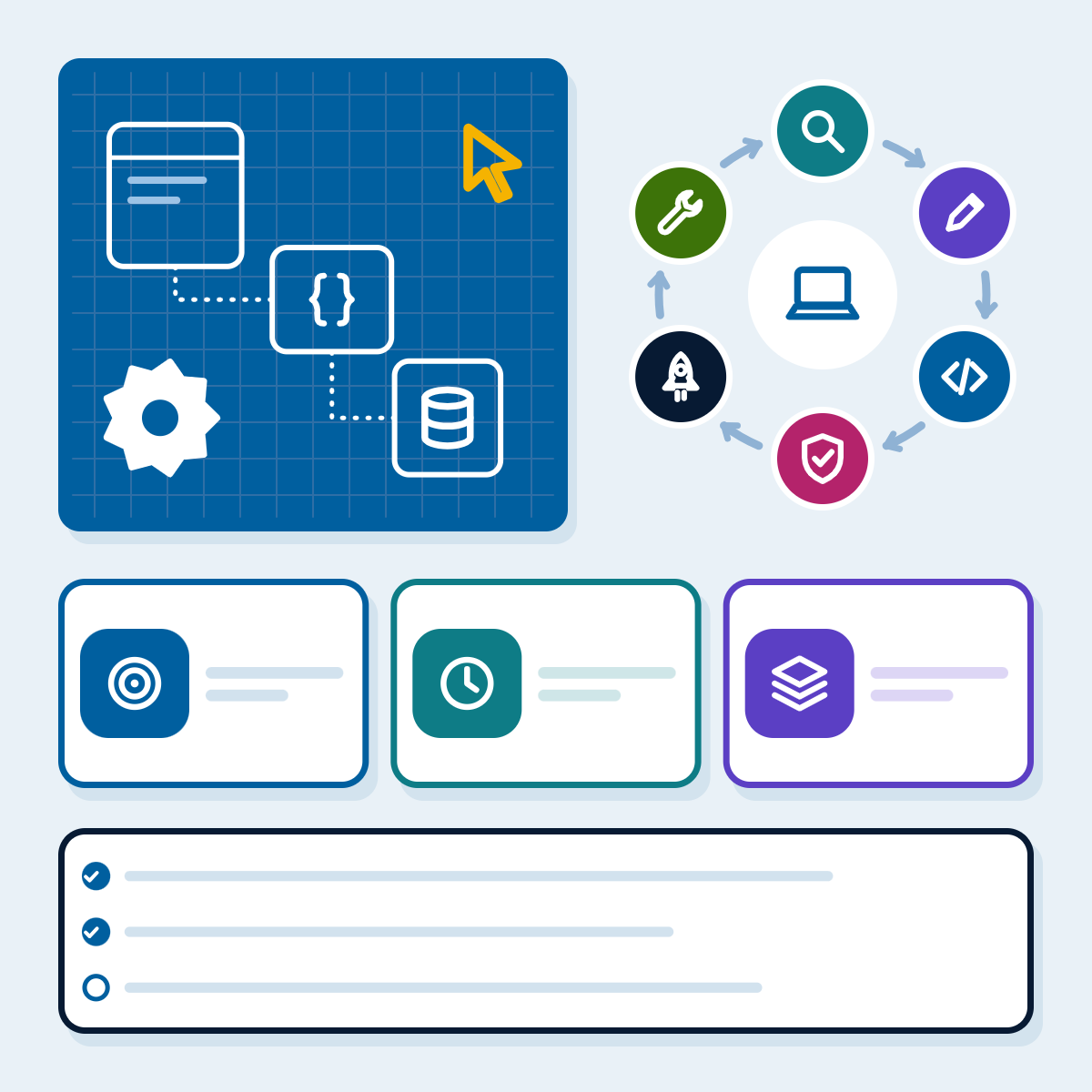
Every well-run project moves through the same phases, whatever method it uses. Each phase ends with something you can review and approve before the next one starts. The steps below are the six phases of our development methodology.
Step 1: Discovery
Workshops and interviews with the people who will use the software. Output: user stories with acceptance criteria, an integration list, a technical approach, risks and an estimate.
Step 2: Design
User flows, wireframes and a clickable prototype, then the visual design, the architecture and the data model. Output: approved designs before development.
Step 3: Agile delivery
The team builds in sprints of one to two weeks from a prioritised backlog. Each sprint ends with a demo of working features you can test.
Step 4: Quality assurance
Functional, regression, performance and security testing runs alongside development, then user acceptance testing with your team.
Step 5: Launch
Deployment plan with a rollback step, data migration, monitoring and a handover of code, access and documents.
Step 6: Support
Fixes within agreed response times, updates and security patches, backups and a roadmap for the next releases.
Discovery: the phase that saves the most money
Discovery is where you find out what the problem really is before paying to build a solution. The UK government’s service manual, written for public services but useful to any buyer, says you should not start building in discovery, that the purpose should set its length, and that around 4 to 8 weeks is typical for its services (GOV.UK Service Manual, how the discovery phase works, checked 13 Nov 2026). Business projects with a narrower scope often need less. It also makes a point most suppliers avoid: stopping after discovery is not a failure if the research shows the build is not worth it.
Sprints and demos
Most custom software is built in short, fixed-length cycles. The Scrum Guide sets sprints at one month or less and describes a Scrum team of typically 10 or fewer people, with three accountabilities: the developers, the product owner and the Scrum Master (The Scrum Guide). We run sprints of one or two weeks, so you see working software within days of the build starting and can change priorities before effort is wasted.
Testing that runs alongside the build
Testing late is the most expensive way to find defects. Code review on every change, automated tests on the main flows and a staging environment that mirrors production catch most problems while they are cheap to fix. Our quality and security practices describe what we apply on every project.
Team shapes for custom software
The right team depends on the phase, not only on the project size. Discovery needs analysts and an architect more than developers; the build needs developers and testers; support needs a smaller team that knows the code.
| Phase | Core roles | Part-time roles |
|---|---|---|
| Discovery | Business analyst, solutions architect, project manager | UX designer, a senior developer to check feasibility |
| Design | UX and UI designer, architect | Business analyst, front-end developer for prototypes |
| Build | Back-end and front-end developers, tester, project manager | DevOps engineer, designer for new screens |
| Launch | Developers, tester, DevOps engineer | Data migration specialist, support lead |
| Support | One or two developers who know the code | Tester, DevOps engineer for updates |
On your side, one person must own the product: someone who can say what matters most, accept work and make decisions within a day or two. Most projects that stall do so because nobody on the client side can decide, not because the developers cannot build.
What drives the cost of custom software
Custom software has no list price, because no two scopes are the same. The cost is the effort of the people needed, multiplied by their rates, plus an allowance for risk in a fixed price. The drivers below decide the effort, roughly in order of impact.
| Driver | Lower effort | Higher effort |
|---|---|---|
| Scope | One user group, a few core workflows | Many roles, complex rules, approvals and reports |
| Integrations | Standard APIs with documentation and test environments | Legacy systems without APIs, many systems, real-time sync |
| Data migration | New data or a clean export | Years of inconsistent data from several sources |
| Quality and compliance | Internal tool with standard security | Regulated data, audit trails, high availability, accessibility conformance |
| Users and load | Tens of internal users | Thousands of users at once, multi-tenant SaaS |
| Team and location | A team sized to each phase | Senior specialists for every role throughout |
| Contract model | Time and material on a changing scope, or a fixed price on a clear one | A fixed price on an unclear scope, with a large risk allowance |
Complexity tiers
It helps to place your project in one of three broad tiers before asking for quotes. The tiers describe scope, not prices; the price comes from an itemised estimate of the work.
| Tier | Typical scope | Usual contract |
|---|---|---|
| Focused tool | One process for one team, a few screens, one or two integrations, an admin area | Fixed price after a short discovery |
| Business system | Several departments, roles and permissions, reports, integrations with finance or CRM, data migration | Fixed price for release one, then a monthly team or time and material |
| Platform or SaaS | Many customers or tenants, billing, public APIs, high availability, security reviews | Dedicated team over months or years, with phased releases |
The in-house comparison
When you compare a supplier’s price with hiring, include the full cost of employment. In the USA, the median annual pay for software developers was 135,980 USD in May 2025, and 134,040 USD for developers, QA analysts and testers combined (US Bureau of Labor Statistics). Add benefits, equipment, recruitment, management time and the months it takes to hire. Our article on outsourcing versus in-house development compares the two routes in detail.
Contract models: fixed price, time and material, dedicated team
The contract model decides who carries the risk of change and how much of the daily work you steer. None is better in general; each fits a different kind of project. These are the models described on our engagement models page.
| Point | Fixed price | Time and material | Dedicated team | Staff augmentation |
|---|---|---|---|---|
| Requirements | Clear and stable | Partly known | Evolving roadmap | Set by your team |
| Budget | Fixed total | Follows the hours worked | Monthly and predictable | Monthly per person |
| Typical length | Weeks to a few months | Any length | Six months or more | Any length |
| Changes | Through change requests | Possible at any time | Absorbed in the backlog | Possible at any time |
| Your involvement | Approval at milestones | Every iteration | Priorities and sprint reviews | Daily management |
| Payment | Milestone instalments, usually with an advance | Monthly against logged time | Monthly per team member | Monthly per specialist |
Source: AcmaSoft engagement models page, 13 Nov 2026
Which contract model fits your project?
Question 1: Can you describe the scope in writing, with screens and acceptance criteria, and is it unlikely to change?
- YesFixed price
- NoGo to question 2
Question 2: Will the software be developed continuously for six months or more?
- YesGo to question 3
- NoTime and material
Question 3: Do you have your own technical lead who will manage the developers day to day?
- YesStaff augmentation
- NoDedicated team
A common path is a fixed price first release followed by a dedicated team or time and material support once the product is live. Switching at the end of a phase keeps the work from being left half done. Our guide to hiring dedicated developers covers the dedicated team model in depth.
Want a second opinion on your plans?
Tell us what you are working on. A specialist will look at it and reply with practical next steps.
Get in touchWhat your contract should cover
A services agreement for custom software should leave nothing important to goodwill. Use the list below to review a draft, and have it checked by your own lawyer: this is a buyer’s checklist, not legal advice.
Contract checklist
- Scope or team: the document, backlog or roles the contract covers
- Rates, payment schedule and what triggers each invoice
- Change control: how a change is requested, estimated, approved and billed
- Acceptance: who tests, against which criteria, and how long they have
- Ownership: when the source code, designs and documents become yours
- Accounts: repositories, hosting, domains and app store accounts registered in your name
- Confidentiality, with a non-disclosure agreement signed before you share details if you need one
- Data protection terms where the supplier handles personal data
- Warranty or defect fixing period, and support terms after launch
- Notice period, exit and handover of code, access and documentation
Data protection terms when the supplier handles personal data
If the software processes personal data and the supplier can access it, data protection law usually requires a written contract between you (the controller) and the supplier (the processor). Under Article 28 of the GDPR and UK GDPR, that contract must cover the subject matter, duration, nature and purpose of the processing, and terms such as processing only on your documented instructions, confidentiality, security, the use of sub-processors, help with individuals’ rights, deletion or return of data at the end and audits (ICO, what needs to be included in the contract).
Where personal data from the EU or the UK is accessed from another country, a transfer mechanism is also needed. The European Commission’s standard contractual clauses, adopted on 4 June 2021, are the usual one for EU data (European Commission, standard contractual clauses); for UK data, the ICO’s international data transfer agreement or its addendum to the EU clauses, in force since 21 March 2022 (ICO, the UK IDTA and the addendum). The simplest protection is to give the team test or anonymised data wherever possible, so production data is not shared at all.
Buying custom software across markets
One team can serve buyers in all eight of our markets. What changes from market to market is the currency, the working hours you share and the laws your software must respect.
Currency and invoicing
Our proposals are priced in US dollars, or in your own currency on request, and our quote form takes a budget in USD, GBP, EUR, CAD, AUD, AED, SGD or INR. Fixed price projects are invoiced at milestones; monthly teams and time and material work are invoiced monthly. How VAT, GST or sales tax applies to an invoice for services from another country depends on your registration, so confirm the treatment with your accountant.
Working hours you share
Our office hours are 9:30 am to 6:30 pm India time (IST), Monday to Saturday, with evening hours by arrangement. The table shows our hours in each buyer’s time, outside daylight saving.
| Region | Our hours in your time | Shared working hours |
|---|---|---|
| UK (London) | 4 am to 1 pm | 9 am to 1 pm |
| Central Europe | 5 am to 2 pm | 9 am to 2 pm |
| Gulf (Dubai, Abu Dhabi) | 8 am to 5 pm | 9 am to 5 pm |
| Singapore | 12 noon to 9 pm | 12 noon to 6 pm |
| Australia East | 3 pm to 12 midnight | 3 pm to 6 pm |
| US East (New York, Toronto) | 11 pm to 8 am | 9 am to 11 am in our evening hours, by arrangement |
| US West (Los Angeles, Vancouver) | 8 pm to 5 am | Early calls 7 am to 8 am, by arrangement |
Source: AcmaSoft hire and offer pages, 13 Nov 2026
Laws to plan for
The data protection law that applies depends on where your users are and what data you hold: the GDPR in the EU, UK GDPR and the Data Protection Act 2018 in the UK, state laws such as the CCPA in the USA, PIPEDA in Canada, the UAE Personal Data Protection Law, the Australian Privacy Act, Singapore’s PDPA and India’s Digital Personal Data Protection Act. Accessibility rules, such as the European Accessibility Act for some products and services sold in the EU, may also apply. Name these in discovery so the design accounts for them; they are expensive to add after launch.
Quality and security to ask for
Quality is easier to buy when you know what to ask about. Two public frameworks are useful as a common language with any supplier.
The NIST Secure Software Development Framework (SP 800‑218, version 1.1) groups secure development practices into four areas: prepare the organisation, protect the software, produce well-secured software and respond to vulnerabilities. Ask a supplier how they cover each one: who can merge code, how dependencies are checked, how secrets are stored and how a reported vulnerability is fixed.
DORA’s research on software delivery describes five measures of throughput and stability (DORA metrics guide, checked 13 Nov 2026).
| Metric | What it measures |
|---|---|
| Change lead time | Time from a change being committed to version control to running in production |
| Deployment frequency | How often deployments happen, or the time between them |
| Failed deployment recovery time | Time to recover from a deployment that fails and needs immediate intervention |
| Change fail rate | Share of deployments that need immediate intervention afterwards |
| Deployment rework rate | Share of deployments that are unplanned and caused by a production incident |
Source: dora.dev, DORA metrics guide, checked 13 Nov 2026
You do not need a supplier to report all five from day one. You do want them to deploy small changes often, recover quickly and know how often a release goes wrong.
Writing a request for proposal
A short, specific brief gets better proposals than a long, vague one. Suppliers can only price what they can see.
What to put in your request for proposal
- The business problem and how you will measure success
- Who will use the software, in which roles, and roughly how many
- The workflows that matter most, in your own words
- Systems it must connect to, with any API documentation you have
- Data to migrate, its size and its condition
- Security, privacy and accessibility requirements, and the markets you operate in
- Hosting preferences and who will run the software after launch
- The decision date, the start date and any hard deadline
- Your budget range, so suppliers can propose a scope that fits
- The contract model you prefer, or a request to recommend one
- How proposals will be compared, and who decides
Red flags in a proposal
Warning signs
- A fixed price with no written assumptions or exclusions
- No discovery or design phase before the build
- No named people, or a team you cannot speak to before signing
- Code, hosting or domains held in the supplier's name with no transfer date
- Demos only at the end, not every sprint
- No answer to how changes are priced
- Testing described as a phase at the end rather than part of every sprint
Related guides
Custom software is often a mobile app, an online store or a team you hire rather than a project. These guides go deeper on each: how much it costs to build an app, the e-commerce development guide and how to hire dedicated developers. For larger systems with many departments and integrations, our enterprise software development team covers the architecture, integration and phased rollout.
Get an estimate: our custom software development team builds web applications, portals and business systems. Send a short brief through the quote form and a specialist replies within one business day with questions, an approach and a cost range, then a proposal with the scope, team, timeline and an itemised estimate.
Get new guides by email
Articles and guides from our team, and company news. Unsubscribe at any time.
About AcmaSoft
AcmaSoft designs and builds websites, mobile apps and custom software, and runs SEO and digital marketing for its clients.
- Years of experience
- 17+
- Clients served
- 650+
- Projects delivered
- 2,000+
- Products shipped
- 300+